 Anacortes
 Why Decks Age Faster in Oak Harbor
Oak Harbor sits out on Whidbey Island, right in the path of Puget Sound weather that's harder on outdoor wood structures than most homeowners expect. Salt-laden air off the water accelerates corrosion on fasteners and hardware. Driving rain off the Sound finds every gap in flashing and decking that a calmer inland climate would never test. And the long, damp shoulder seasons here mean moss and algae get a real foothold on any horizontal wood surface that doesn't drain and dry quickly. None of that is unique to any one street or subdivision — it's just what a deck faces sitting outside in this part of the Pacific Northwest, year after year.
A deck built without those specific stresses in mind can look fine for a few years and still be failing underneath. That's the gap we see most often: decking boards that look presentable while the framing, flashing, or fasteners underneath have already started to go. Replacement work here has to be built for the actual conditions, not just to pass a quick look.
Signs a Repair Won't Cut It Anymore
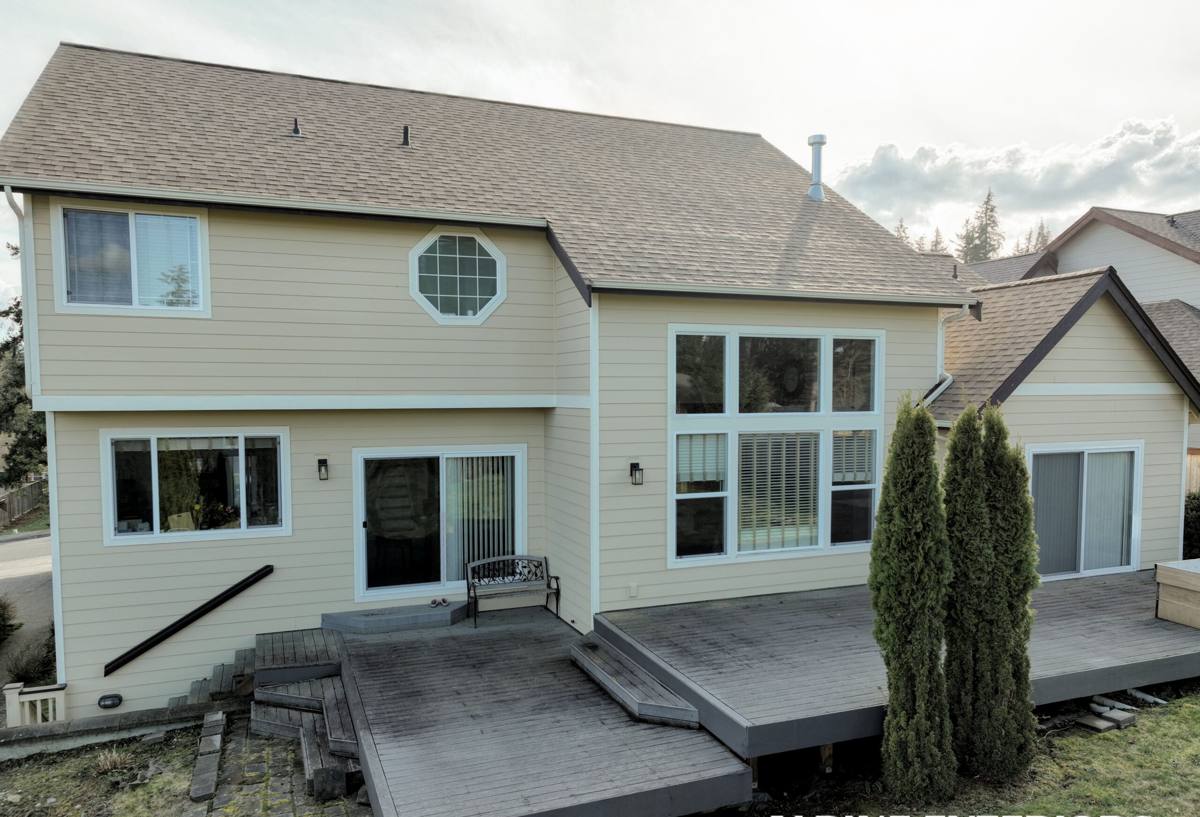
Not every tired deck needs a full replacement. But there's a point where patching boards is just delaying a bigger, more expensive problem — and often masking a structural one.
- Soft, spongy, or spalling spots in the decking, especially near the house or in shaded, moss-prone corners
- Rust streaking or crumbling around fasteners and joist hangers
- Visible gaps, staining, or soft wood at the ledger board where the deck meets the house
- Posts or footings that feel loose, or a deck that has a noticeable bounce or sway
- Persistent moss or black algae growth that keeps coming back no matter how often it's cleaned
- Boards cupping, splitting, or popping fasteners across large sections rather than just a few spots
If you're seeing two or more of these, it's worth having someone look at the framing underneath before you spend more money on surface fixes.
What a Correct Deck Replacement Actually Involves
Framing and Structure First
The decking boards are the part everyone sees, but the framing underneath is what actually determines how long the deck lasts. That means properly sized joists and beams, correct joist spacing for the decking material chosen, and footings that are sound and appropriately sized for the soil conditions on site. We don't build new decking on top of framing we haven't verified is solid.
Ledger Attachment and Flashing
The ledger board — where the deck attaches to the house — is the single most common failure point on decks in wet climates, and it's almost always a flashing problem, not a decking problem. Water that gets behind an improperly flashed ledger doesn't just rot the ledger; it can work its way into the house's rim joist and wall framing. A correct replacement means proper ledger flashing, the right fasteners at the right spacing, and a clean break between the ledger and any siding above it so water sheds away from the house instead of into it.
Fasteners and Hardware
Salt air is hard on standard fasteners. Screws, joist hangers, and structural connectors that aren't rated for coastal or treated-lumber exposure will corrode faster here than in a dry inland climate, and a corroding fastener is a structural liability, not just a cosmetic one. We use fasteners and hardware rated for treated lumber and coastal exposure throughout the structure, not just on the visible decking.
Drainage and Airflow
Moss and rot both need moisture that doesn't leave. Proper board spacing, a slight slope away from the house, and clear airflow underneath the deck all matter more here than they would in a drier region, because the drying window between rain events is shorter for a good chunk of the year.
Choosing a Decking Material for This Climate
There's no single "best" decking material — it depends on your budget, how much upkeep you want to do, and how the deck is used. Here's how the common options actually perform under Oak Harbor's conditions.
| Material | Moisture & Moss Resistance | Maintenance | Typical Lifespan |
|---|---|---|---|
| Pressure-treated wood | Good if sealed regularly; moss and algae will take hold if surfaces aren't cleaned periodically | Needs cleaning and re-sealing every 1-2 years | 10-15 years with upkeep |
| Cedar | Naturally rot-resistant but still needs sealing in a wet climate; grays and can stain if untreated | Annual cleaning, periodic sealing | 15-20 years with upkeep |
| Composite decking | Very good — doesn't absorb water or rot, though surface can still get slick with moss/algae film | Occasional washing; no sealing or staining | 25-30 years, manufacturer-dependent |
| PVC decking | Excellent — fully moisture-resistant, won't rot or support fungal growth in the board itself | Occasional washing | 25-30+ years, manufacturer-dependent |
Composite and PVC decking cost more up front but remove the recurring sealing and staining work that wood demands — which matters more here than in a drier climate, since neglected wood decking degrades faster under this much moisture. Wood is still a legitimate choice for homeowners who want that look and are willing to keep up with maintenance. We'll walk through the honest trade-offs for your specific situation rather than push one option.
Our Deck Replacement Process
1. On-Site Assessment
We start by getting under the existing deck, not just looking at the surface. That means checking the ledger connection, footings, joist condition, and any signs of hidden moisture damage before we scope the job.
2. Full Removal
Old decking, framing, and any compromised ledger flashing come out completely. We don't build new decking over old, questionable framing — that just carries the underlying problem forward under a fresh surface.
3. Rebuild the Structure
New framing, corrected ledger flashing, and coastal-rated hardware go in first, sized and spaced correctly for the decking material you've chosen.
4. Install Decking and Finish Details
Decking, railings, and stairs go in last, with attention to board spacing and drainage so the finished deck actually sheds water the way it's supposed to.
5. Walkthrough
We go over the finished deck with you, including what maintenance (if any) the material you chose will need going forward.
Permits and Code Considerations
Deck replacement — especially when it involves new footings, structural framing, or railing height changes — is typically subject to local building permit and inspection requirements. Requirements vary by jurisdiction and by the scope of work, so this isn't something to guess at. Part of doing this correctly is handling that process rather than leaving it for the homeowner to sort out after the fact.
Why Local Experience on Oak Harbor Jobs Matters
A crew that regularly works Oak Harbor and the surrounding island and coastal communities has already seen how decking, fasteners, and flashing details hold up under this specific combination of salt air, rain, and moss pressure — not a generic climate assumption. That translates into practical decisions on your job: which fastener grade is worth the extra cost, where drainage details matter most, and which material trade-offs are actually worth making versus which ones are just upsells.
It also means fewer surprises around scheduling and access. Coastal and island properties can have site conditions — tighter lots, ferry-dependent material deliveries, seasonal weather windows — that a crew unfamiliar with the area hasn't planned around. Local experience shows up in the small logistics as much as the craftsmanship.
Keeping a New Deck Ahead of Moss and Salt Air
Whatever material you choose, a few habits go a long way in this climate:
- Sweep debris and needles off the deck regularly — trapped organic matter is what feeds moss growth
- Rinse off salt residue after storms if the deck is exposed to direct wind off the water
- Keep gutters and downspouts near the deck clear so runoff isn't dumping directly onto or under it
- Follow the manufacturer's cleaning schedule for composite or PVC decking rather than assuming "low maintenance" means "no maintenance"
- Re-seal wood decking on schedule rather than waiting until it's visibly weathered
A little consistency here is what separates a deck that looks good at year fifteen from one that's back on the replacement list at year eight.
Get a Straight Answer on Your Deck
If your deck is showing soft spots, rust, persistent moss, or just isn't holding up the way it should, we're glad to take a look and give you an honest read on whether it needs repair or full replacement. There's no pressure and no obligation — just a straightforward assessment from a crew that knows what this climate does to a deck. Use the form below to request a free estimate.