 Anacortes
 Exterior Contracting for Bow, Washington
Bow sits along Samish Bay in Skagit County, a stretch of coastline and farmland between Anacortes and Bellingham where water, wind, and tree cover shape everything about how a house ages. It's a quieter part of our service area than downtown Anacortes, with a mix of older farmhouses, waterfront homes, and newer construction spread across acreage rather than tight lots. That setting is beautiful, and it's also demanding on exterior materials in ways that a lot of siding, roofing, and trim simply isn't built to handle over the long term.
We work on siding, roofing, windows, and decks throughout the Anacortes and Skagit County area, and Bow is part of our regular route. That matters more than it sounds like it should — a crew that drives out to Bow once a year for an emergency call sees the area differently than one that's out there regularly and knows what tends to fail first on a Samish Bay-facing wall versus a shaded, tree-covered lot set back from the water.
What the Bow Climate Does to a House
Salt Air
Homes closer to Samish Bay are exposed to salt-laden air carried in off the water. Salt accelerates corrosion on fasteners, flashing, and any metal trim, and it degrades paint film and caulk faster than it would inland. Untreated or under-primed wood siding is especially vulnerable — salt air keeps wood surfaces damp longer and speeds up the cycle of swelling, cracking, and paint failure.
Driving Rain
Skagit County gets a lot of rain, and in Bow's open, water-adjacent terrain it often arrives sideways during fall and winter storms. Wind-driven rain doesn't just wet a wall surface — it pushes moisture into seams, laps, and any gap in the water-resistive barrier behind the siding. A siding system's water management (how it sheds rain, how it's flashed at penetrations, how it drains if moisture does get behind it) matters as much as the surface material itself.
Moss and Shade
Much of Bow is wooded or has significant tree cover, and shaded, damp surfaces are where moss and algae take hold fastest. North-facing walls, roof valleys, and anything under a tree canopy stay wet longer after a storm, which extends the growing season for moss well beyond what a more open, sun-exposed property would see. Moss holds moisture against a surface, and on wood-based products that moisture exposure is what eventually leads to rot at seams and butt joints.
How This Plays Out on Different Siding Materials
Not every siding product handles this combination — salt, wind-driven rain, and a long moss season — the same way. This is the core of why we made the material decision we did.
- Wood-based siding (cedar, primed spruce, engineered wood products): Organic wood fiber is a food source for the fungi that cause rot, and repeated wetting from moss and driving rain shortens the interval between repaints and touch-ups.
- Vinyl siding: Doesn't rot, but it's a thin material that can warp, fade, and crack with temperature swings and UV exposure, and it isn't fire-resistant — a consideration some homeowners weigh given the region's wildfire-season air quality concerns in recent years.
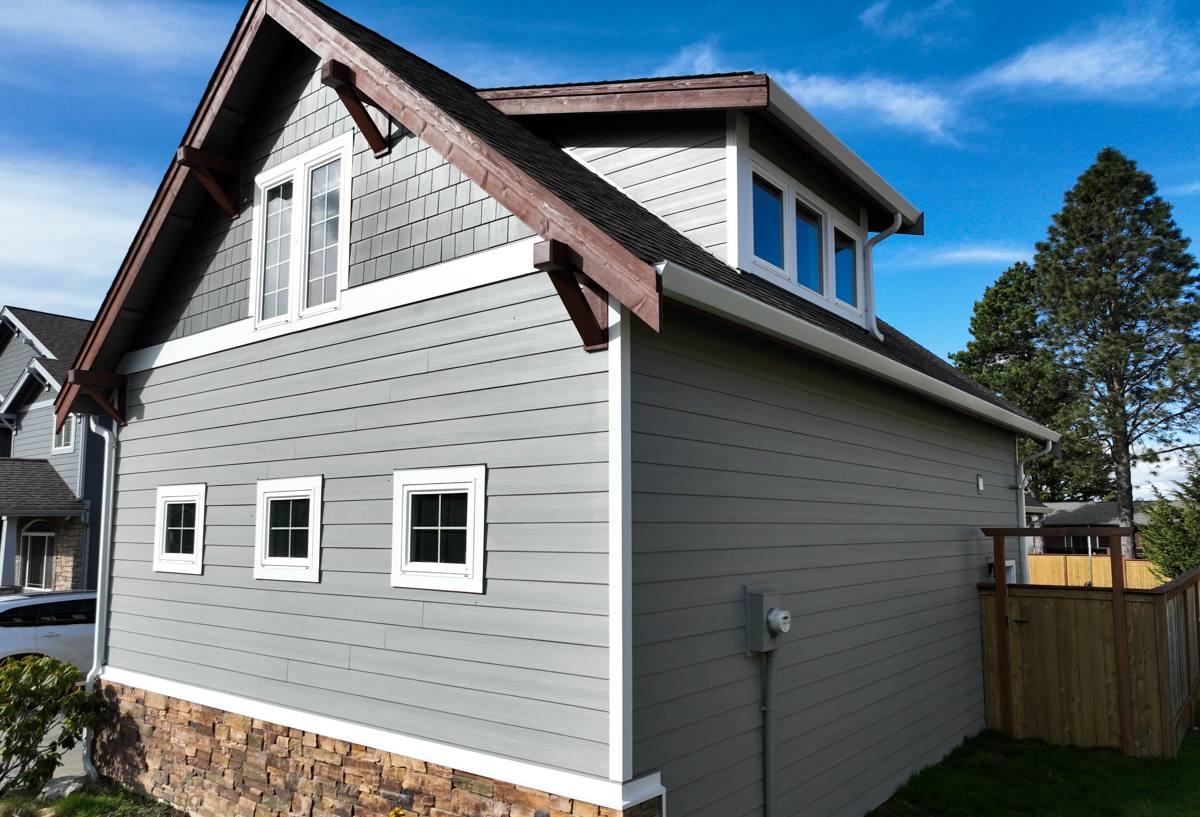
- Fiber cement (what we install): Made primarily from sand, cement, and cellulose fiber — it doesn't feed rot fungi the way wood does, it holds paint and factory finish far longer than wood, and it's non-combustible.
Why We Only Install James Hardie Fiber Cement
We don't install LP SmartSide, vinyl, Cemplank, Allura, primed spruce, or raw cedar siding. That's a deliberate standard, not a supply issue. James Hardie is the fiber cement manufacturer we've settled on for a few specific reasons:
- Non-combustible material — fiber cement doesn't contribute fuel to a fire the way wood-based siding does.
- ColorPlus factory finish — a baked-on finish applied under controlled conditions, which holds color and resists the chalking and peeling that field-applied paint is prone to, especially in a salt-air, high-moisture environment like Bow.
- Climate-engineered HZ product lines — Hardie manufactures HZ5 formulations specifically for the Pacific Northwest's wet, moderate climate, rather than a one-size-fits-all national product.
- A strong, transferable warranty — backed by a manufacturer with decades of fiber cement manufacturing behind it.
- Proven track record when installed to manufacturer spec, which is the other half of the equation — material quality only pays off if the installation respects it.
We're not going to tell you every other product on the market is junk — some of them are reasonable choices for certain budgets and situations. What we will say is that for a coastal, high-moisture, moss-prone area like Bow, we've concluded fiber cement done right is the material that holds up longest with the least maintenance burden on the homeowner, and James Hardie is the fiber cement line we trust enough to put our name behind.
What Correct Installation Looks Like in Bow
Fiber cement siding is only as good as the installation behind it, and in a wind-driven-rain environment the installation details matter more than usual.
- Proper rain-screen or drainage plane behind the siding so any moisture that does get past the surface has somewhere to go.
- Correct flashing at windows, doors, and any wall penetration — the majority of moisture intrusion problems we see trace back to flashing details, not the siding material itself.
- Manufacturer-specified fastening patterns and clearances, including the gap kept between siding and roofing, decks, and grade.
- Factory-mitered or properly caulked joints, since a poorly sealed butt joint is where moss and standing water find their way in first.
- Adequate ventilation behind the cladding on shaded, tree-covered lots where surfaces stay damp longer.
None of this is unique to Hardie products, but it's where we spend our attention — getting a good material installed wrong still fails early.
Beyond Siding: Roofing, Windows, and Decks in Bow
Siding is rarely the only exterior system under stress on a Bow property. We also handle roofing, window replacement, and decks, and on a lot of jobs those systems intersect directly with the siding work:
- Roofing: Roof-to-wall flashing and moss buildup in valleys and on north-facing slopes are common issues on shaded Bow lots — the same moss pressure that affects siding hits the roof first.
- Windows: Window flashing and the seal between the window unit and the siding is one of the most common points of water intrusion we find during siding replacement — it's worth addressing both at once if a window is original and aging.
- Decks: Salt air and driving rain age deck fasteners and railings quickly, and a deck ledger board tied into failing siding is a common source of hidden rot behind an otherwise fine-looking deck.
Handling these as one exterior envelope, rather than four separate contractors working around each other, is usually more efficient and produces fewer gaps where two trades' work meets.
Cost Factors for a Bow Siding Project
Every property is different, and we'll give you a firm number after walking the site — but these are the main variables that move a project's cost up or down:
| Factor | Why It Matters |
|---|---|
| Home size and wall complexity | More corners, gables, and dormers mean more cutting, flashing, and labor time. |
| Existing siding removal | Tear-off of old wood or other siding, plus any sheathing repair found underneath, adds time before new siding goes up. |
| Hidden moisture or rot damage | Common on shaded, moss-affected walls — repair scope isn't fully known until old siding comes off. |
| Hardie product line and profile | Lap siding, panel siding, and shingle-style products carry different material and labor costs. |
| Trim and accessory work | Fascia, soffit, and window trim replacement alongside siding affects total scope. |
| Site access | Rural and wooded Bow lots can mean longer material staging or scaffolding needs than a standard in-town lot. |
Choosing a Contractor for a Bow Property
A few things worth checking before hiring anyone for exterior work out here:
- Do they carry current Washington contractor licensing and adequate insurance?
- Do they have specific experience with fiber cement installation, not just general siding work?
- Will they walk you through their flashing and moisture-management approach, not just the finished appearance?
- Are they familiar with Skagit County permitting requirements for exterior work?
- Do they regularly work in rural, coastal, or tree-covered properties, or mostly tighter in-town lots?
- Will they put the manufacturer warranty terms in writing, and explain what voids it?
A crew that's only ever installed siding on sunny, open, in-town lots may not think about drainage planes and moss-prone shaded walls the same way a crew that regularly works Bow and the surrounding waterfront does.
Get a Free Estimate
If you're planning siding, roofing, window, or deck work on a Bow property, we're happy to come take a look, walk the site with you, and put together a straightforward, no-pressure estimate. Use the form below to get started.