 Anacortes
 Why Color Choice Is a Bigger Decision With Fiber Cement
Picking a siding color used to mean flipping through paint chips and hoping for the best. With James Hardie fiber cement, the decision runs deeper, because the color isn't something you add later — for most homeowners, it's baked into the product before it ever reaches Anacortes. That changes how you should think about it. You're not just choosing a shade that looks good against your roofline; you're choosing a finish system that has to survive salt-laden marine air off Fidalgo Bay, months of driving rain, and the kind of persistent shade and moisture that lets moss get a foothold on north-facing walls. A color that photographs well in a showroom isn't automatically a color that photographs well in Skagit County ten years from now.
This page walks through how James Hardie's factory-applied color system actually works, what the real color and finish options are, and what's worth thinking through before you commit — whether you're re-siding a whole house or just picking accent trim.
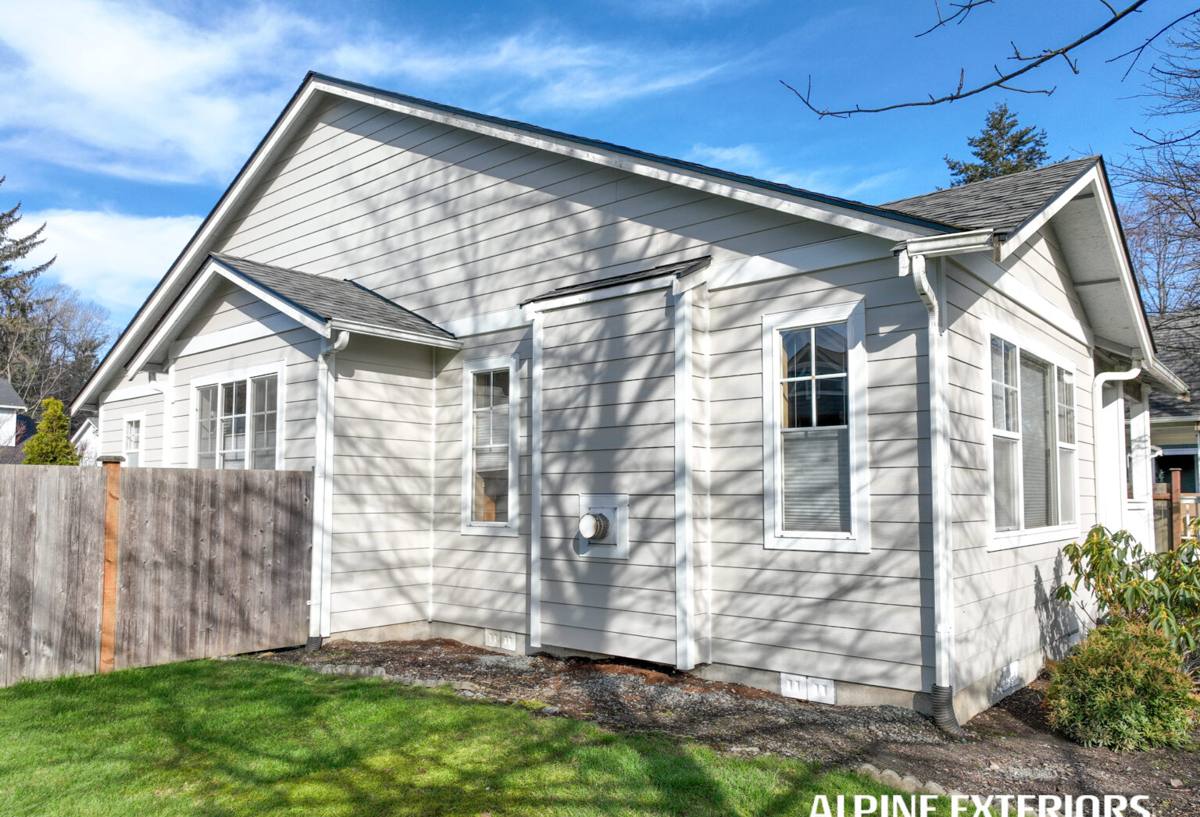
ColorPlus Technology: What Makes It Different From Paint
James Hardie's ColorPlus finish is not a coat of paint applied at a lumberyard or job site. It's a multi-coat, baked-on finish applied to the fiber cement in a controlled factory environment, then cured before the boards ever ship. The process is closer to how automotive or appliance finishes are applied than to how a house typically gets painted. That matters for a few concrete reasons:
- The finish bonds to the substrate more uniformly than a field-applied coat, because it's cured under controlled heat and conditions rather than whatever the weather happens to be doing on installation day.
- Color consistency from board to board is tighter — no batch-to-batch drift the way you sometimes get when a painter mixes and re-mixes a five-gallon bucket over multiple days.
- It carries its own dedicated finish warranty, separate from the substrate warranty, which is not something a field-painted product offers.
Homeowners who go this route also skip the first repaint cycle that primed siding requires almost immediately — primed Hardie boards are meant to be field-painted after installation, not left as-is. ColorPlus boards arrive ready to install with the finish already done.
Primed vs. ColorPlus: The Practical Trade-offs
James Hardie sells both primed fiber cement (meant for field painting in a color of your choice) and ColorPlus pre-finished boards. Both are legitimate options, but they solve different problems and come with different long-term maintenance pictures. Here's how they actually compare for a coastal Skagit County home:
| Factor | Primed (Field-Painted) | ColorPlus (Factory Finish) |
|---|---|---|
| Color flexibility | Any color you can have mixed | Fixed palette, but a wide one |
| Finish consistency | Depends on painter and weather conditions during application | Applied and cured in a controlled factory setting |
| First repaint needed | Immediately after install | Not for many years, if ever, under normal conditions |
| Touch-up matching | Easy — same paint, same batch | Requires ColorPlus-matched touch-up product |
| Warranty coverage | Substrate only; finish is on you and your painter | Substrate plus separate finish warranty |
| Upfront cost | Lower material cost, added labor/paint cost | Higher material cost, no immediate paint labor |
For most homeowners in this area, the ColorPlus route ends up being the more practical long-term choice, simply because it removes the first big maintenance expense from the equation and gives you a finish that was engineered to handle UV and moisture cycling from day one — relevant in a climate that swings between long gray wet stretches and intense summer sun reflecting off the water.
The Color Palette: What's Actually Available
James Hardie organizes its ColorPlus colors into curated collections rather than an open-ended custom-mix system. That's a deliberate trade-off — you give up unlimited choice in exchange for colors that have been tested together as coordinated palettes, so siding, trim, and accent colors are designed to work as a system rather than three separate guesses.
Statement Collection
This is the larger, standard palette — a range of neutrals, warm woodsy tones, and a handful of deeper colors, generally available across most Hardie board profiles (lap siding, panel, shingle-style, and trim).
Dream Collection
A smaller set of premium, more saturated or distinctive colors, often used as a statement color on a portion of the home — an accent gable, a door surround, or a full-color choice for homeowners who want something bolder than the standard range.
Trim and Accent Coordination
Hardie Trim boards come in matching or complementary ColorPlus finishes, which is what lets you do the classic two- or three-tone look — body color, trim color, and sometimes a shutter or door accent — without guessing at paint-store color matching years apart.
The exact palette available changes over time as Hardie updates its offerings, so the practical move is to look at current physical color samples rather than working purely off online swatches, since screens shift color temperature more than most people expect.
What Actually Holds Up in Anacortes Conditions
Color performance isn't just about fade resistance — it's about how a color interacts with this specific climate. A few things worth weighing before you settle on a shade:
Salt air and marine exposure
Homes closer to the water deal with airborne salt that can accelerate wear on any exterior finish over time. ColorPlus's factory-cured finish holds up better here than a field-applied coat, but rinsing salt spray off siding periodically — especially on water-facing elevations — is still worth doing regardless of which color you pick.
Moss and shaded north walls
Anacortes' long wet season and tree cover mean north- and shade-facing walls are prone to moss and algae growth, same as a roof. Darker colors can make moss and grime more visually forgiving on a sunny wall, but on a shaded wall, darker colors also tend to hold moisture-related discoloration longer and show green streaking more, not less. Lighter, more neutral tones on heavily shaded elevations are often the more practical choice, not just an aesthetic one.
Heat and UV on south and west exposures
Very dark colors absorb more heat, which is a factor Hardie's HZ10 climate-engineered products are designed to handle, but it's still worth knowing that darker siding on a south- or west-facing wall will run warmer and may show more visible fading over decades than a mid-tone or light color in the same spot.
Matching Color to Local Architecture
Anacortes and the broader Skagit County area have a real mix of housing stock — craftsman bungalows, Pacific Northwest modern builds, waterfront homes, and standard suburban construction. A few practical patterns tend to work well locally:
- Muted, natural tones (soft grays, greens, warm taupes) tend to read as "belongs here" against evergreen backdrops and overcast skies, rather than looking washed out the way very bright or saturated colors sometimes do under gray light.
- Craftsman and cottage-style homes generally look right with a body color plus a contrasting trim, rather than a single flat color across the whole exterior.
- Waterfront and view-lot homes often benefit from slightly lighter body colors that don't disappear into fog or gray-sky conditions, with a darker trim or accent for definition.
- Whatever direction you lean, pulling a large physical sample and viewing it on the actual house, in actual Anacortes daylight, at different times of day, beats any online rendering.
The ColorPlus Warranty, in Plain Terms
James Hardie's ColorPlus finish carries its own warranty coverage against fading, chipping, cracking, and peeling of the factory finish, layered on top of the separate substrate warranty covering the fiber cement itself. That two-part structure — one warranty for the board, one for the finish — is part of why ColorPlus tends to hold long-term value better than a product where a single paint job is expected to perform for decades with no dedicated backing. As with any manufacturer warranty, it's transferable in most cases if you sell the home, which is a detail worth mentioning to a buyer's inspector or agent down the road. The specifics of coverage terms should always be confirmed against current Hardie documentation rather than assumed, since warranty language is updated periodically.
Practical Checklist Before You Choose
- Pull physical ColorPlus samples, not just digital swatches — view them outdoors, in daylight, against your actual roof and trim.
- Check the sample against both a sunny-side wall and a shaded wall of your house before deciding.
- Decide on body, trim, and accent colors together as a coordinated set, not one at a time.
- Ask about touch-up product availability and how ColorPlus touch-up paint is matched if a board ever gets damaged.
- If considering primed boards for a fully custom color, factor in the first-repaint cost and timeline, not just the material savings.
- Think about maintenance access — darker colors on hard-to-reach upper stories mean more effort if rinsing or inspection is ever needed.
Why We Only Install James Hardie
Color is only part of the reason we standardized on James Hardie, but it's a meaningful one. A factory-cured finish with its own warranty is a fundamentally different proposition than a field-painted product where long-term color performance depends heavily on paint quality, weather during application, and how well the crew prepped the surface. Combined with Hardie's non-combustible fiber cement construction and climate-engineered HZ product lines, it's a system we can install to spec and stand behind — which matters more here than most places, given how hard Skagit County's combination of salt air, sustained moisture, and moss pressure is on exterior materials.
If you're weighing colors, comparing primed versus ColorPlus, or just want to see physical samples against your own house, we're happy to walk through it with you. Reach out for a free, no-pressure estimate — there's no obligation, and it's the easiest way to see how a color actually looks in Anacortes light before you commit to it.