 Anacortes
 Why Moisture, Not Age, Is What Actually Ruins Siding
Most homeowners assume siding fails because it gets old. In reality, siding rarely wears out from age alone — it fails because water gets behind it and stays there. Once moisture is trapped against your home's sheathing and framing, the clock starts on a much bigger problem than a cosmetic one. By the time paint is peeling or boards are visibly warped, the damage underneath has often been building for years.
This matters more here than in a lot of places. Anacortes sits right on the water, and Skagit County's marine climate means your siding is doing constant, low-grade battle with salt-laden air, wind-driven rain that comes in sideways off Fidalgo Bay and Rosario Strait, and a long, damp moss season that keeps north-facing walls wet for weeks at a stretch. Siding that would hold up fine in a dry inland climate can fail here in a fraction of the time if it isn't installed and maintained with that reality in mind.
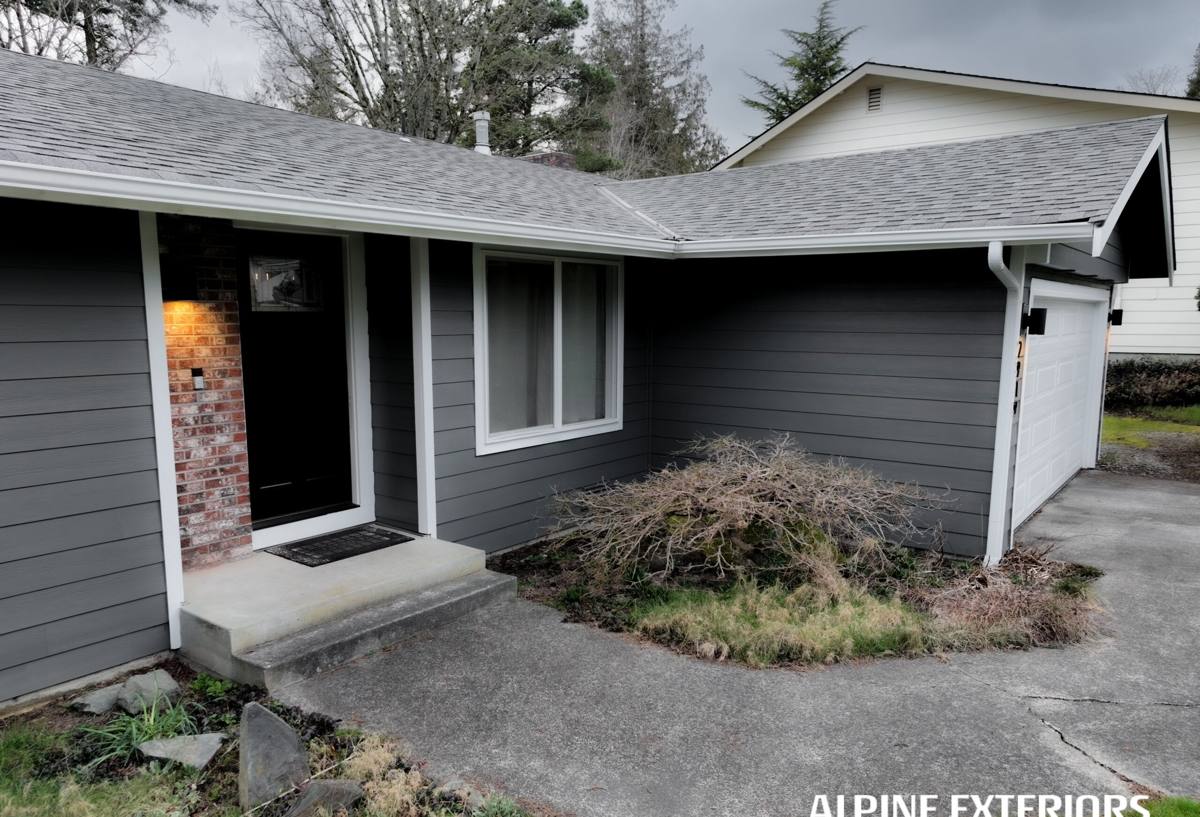
How Water Actually Gets Behind Siding
Siding is not meant to be a perfect waterproof shell — no exterior cladding is. It's meant to shed the vast majority of water while a secondary system (the weather-resistive barrier, flashing, and building paper underneath) manages what gets through. Problems start when that secondary system is missing, damaged, or was never installed correctly in the first place. Common entry points include:
- Butt joints and seams where boards meet, especially if they weren't back-primed or properly caulked
- Missing or poorly lapped flashing above windows, doors, and any horizontal trim
- Nail holes that were overdriven, splitting the material or breaking the factory seal
- Siding installed too close to grade, decks, or roof lines, where it wicks up moisture directly
- Gaps where siding meets corner boards, fascia, or roof-to-wall transitions
- Caulk joints that have cracked, shrunk, or separated with age
Any one of these can be a minor issue for a season. Left unaddressed through a Skagit County winter, they become a chronic leak path — and chronic is the operative word. It's not the occasional heavy rain that does the damage, it's the repeated cycle of wetting and drying, month after month, that eventually overwhelms the wall assembly.
Why the Anacortes Climate Makes This Worse
Three regional factors compound the moisture problem here specifically:
- Salt air: Coastal salt exposure accelerates corrosion of fasteners and metal flashing, and it degrades certain paints and finishes faster than they'd wear inland.
- Driving rain: Storms off the Strait often push rain horizontally into walls rather than straight down, which stresses seams, laps, and flashing details that would barely get tested in calmer weather.
- Moss season: Shaded, north- and west-facing walls stay damp long after a storm passes. Moss and algae hold moisture directly against the siding surface for extended periods, which is especially hard on wood-based products.
What Moisture Does Once It's Behind the Wall
This is the part most homeowners never see until it's a major repair. Once water gets past the siding and into the wall cavity, it can affect several layers at once:
- Sheathing: Plywood or OSB sheathing absorbs moisture and begins to delaminate, soften, or rot, which weakens the structural skin of the house.
- Framing: Wood studs and headers exposed to sustained moisture are vulnerable to rot and, in the Pacific Northwest, carpenter ant activity that's drawn to softened wood.
- Insulation: Wet insulation loses much of its R-value and can stay saturated long after the source leak is fixed, undermining energy efficiency.
- Interior finishes: In advanced cases, moisture works its way through to interior drywall, causing staining, bubbling paint, or musty odors — usually a sign the problem has been present for a long time.
None of this is visible from the driveway. That's what makes hidden moisture damage different from a simple cosmetic issue — by the time it shows up on the surface, the underlying repair scope is often much larger than the siding itself.
Warning Signs Worth Taking Seriously
You don't need to open up a wall to get useful information. These signs, especially in combination, are worth a closer look:
- Siding that feels soft, spongy, or crumbles slightly when pressed near the bottom edge
- Visible warping, bowing, or boards pulling away from the wall
- Persistent dark streaking, staining, or moss growth concentrated in one area
- Peeling or bubbling paint, particularly on wood-based siding
- A musty smell near an exterior wall on the inside of the house
- Interior drywall staining, especially below windows or near rooflines
- Visible daylight or gaps at trim, corners, or window flashing
A single early sign — a little discoloration, one soft spot — usually means a manageable repair. Multiple signs in the same area, especially paired with interior symptoms, usually mean the damage has already spread past the siding itself.
How Different Siding Materials Handle Moisture
Not all siding responds to sustained moisture exposure the same way. This is a big part of why we made the call to install only James Hardie fiber cement and stopped installing several other common products.
| Material | How It Handles Sustained Moisture | Longer-Term Risk in This Climate |
|---|---|---|
| Vinyl siding | Sheds surface water well but doesn't stop moisture that gets behind it through gaps or poor installation; traps water against sheathing | Hidden rot can progress unnoticed for years since the vinyl surface itself shows little change |
| Engineered wood (e.g., LP SmartSide) | Treated to resist moisture, but any breach in the factory coating or cut edge exposes wood fiber directly to water | Edge and seam failures can lead to swelling and deterioration if caulking and paint maintenance lapse |
| Primed spruce or cedar | Natural wood that absorbs and releases moisture constantly; performance depends heavily on paint maintenance | Requires the most frequent repainting and caulk upkeep of any option; high maintenance burden in a wet marine climate |
| James Hardie fiber cement | Cement-based composition doesn't swell, rot, or support fungal growth the way wood-based products can | Still requires correct flashing and installation, but the material itself isn't the weak point |
The point here isn't that the other products are junk — vinyl, engineered wood, and cedar all have legitimate uses and plenty of homes wear them well when properly maintained. The trade-off is that each of them puts more of the long-term moisture performance on the installation quality and the homeowner's maintenance schedule. In a climate with this much sustained moisture exposure, we decided the margin for error was too thin, and standardized on a product where the material itself isn't the vulnerability.
What Correct Installation Actually Involves
Material choice only solves part of the problem — most moisture failures we see trace back to installation details, not the siding itself. A properly installed system includes:
- A continuous weather-resistive barrier behind the siding, lapped correctly from bottom to top
- Step and head flashing at every window, door, and roof-to-wall intersection
- Proper clearance between siding and grade, decks, patios, and roof lines
- Correct nailing patterns and fastener depth to avoid splitting or breaking the seal
- Quality caulking at seams and penetrations, applied to manufacturer spec
- A drainage plane (often a rainscreen gap) that lets any incidental moisture drain and dry rather than sit against the sheathing
These details matter with any siding material, but they matter more here because of how much moisture the walls are exposed to over a typical Skagit County winter. A well-installed lower-tier product will consistently outperform a poorly installed premium one.
Repair, or Time to Replace?
Not every moisture issue means a full re-side. The right call depends on how far the damage has spread.
| Situation | Typical Approach |
|---|---|
| Isolated soft spot or staining, sheathing still solid | Localized repair — replace affected boards, correct the flashing or caulking that caused it |
| Moisture damage at multiple points on the same wall | Section replacement, including inspection of sheathing behind the affected area |
| Widespread soft siding, interior staining, or musty odor | Full assessment of sheathing and framing before any new siding goes on — patching over hidden rot only hides the problem |
| Siding is original and near or past its expected service life | Full replacement is usually the more cost-effective long-term choice over repeated repairs |
The general rule: the earlier a moisture issue is caught, the smaller and less expensive the fix. Deferred maintenance is what turns a caulk repair into a sheathing replacement.
A Simple Moisture Inspection Checklist
Twice a year — once after the wet winter season and once before it — walk your home's exterior and check for the following:
- Press gently on siding near the bottom of walls and around windows, feeling for soft or spongy spots
- Look for staining, streaking, or moss concentrated in one spot rather than spread evenly
- Check caulk joints at corners, trim, and window frames for cracking or gaps
- Inspect flashing above windows and doors for rust, gaps, or improper lapping
- Confirm siding isn't in direct contact with soil, mulch beds, decks, or roofing
- Note any interior staining, bubbling paint, or musty smells on exterior-facing walls
- Clear gutters and downspouts so water isn't overflowing directly onto siding below
Why We Only Install James Hardie
We used to install a wider range of siding products. After years of doing repairs and tear-offs on homes throughout Anacortes and the rest of Skagit County, the pattern was consistent: the moisture failures we were called out for were almost always tied to wood-based or moisture-sensitive materials that had been under-maintained, poorly flashed, or simply asked to perform in a climate tougher than they were built for.
James Hardie's fiber cement lines are engineered specifically for climate conditions like ours, with a factory-applied ColorPlus finish that doesn't rely on the homeowner keeping up a repainting schedule to stay protected. The material doesn't swell or rot the way wood-based siding can, it's non-combustible, and it carries a strong transferable warranty. It isn't a magic fix for bad installation — flashing and drainage details still have to be done right — but it removes the material itself as the weak link in a climate that gives siding no easy days.
If you're noticing early warning signs on your own home, or you'd just like a professional set of eyes on how your siding is holding up against Anacortes weather, we're happy to take a look. Reach out for a free, no-pressure estimate using the form below.