 Anacortes
 Exterior Work Built for Flounder Bay's Marine Environment
Flounder Bay sits close enough to the water that homes here live with conditions most inland Skagit County neighborhoods never deal with: near-constant marine air, salt-laden wind off Rosario Strait and the surrounding waterways, and long stretches of gray, damp weather that keep exterior surfaces wet for days at a time. If you own a home in this part of Anacortes, you already know your siding, roof, windows, and deck take more of a beating than a house twenty miles inland. That's the entire reason we approach exterior work here differently than a general contractor might.
We're a local Anacortes crew, and we work this part of Fidalgo Island regularly. That matters more than it sounds like it should. A contractor who only shows up in Skagit County once or twice a year doesn't have a feel for how fast moss colonizes a north-facing roof slope near the water, or how quickly cheap trim starts to show soft spots when it's marinating in salt spray six months out of the year. We do.
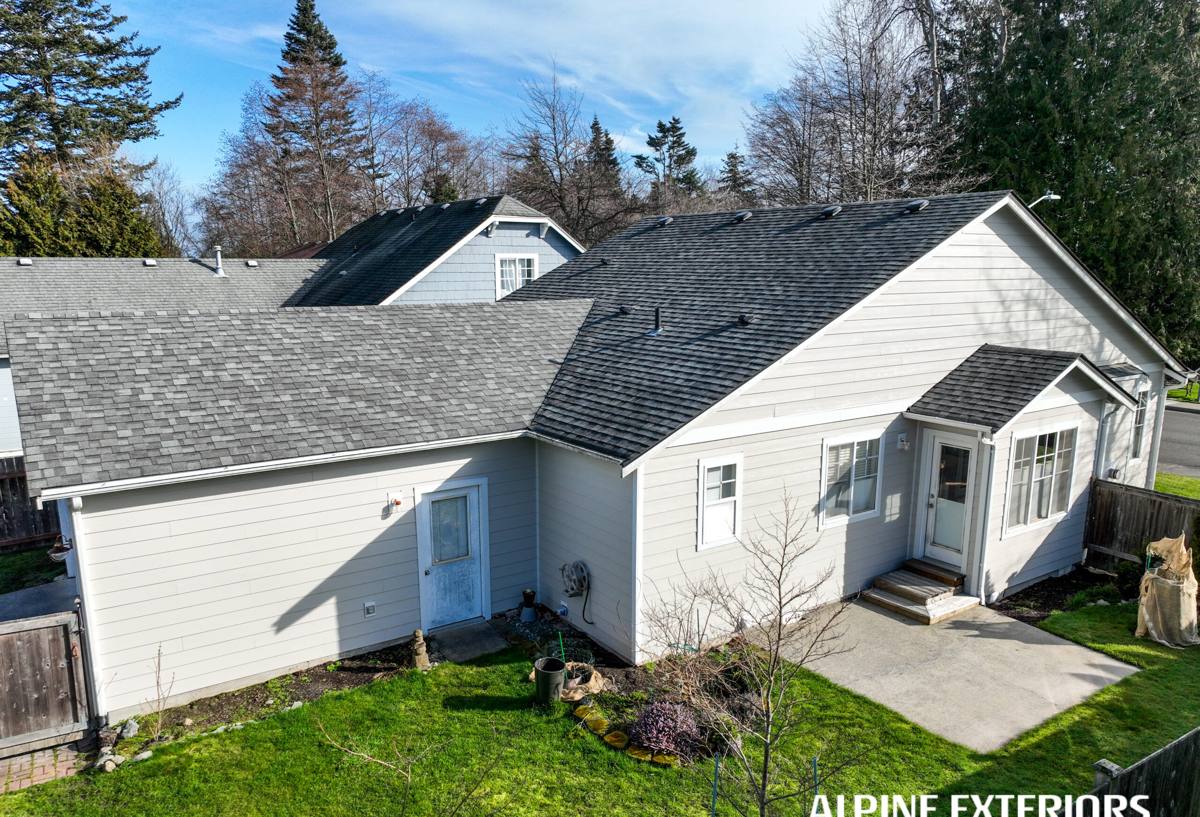
What Salt Air and Driving Rain Actually Do to a House
It's worth being specific about the mechanisms, because "coastal weather is tough on homes" is true but vague. Here's what's actually happening on a Flounder Bay exterior over time:
Salt Air
Airborne salt is corrosive to exposed metal — fasteners, flashing, gutter hardware, hinges, and light fixtures all degrade faster near the water than they do inland. It also accelerates the breakdown of lower-quality paints and coatings, which is one of the reasons a factory-applied, baked-on finish holds up so much better than field-applied paint in a marine setting.
Driving Rain
Wind-driven rain off the water doesn't just fall straight down — it gets pushed sideways into siding seams, window flashing, and anywhere two building materials meet. That means the quality of the installation (how laps, seams, and flashing details are handled) matters as much as the material itself. Water finds the weak point, and on an exposed lot near Flounder Bay, it's actively looking for one most of the year.
Moss and Persistent Moisture
Anacortes gets a long moss season, and shaded, water-adjacent lots often get more of it than homes further inland. Moss holds moisture against roofing and siding surfaces, which is bad news for any material that isn't dimensionally stable or resistant to moisture-driven swelling and rot.
Why We Install Only James Hardie Fiber Cement Siding
We don't install vinyl, LP SmartSide, primed spruce, cedar, or other fiber cement brands like Cemplank or Allura. That's a deliberate standard, not a lack of options, and it matters even more in a location like Flounder Bay than it does elsewhere in Anacortes.
- Non-combustible: Fiber cement doesn't feed a fire the way wood-based products can — a meaningful consideration for insurance and long-term peace of mind.
- Dimensionally stable in wet climates: Hardie's cement-based composition doesn't swell, warp, or delaminate the way engineered wood or untreated wood products can when they stay damp for extended periods — which is the norm here, not the exception.
- ColorPlus factory finish: Rather than relying on field-applied paint to hold up against salt air, Hardie's ColorPlus finish is baked on at the factory and backed by its own finish warranty, which holds up better against fading and wear in marine exposure.
- Climate-engineered HZ product lines: Hardie manufactures region-specific formulations for climates like ours, engineered around moisture exposure rather than a one-size-fits-all approach.
- Strong, transferable warranty: A meaningful warranty on the product itself, on top of our own installation workmanship warranty.
We're not saying every other product is worthless — vinyl and engineered wood have their place, and plenty of homes around the country are sided in them without issue. But once you factor in what a Flounder Bay exterior is exposed to year-round, we've made the call that Hardie is the product we're willing to put our name behind here. That's a professional standard we hold across every job, not a marketing line.
Siding Installation: What Correct Work Looks Like Near the Water
The material is only half the equation. A Hardie installation that's cutting corners on flashing, fastening, and clearances will still fail prematurely in a marine environment, no matter how good the siding itself is. On every Flounder Bay job we pay close attention to:
- Proper water-resistive barrier and flashing integration at every window, door, and penetration
- Correct fastener type and spacing to resist wind-driven rain and salt-air corrosion
- Manufacturer-specified clearances from grade, roofing, and decks so moisture doesn't wick into the bottom edge of the siding
- Proper caulking and sealant at joints, sized and placed according to Hardie's installation specs, not just "good enough"
- Ventilation behind the siding where the assembly calls for it, so trapped moisture has somewhere to go
This is the kind of detail work that separates a siding job that looks good on install day from one that still looks good in year fifteen.
Roofing, Windows, and Decks: The Rest of the Envelope
Siding doesn't work in isolation — it's one piece of a building envelope that has to work together to keep water out. We handle all four major exterior systems, which means we're looking at your home as a whole rather than patching one component and leaving the rest exposed.
Roofing
A roof under constant moss pressure and salt exposure needs attention to ventilation, underlayment, and flashing details at valleys and penetrations — the places most reroofs fail first.
Windows
Window flashing integration is one of the most common failure points on coastal homes. Poorly flashed windows let wind-driven rain behind the siding, where it can sit and do damage long before anyone notices a problem from inside.
Decks
Decks near the water face the same salt and moisture exposure as siding, with the added stress of foot traffic and standing water. Fastener choice and proper drainage matter just as much here as they do on the wall assembly above.
Comparing Siding Options in a Marine Climate
| Factor | James Hardie Fiber Cement | Vinyl | Engineered Wood (LP SmartSide) | Cedar / Primed Spruce |
|---|---|---|---|---|
| Moisture stability | Excellent — cement-based, doesn't swell or rot | Good, but seams can trap moisture | Moderate — vulnerable at cut edges and seams | Requires diligent maintenance to resist rot |
| Salt air resistance | Strong; factory finish resists fading and wear | Can chalk and become brittle over time | Coating wears; edges are the weak point | Needs frequent recoating near the water |
| Fire resistance | Non-combustible | Melts/deforms under heat | Combustible (wood-based) | Combustible |
| Finish durability | Factory-baked ColorPlus, own warranty | Color molded in, but can fade/chalk | Field or factory paint, needs upkeep | Paint/stain needs regular reapplication |
| Typical maintenance | Low — occasional wash, recaulk over time | Low, but cracks/warps aren't repairable | Moderate — watch for swelling, edge wear | High — recoat every few years |
What a Typical Project Involves
Every home in Flounder Bay is a little different — some are more exposed to direct wind off the water, others are more sheltered by trees or terrain — so we start with an on-site look before talking specifics. In general, a siding project moves through:
- On-site evaluation of existing siding, trim, flashing, and any moisture damage
- Product and color selection from Hardie's available lines and ColorPlus palette
- Removal of old siding and inspection of the sheathing and water-resistive barrier underneath
- Repair of any damaged sheathing or framing found once the old material is off
- Installation to manufacturer specification, including flashing, fastening, and clearances
- Final trim, caulking, and cleanup
A Local Crew Is Worth More Than It Sounds
Anacortes and the rest of Skagit County have their own permitting requirements, their own weather patterns, and their own quirks depending on how close a lot sits to the water. A crew based here understands those details without having to relearn them on your dime. We're also around after the job is done — for warranty questions, for a caulking touch-up down the road, or for the next exterior project when it's time. That kind of continuity matters more on a coastal property than it does almost anywhere else, because coastal exteriors need to be checked on, not just installed and forgotten.
Questions to Ask Before Hiring an Exterior Contractor Here
- Do you install fiber cement to manufacturer flashing and fastening specifications, or a generic standard?
- What's your experience with homes directly exposed to marine air and wind-driven rain?
- Is your warranty on workmanship separate from the manufacturer's product warranty, and what does each actually cover?
- Will you inspect the sheathing and water barrier once old siding is removed, not just install over what's there?
- Are you licensed and insured to work in Washington, and can you provide proof?
If you're weighing a siding, roofing, window, or deck project on a Flounder Bay home, we're happy to take a look and walk you through what we're seeing and what it would take to address it. There's no pressure and no cost to get an honest assessment — just fill out the form below to get started.