 Anacortes
 Storm Damage Roofs Look Different in Old Town Anacortes
Old Town Anacortes sits close to the water, on a peninsula that catches wind and weather from several directions at once. When a storm rolls through Skagit County, the roofs in this older part of town take a specific kind of beating: gusts that lift shingles at the edges, driving rain that finds its way under flashing that's been baking and freezing for decades, and salt-laden air that quietly corrodes fasteners and metal long before anyone notices a leak. If you own a home in this neighborhood, storm damage repair isn't a generic job — it's a job that has to account for an older roof system, a coastal microclimate, and often a house that wasn't built with today's wind-rated materials in mind.
We work on roofs throughout Anacortes and the surrounding area, but Old Town's mix of older homes and exposure to weather off the water means we see the same failure patterns again and again. Knowing those patterns is what separates a repair that actually holds from one that just patches the visible problem and lets the real damage keep spreading underneath.
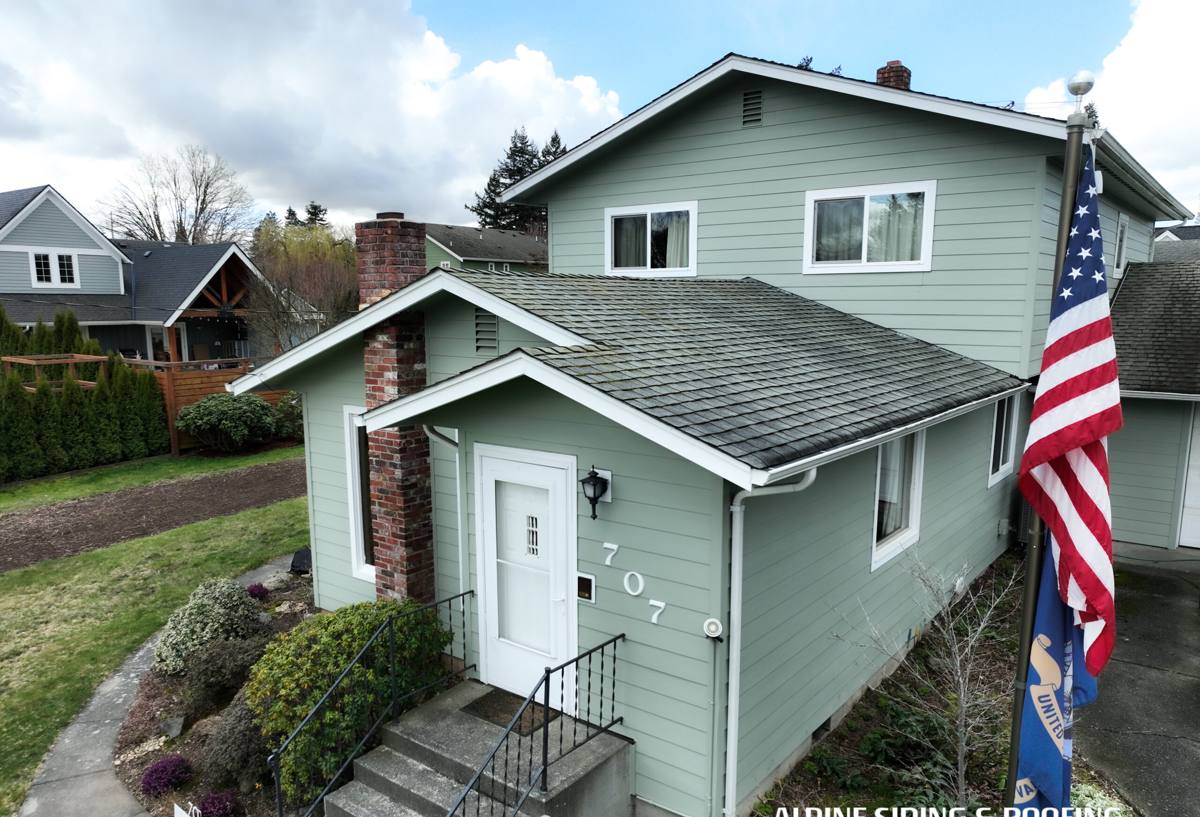
What Salt Air, Rain, and Moss Do to an Older Roof
Salt Air and Metal Fatigue
Homes near Puget Sound get a steady dose of salt-laden air, and that air is hard on anything metal on your roof — flashing, fasteners, vent boots, gutter hangers. Corrosion doesn't announce itself. It works slowly, weakening metal edges and fastener heads until a storm's wind load is the thing that finally breaks them loose. On an older Old Town home, this is often the actual root cause behind a "sudden" storm leak — the storm didn't create the weakness, it just found it.
Driving Rain and Wind-Driven Water
Anacortes storms rarely come straight down. Wind off the water pushes rain sideways and up under roof edges, at valleys, and around any penetration — chimneys, vents, skylights. A roof that sheds water fine in a light rain can still leak badly in a wind-driven storm because the water is being forced uphill or sideways into gaps that were never a problem before. This is why storm damage repair has to look past the obvious torn or missing shingle and check every edge, valley, and penetration nearby.
Moss and the Long Wet Season
Skagit County's long moss season is hard on any roof, but it compounds storm damage specifically. Moss holds moisture against the roofing material year-round, which softens shingles and slowly lifts their edges. A roof with established moss growth is already weaker at the exact points — edges, laps, exposed nail heads — that storm wind and rain attack. After a storm, a moss-covered section of roof is far more likely to have hidden damage than a clean one, even if it looks the same from the ground.
Common Storm Damage We Find in This Neighborhood
- Shingles lifted or torn loose at eaves, ridges, and rakes where wind uplift is strongest
- Flashing pulled away or corroded at chimneys, sidewalls, and roof-to-wall transitions
- Granule loss and cracking on older asphalt shingles that were already brittle from age and sun
- Soft, saturated decking under moss patches, discovered only once the covering is pulled back
- Gutter and downspout damage that lets water dump against the fascia and soffit instead of away from the house
- Vent boots and pipe collars cracked from age and UV exposure, now leaking after wind-driven rain
What a Correct Storm Damage Repair Actually Involves
A quick patch on the visible damage is tempting, especially when a homeowner just wants the leak stopped. But a repair that doesn't account for what's underneath and around the damaged area tends to fail again in the next storm. Here's what we consider a complete job:
1. Full-Roof Assessment, Not Just the Damaged Spot
We look at the entire roof, not only the section that's obviously damaged. Storm-driven rain and wind often cause secondary damage — a loosened ridge cap here, a lifted flashing edge there — that isn't leaking yet but will be after the next system moves through.
2. Deck Inspection Where Water Got In
Any spot with an active or recent leak gets the covering pulled back far enough to check the decking underneath. Soft or delaminated decking has to be cut out and replaced — shingling over compromised decking just hides the problem until it reappears, usually worse.
3. Matching Materials and Fastening for Wind Exposure
Where we're replacing shingles or flashing, we use fastening patterns and materials suited to a wind-exposed, salt-air location — not just whatever's fastest. That includes corrosion-resistant fasteners and proper nailing patterns at edges and high-wind zones, which is often where the original roof was under-built for this specific location.
4. Flashing and Sealant Details Done Right
Most leaks trace back to flashing, not the field of the roof. Flashing has to be properly lapped and integrated with the roofing material, not just caulked over. Sealant is a backup, not the primary defense — we treat it that way.
Repair vs. Replacement: How We Help You Decide
Storm damage doesn't automatically mean a full roof replacement, but it's a natural point to take stock of the roof's overall condition. Here's how we think through it with homeowners:
| Factor | Leans Toward Repair | Leans Toward Replacement |
|---|---|---|
| Roof age | Under 12-15 years, otherwise sound | Nearing or past expected service life |
| Extent of damage | Isolated to one section or slope | Widespread across multiple slopes |
| Decking condition | Solid, dry decking found on inspection | Soft or rotted decking in multiple areas |
| Moss/granule condition elsewhere | Minimal, roof otherwise healthy | Heavy moss and granule loss roof-wide |
| Insurance scope | Adjuster scopes a targeted repair | Adjuster scopes full slopes or full roof |
We'll always tell you honestly which side of that table your roof falls on. If a targeted repair will hold up, we say so — there's no reason to sell a full replacement when the underlying roof still has good years left in it.
Working With Insurance on a Storm Claim
Storm damage repair is often tied to an insurance claim, and having a contractor who documents damage clearly matters. We photograph and describe the damage in a way adjusters can work with, and we can walk the roof with an adjuster if that's helpful. We don't inflate scope to pad a claim, and we don't under-document damage to make a job look simpler than it is — our job is to give you and your insurer an accurate picture so the claim reflects the actual repair needed.
Why a Crew That Works Old Town Anacortes Matters Here
A roofing crew that mostly works inland or in newer subdivisions doesn't see this neighborhood's specific combination of factors every week: older roof systems, direct exposure to weather off the water, and a moss season that runs longer than in drier parts of the state. Knowing to check flashing corrosion before it's visible, knowing which slopes in this area take the worst wind-driven rain, and knowing how moss has likely already compromised a roof before a storm even hits — that comes from repeated work in this exact setting, not from a general roofing background.
We also know that homes in Old Town tend to be older, sometimes with roof framing or decking that isn't a modern standard dimension or spacing. That affects how a repair is executed — matching existing conditions instead of assuming a newer-construction layout.
After the Storm: What to Do First
- Note and photograph visible damage from the ground — don't get on the roof yourself after a storm
- Check attic or top-floor ceilings for water stains, even small ones, in the days following a storm
- Cover exposed openings temporarily only if it's safe to do so, or call for emergency tarping
- Contact your insurer to start the claim process if damage looks significant
- Get a roof assessment before the next storm system arrives — Skagit County weather rarely gives long gaps between systems in the wetter months
Get an Honest Look at Your Roof
If your Old Town Anacortes home has visible storm damage, or you just want a roof checked after a rough system came through, we're happy to take a look. We'll tell you plainly what we find, what it will take to fix it correctly, and whether a repair or a fuller scope makes sense for your roof. Fill out the form below for a free, no-pressure estimate.