 Anacortes
 Why Siding Wears Out Faster Near Oak Harbor's Shoreline
Homes along this stretch of Puget Sound take a different kind of beating than houses twenty miles inland. Salt-laden air, rain that comes in sideways off the water, and a moss season that can stretch from October into May all work on siding at the same time, year after year. A product or installation that would hold up fine in a drier, more sheltered location can start failing early here if it wasn't built and installed for this exposure. That's the lens we use on every Oak Harbor siding replacement: not just what looks good going up, but what will still be sound in fifteen or twenty years of this specific climate.
Salt Air and Marine Exposure
Airborne salt is corrosive and hygroscopic — it pulls moisture out of the air and holds it against whatever surface it settles on. On a house close to the water, that means fasteners, flashing, and caulk joints are under constant low-grade chemical stress. Painted wood and some engineered wood products can chalk, degrade, or lose adhesion faster under this kind of exposure than they would a few miles inland.
Driving Rain and Wind-Driven Moisture
Storms coming off the Sound don't just fall straight down — wind pushes rain sideways into laps, corner boards, and window trim. Siding that's only designed to shed water vertically can let moisture work its way behind the cladding during a hard blow. Once water gets behind siding, the problem usually isn't visible until the sheathing or framing underneath has already started to suffer.
A Long Moss and Mildew Season
Mild, wet winters and shoulder seasons give moss and algae a long window to establish themselves, especially on north-facing walls and anywhere shaded by trees or roof overhangs. Moss holds moisture against the siding surface for extended periods, which accelerates wear on absorbent materials and can trap dampness at seams and butt joints long after a storm has passed.
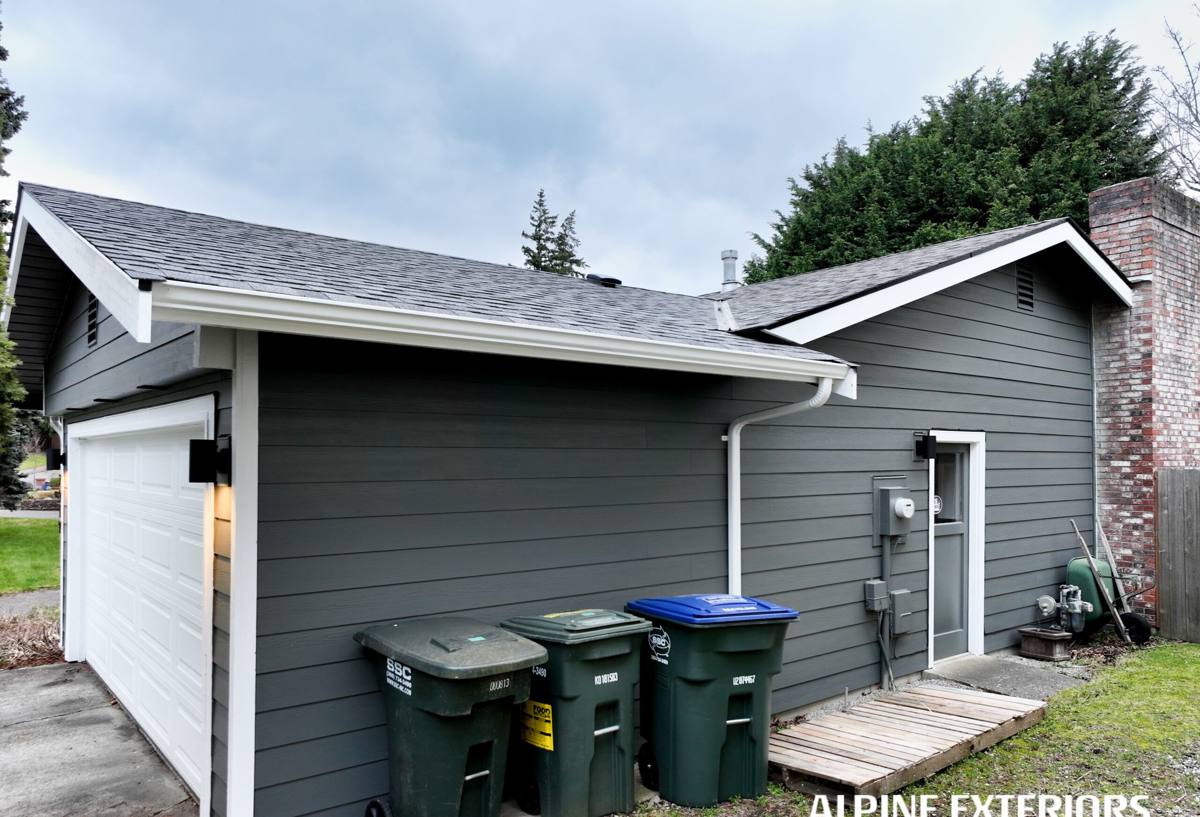
Signs Your Oak Harbor Home's Siding Is Due for Replacement
Some warning signs are obvious from the curb; others only show up once you know what to look for. If you're seeing more than one or two of these, it's worth having the siding looked at before it turns into a sheathing or framing repair.
- Soft or spongy spots when you press on the siding, especially near the bottom courses or under windows
- Paint or finish that's failing within a few years of being applied
- Visible moss, algae, or persistent green staining that keeps coming back after cleaning
- Gaps opening up at corners, seams, or where siding meets trim
- Warping, cupping, or buckling panels
- A noticeable jump in heating costs, which can point to moisture-compromised insulation behind the wall
- Visible rot, delamination, or crumbling at any exposed edge
What a Correct Siding Replacement Actually Involves
Siding replacement is often sold as a cosmetic upgrade, but the real value is in what happens underneath the new panels. A proper job addresses the wall assembly, not just the finish coat.
Tear-Off and Sheathing Inspection
Once the old siding comes off, the sheathing gets inspected for soft spots, rot, or delamination. In a marine climate, this step matters more than in drier regions — hidden moisture damage is far more common on a coastal wall than an inland one, and it has to be repaired before anything new goes up.
Weather-Resistive Barrier and Flashing
A new weather-resistive barrier, properly lapped and taped, along with correctly integrated flashing at windows, doors, and penetrations, is what actually keeps wind-driven rain out of the wall assembly. This detailing matters more here than in a sheltered inland neighborhood, because the volume and angle of rain this house will see over its life is higher.
Installation to Manufacturer Clearances
Correct ground clearance, roofline clearance, fastener spacing, and joint treatment aren't optional extras — they're what the manufacturer's warranty is actually built around. Skipping them is one of the most common reasons siding fails years before it should, regardless of which product was used.
Why We Install Only James Hardie Fiber Cement
We don't install vinyl, LP SmartSide, Cemplank, Allura, primed spruce, or cedar. Every one of those products has legitimate uses and loyal installers, and we're not going to tell you they're worthless — vinyl is inexpensive, cedar looks great, engineered wood is easier on a budget. But given what this coastline does to siding over time, we standardized on one product system and stopped installing the others.
A Non-Combustible, Dimensionally Stable Core
Fiber cement is roughly 90% sand, cement, and cellulose fiber. It doesn't burn, it doesn't feed insects, and it doesn't expand and contract with moisture the way wood-based products do. That stability matters directly in a climate where the siding is wet more often than it's dry.
ColorPlus Factory Finish
Rather than site-applied paint, James Hardie's ColorPlus finish is baked on at the factory in multiple coats before the boards ever reach a jobsite. It resists fading and chipping better than field-applied paint and carries its own separate finish warranty — which matters in a salt-air environment where painted finishes are under more stress than average.
Climate-Engineered for This Coastline
James Hardie formulates its siding differently depending on regional climate, with product lines built around moisture exposure and freeze-thaw patterns rather than a single one-size-fits-all formula. For a mild, wet, coastal climate like ours, that means a product engineered around constant moisture exposure rather than hard freezes — which is the more relevant threat here.
Comparing Siding Materials for a Coastal Oak Harbor Home
| Material | Moisture & Salt Air Resistance | Maintenance | Typical Lifespan | Fire Resistance |
|---|---|---|---|---|
| James Hardie fiber cement | Strong — dimensionally stable, factory finish | Low — occasional wash, no repainting cycle | Decades with correct install | Non-combustible |
| Vinyl | Fair — doesn't rot, but can warp/crack in wind and cold snaps | Low, but finish can't be renewed once faded | 15–30 years, varies widely | Combustible |
| Cedar | Moderate — needs consistent sealing to resist moisture and rot | High — regular refinishing required | Depends heavily on maintenance | Combustible |
| Engineered wood (e.g. LP SmartSide) | Moderate — engineered to resist moisture, but edges are moisture-sensitive if not sealed/maintained | Moderate — finish upkeep needed | Depends heavily on maintenance | Combustible |
What Affects the Cost of a Siding Replacement Here
There's no honest flat number for a project like this — cost depends on the specifics of the house and the condition of what's underneath the old siding. The factors that move the number most are:
- Total wall square footage and the complexity of the roofline and wall angles
- Tear-off, hauling, and disposal of the old siding
- How much sheathing repair is needed once the old siding comes off — this is often the biggest unknown on a coastal home
- Amount of trim, window, and door flashing detail work required
- Siding profile and color selection
- Access — multi-story walls, tight side yards, or obstructed elevations take longer to work
Our Process for Oak Harbor Siding Projects
- Walk-around inspection of the exterior, checking siding condition, moisture readings where accessible, and problem areas at grade, roof, and window transitions
- A written proposal that spells out scope — tear-off, anticipated sheathing repair allowance, flashing detail, and product selection
- Tear-off and disposal of the existing siding
- Sheathing repair and correction of any water damage found underneath
- Installation of new weather-resistive barrier and flashing at every penetration and transition
- James Hardie installation to manufacturer clearance and fastening specs
- Final walkthrough to confirm fit, finish, and clean job-site cleanup
Why Hiring a Crew That Already Works This Coastline Matters
A crew that only occasionally works this close to the water can miss things that a crew working it regularly catches automatically — which elevations take the worst wind-driven rain, how much clearance to leave given the humidity here, and where moss and shade patterns tend to cause the most long-term trouble. It also means fewer surprises during the project itself: local crews know what condition to expect once the old siding comes off, and price and plan for it up front instead of discovering it mid-project.
A Pre-Estimate Checklist for Oak Harbor Homeowners
Before you schedule an estimate, a quick walk around your own house will help the conversation go faster and give you a better sense of what you're dealing with.
- Note any soft, spongy, or visibly warped sections of siding
- Check for moss or persistent staining, and note which walls it's concentrated on
- Look for gaps or cracked caulk at corners, trim, and window edges
- Identify which side of the house takes the worst weather and wind
- Check the attic or crawlspace for any signs of moisture intrusion near exterior walls
- Make a rough note of the home's age and whether the siding has ever been replaced before
If any of this sounds familiar, we're happy to take a look and give you a straight, no-pressure estimate on what a correct replacement would involve for your home. There's a form below — reach out and we'll set up a time to walk the property with you.