 Anacortes
 Oak Harbor's Waterfront Climate Is Tougher on Siding Than Most Homeowners Realize
Oak Harbor sits on Whidbey Island, connected to our home base in Anacortes by the Deception Pass Bridge, and it shares the same marine exposure that defines siding performance across this part of the Salish Sea. That's good news in some ways and bad news in others. The good news: we already understand this climate because it's the one we work in every week. The bad news: it's a genuinely hard climate on exterior siding, and homes here show damage patterns that inland Skagit and Island County homes simply don't see as often.
Three factors do most of the damage. Salt-laden air off the water accelerates corrosion on fasteners, flashing, and any exposed metal trim, which in turn stains and degrades the siding around it. Driving rain, pushed sideways by wind off the water, gets forced into seams, laps, and butt joints that would stay dry on a more sheltered inland lot. And a long moss and algae season — often running from fall through spring in shaded, north-facing, or tree-covered areas — keeps siding surfaces damp for extended stretches, which accelerates rot in any wood-based product and keeps paint and caulk under constant stress.
None of this means Oak Harbor homes are doomed to constant repair. It means siding repair here has to account for causes, not just symptoms. Patching a stained board without addressing the flashing detail that let water in behind it is a repair that fails again within a year or two.
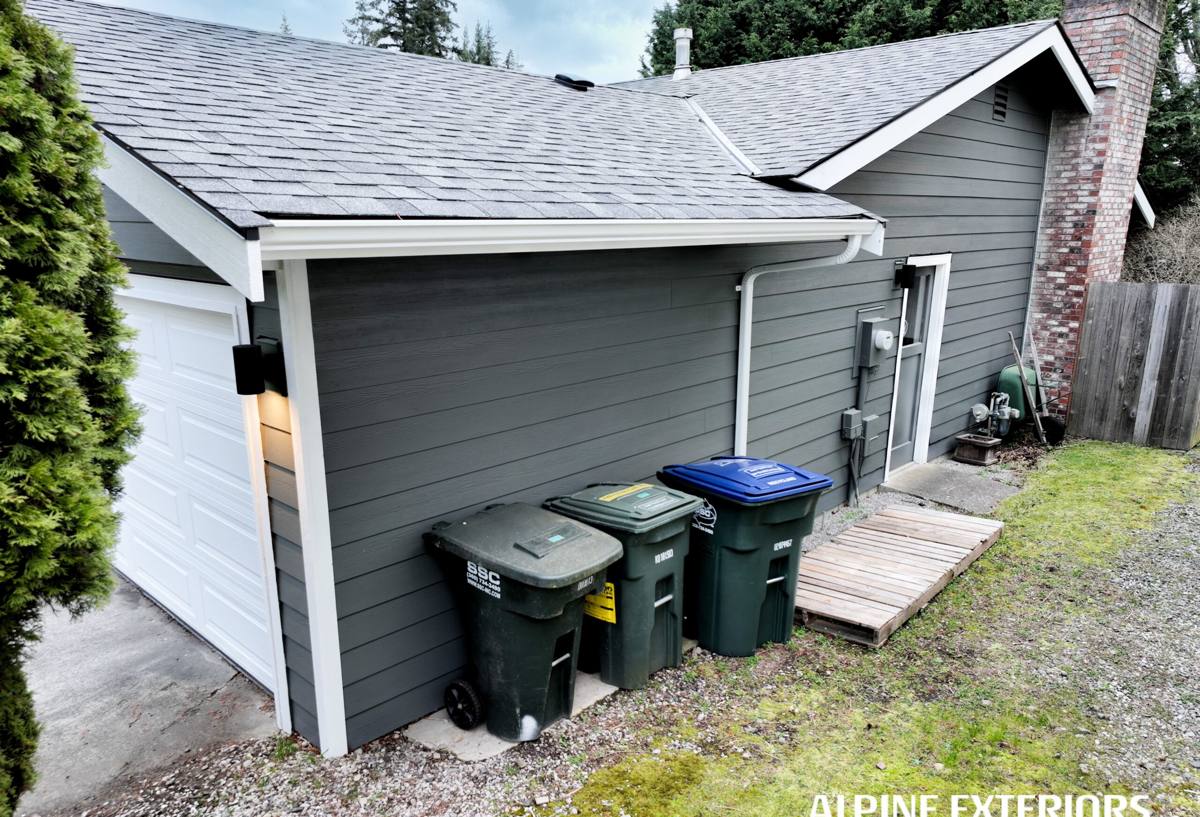
Signs an Oak Harbor Home Needs Siding Repair
Most siding problems don't show up as an obvious hole or crack. They show up as smaller signals that get dismissed as cosmetic until they're not. Homeowners in this area should watch for:
- Soft or spongy spots when you press on siding near the bottom edge of walls, around window sills, or below roof-to-wall transitions
- Persistent moss or algae growth that keeps coming back within weeks of cleaning, especially on north- or west-facing walls
- Streaking or dark staining running down from seams, nail heads, or trim joints — often a sign water is tracking behind the surface, not just sitting on top of it
- Visible gaps, cupping, or warping in individual boards or panels, particularly after a stretch of wind-driven rain
- Peeling or bubbling paint that returns quickly after repainting, which usually points to moisture trapped behind the finish rather than a paint quality issue
- Rusty streaks below fasteners or trim, a common sign of corrosion accelerated by salt air
Any one of these on its own might be minor. Several appearing in the same area, or the same problem returning after a previous patch job, usually means there's a moisture or flashing issue underneath that needs to be traced back to its source.
What a Correct Siding Repair Actually Involves
A repair that holds up in this climate is not just "cut out the bad piece and nail in a new one." Done right, it involves several steps that are easy to skip and easy for a homeowner to never notice were skipped:
Finding the actual water path
Damaged siding is usually a symptom. Before replacing anything, we trace where water is actually getting in — a failed piece of flashing, a caulk joint that's given out, a butt joint that wasn't sealed, or a penetration (vent, light fixture, hose bib) that was never properly flashed. Replacing the visible board without fixing the entry point means the same failure comes back.
Checking what's behind the siding
Once siding is opened up, we check the weather-resistive barrier and sheathing underneath. If moisture has reached the sheathing, that has to be addressed — dried out, repaired, or in worse cases replaced — before new siding goes back on. Covering damaged sheathing with new siding just hides a problem that keeps getting worse.
Matching the material correctly
We repair with James Hardie fiber cement products, matched to the existing plank width, exposure, and texture wherever the home already has Hardie siding installed. Hardie's factory ColorPlus finish is formulated to be touched up or color-matched by an authorized applicator, which is a real advantage over field-painted repairs that fade or shift in tone within a couple of seasons.
Fasteners and flashing appropriate to a marine environment
Given the salt air here, we use corrosion-resistant fasteners and flashing details rated for coastal exposure, not standard interior-grade hardware. This is one of the most common shortcuts in cheaper repair work, and it's usually invisible until the rust stains show up a year or two later.
Sealing and finishing to spec
Caulk joints, butt joint treatment, and paint or finish touch-up are done to the manufacturer's installation guidelines, not just "close enough." A repair that looks fine on day one but wasn't sealed correctly will fail again — usually right where the last repair was.
Repair or Replace? How We Help You Decide
Not every damaged section needs a full re-side, and not every repair is worth doing instead of planning a replacement. The right call depends on how much of the home is affected, what's causing the damage, and the age and condition of the existing siding.
| Situation | Repair Usually Makes Sense | Replacement Should Be Considered |
|---|---|---|
| Extent of damage | Isolated to one wall, corner, or a handful of boards | Recurring damage across multiple walls or elevations |
| Underlying material | Sheathing and barrier are still sound once opened up | Widespread rot, soft sheathing, or repeated moisture intrusion |
| Siding material | Existing James Hardie fiber cement in good general condition | Older wood, vinyl, or non-Hardie fiber cement nearing end of service life |
| Age of siding | Well within expected service life, one localized failure point | Original siding is decades old with damage showing up in new areas each year |
| Cost over time | One-time fix addresses the root cause | Cost of repeated repairs starts approaching a full re-side |
We'll always tell you honestly which side of that table your home falls on. A patch job that's likely to fail again within a couple of years isn't a favor to you — it just delays a bigger repair bill.
Why We Repair and Replace With James Hardie Fiber Cement Only
We install and repair with James Hardie fiber cement exclusively — we don't work with vinyl, LP SmartSide, primed spruce, cedar, or other fiber cement brands. That standard matters even more on repair work, because a repair is only as good as the material going back into the wall.
Fiber cement doesn't absorb water the way wood-based products do, which matters directly in a moss-prone, high-rainfall climate like this one. It's non-combustible, holds paint and factory finish far longer than wood substrates, and James Hardie's HZ5 product line is engineered specifically for climates with significant moisture exposure — which describes Oak Harbor and the surrounding Puget Sound region well. When we repair a Hardie-sided home, we're working with a material system we trust to perform the same way in year fifteen as it did on day one, as long as the installation details are done correctly.
If your home currently has a different siding product and is showing recurring damage, we'll be straightforward with you about whether targeted repair is worth it or whether a full transition to Hardie is the better long-term investment. That's a conversation, not a sales pitch — we'd rather tell you a small repair will hold than upsell you into work you don't need.
Our Process for Oak Harbor Siding Repair Jobs
- On-site inspection. We look at the visible damage, then check surrounding areas, flashing details, and penetrations that commonly cause the same problem.
- Diagnosis, not just a patch quote. We identify the actual water path and any underlying sheathing or barrier damage before quoting the fix.
- Honest repair-vs-replace recommendation. You get a clear picture of what a repair will and won't solve, and what it would cost to address more comprehensively if that's the better path.
- Material matching. For Hardie-sided homes, we match plank profile, exposure, and finish as closely as manufacturer options allow.
- Correct installation. Coastal-rated fasteners, proper flashing, correct sealing, and finish work done to spec — not shortcuts that show up again in a year.
- Cleanup and walkthrough. We leave the site clean and walk you through what was done and why.
Why a Crew That Already Works Oak Harbor Matters
Siding repair is detail work, and the details that matter here are specific to this stretch of coastline. A crew that mostly works drier, more sheltered inland areas won't automatically think to check for salt-accelerated fastener corrosion, or recognize how aggressively moss reestablishes itself on a shaded Whidbey Island wall through a wet Pacific Northwest fall and winter. We cross the Deception Pass Bridge regularly for jobs in this area, so scheduling, material sourcing, and access aren't obstacles — and we've seen enough Oak Harbor homes to recognize damage patterns quickly instead of treating every job as a first guess.
That familiarity also matters when it comes to matching existing Hardie siding correctly, sourcing the right profile without delay, and giving you a repair timeline that accounts for this region's weather windows rather than a generic estimate.
Keeping Repaired Siding in Good Shape
Once a repair is done correctly, a little ongoing attention keeps it that way. We recommend homeowners in this area build a light seasonal habit around the following:
- Rinse siding gently once or twice a year to keep salt residue and organic buildup from accumulating, especially on walls facing the water
- Trim back trees and shrubs that keep siding shaded and damp for extended periods, which is the biggest driver of moss regrowth
- Check and refresh caulking at trim, window, and door joints every few years, since sealant is often the first thing to fail
- Look at ground-level siding after major storms for splash-back staining or standing water against the wall
- Address small stains or soft spots as soon as you notice them rather than waiting for a full season to pass
If you're seeing any of the warning signs above, or just want an honest read on whether a repair or a longer-term plan makes more sense for your home, we're glad to take a look. Estimates are free and there's no pressure — just a clear assessment from a crew that already knows what this coastline does to siding.