 Anacortes
 Siding Replacement in Skyline: Built for What Anacortes Weather Actually Does
Skyline homes sit close enough to the water that the air itself works against your siding, year-round, whether you notice it or not. Add in the long, wet stretch of driving rain that defines a Skagit County winter and the moss season that follows it, and you've got a climate that's genuinely tough on exterior materials. A siding replacement here isn't a cosmetic upgrade — it's a chance to put a system on your house that's actually built for these conditions instead of one that's just tolerating them.
This page covers what siding replacement specifically means for a Skyline home: what the local climate does to siding over time, what a correct tear-off-to-finish job looks like, how our process works, and why it matters to hire a crew that already knows this neighborhood instead of one learning it on your dime.
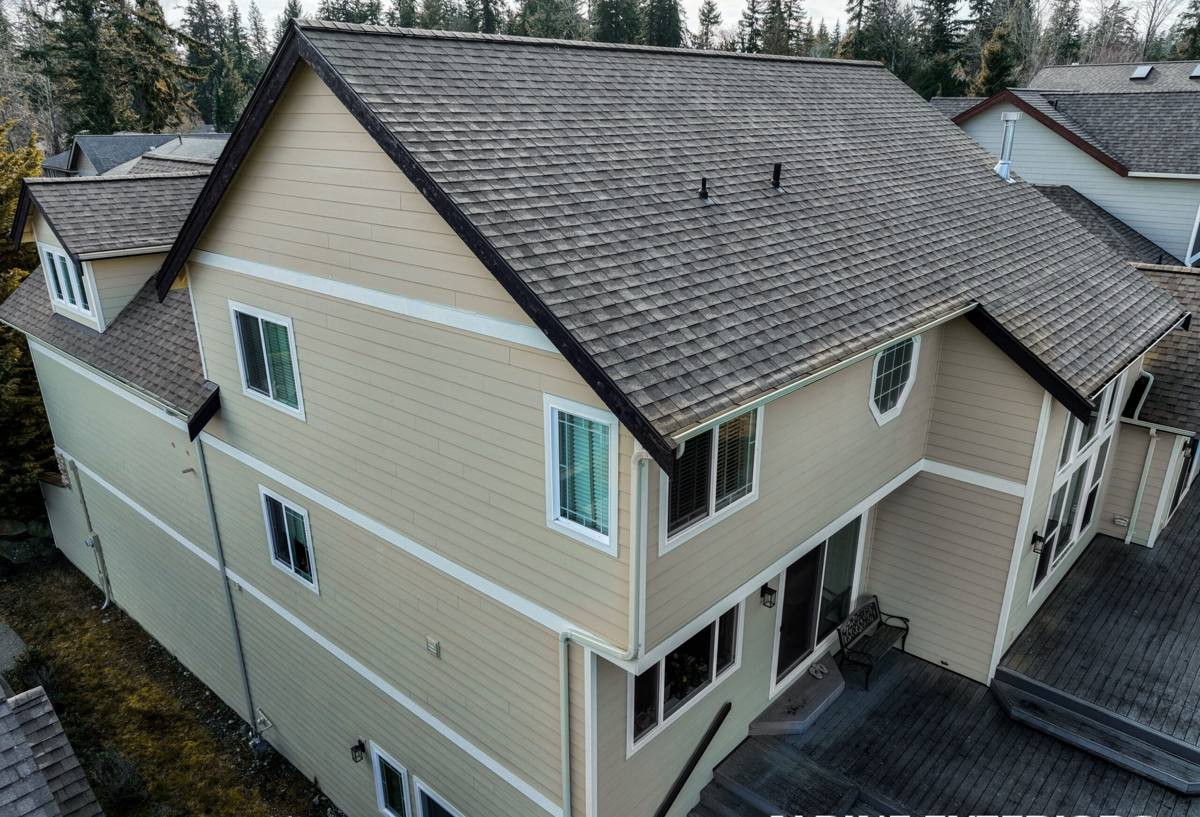
What Salt Air, Rain, and Moss Do to Siding in Skyline
Three things drive almost every siding failure we see in this part of Anacortes, and they compound each other.
Salt air. Being near the water means airborne salt is a constant, low-grade presence on every exterior surface. It accelerates corrosion in fasteners, trim flashing, and any metal component that isn't rated for a marine-influenced environment. On siding materials that rely on paint film or a factory coating to protect a wood or wood-composite core, salt-laden moisture finds the seams and edges first — and that's where deterioration starts, often long before it's visible from the ground.
Driving rain. Anacortes doesn't just get rain — it gets wind-driven rain that hits siding at an angle instead of running straight down. That matters because it pushes water into laps, seams, and butt joints that were designed for water running vertically, not water being forced sideways. A siding system with weak lap coverage, poor flashing details, or gaps at trim will let that water behind the cladding, where it sits against sheathing and framing.
Moss season. The Pacific Northwest's long damp stretch (roughly fall through spring) keeps north-facing walls, areas under eaves, and anything shaded by trees wet for extended periods. Moss and algae thrive in that moisture, and where they take hold on siding, they hold water against the surface even longer — a feedback loop that shortens the life of anything not engineered to shed water and resist organic growth.
None of this means Skyline is an unusually harsh place to build. It means the margin for error in material choice and installation quality is smaller here than it is in a drier inland climate, and it's worth taking seriously when you're planning a replacement.
Signs a Skyline Home Needs Siding Replacement — Not Just a Repair
Not every siding problem calls for a full replacement. But there's a point where patching individual boards stops making sense and a full re-side becomes the more honest recommendation. Signs worth taking seriously include:
- Soft, spongy, or crumbling siding when you press on it, especially near the bottom courses or around window and door trim
- Visible bubbling, peeling, or persistent paint failure that keeps coming back within a year or two of repainting
- Warping, cupping, or boards pulling away from the wall at seams and corners
- Moss or dark staining that returns quickly after cleaning, particularly on shaded or north-facing walls
- Rot or water staining visible on interior walls near exterior corners, especially after a hard rain
- Siding that's original to a home more than 20-25 years old and made of a material not rated for this climate
- Rising energy bills with no other explanation, which can point to compromised insulation and air sealing behind failing siding
If you're seeing one or two of these in isolated spots, a repair may genuinely be enough. If you're seeing several, or the same problem keeps reappearing after repairs, that's usually a sign the underlying material or the original installation is the real issue — and no amount of patching fixes that.
What a Correct Siding Replacement Job Actually Involves
Tear-off and a real look at what's underneath
Replacing siding correctly starts with removing the old material entirely, not just fastening new siding over it. This is the point where hidden rot, damaged sheathing, or old moisture problems finally become visible — and it's the only chance to fix them before they're sealed behind a new wall system for another few decades.
Moisture barrier and flashing details
Given how much of a Skyline siding failure traces back to water getting behind the cladding, the weather-resistive barrier and flashing at windows, doors, and penetrations matter as much as the siding itself. Correct lapping (upper layers overlapping lower ones, shingle-style) and properly integrated flashing at every opening are what actually keep driving rain out — the siding material is really the second line of defense, not the first.
Fastening and installation to manufacturer spec
Fiber cement siding has specific nailing patterns, fastener types, and clearance requirements (from grade, roof lines, and decks) that are engineered for a reason — mostly moisture management. Installing it to spec is what preserves the manufacturer's warranty and what actually delivers the performance the material is capable of. Shortcuts here are invisible on install day and expensive five years later.
Finish work: caulking, paint lines, and trim
The last stage — factory-finish touch-up where needed, caulking at the right joints (and not over the ones that need to breathe), and clean trim lines — is what makes a job look right for years, not just on the day the crew leaves.
Why We Install Only James Hardie Fiber Cement
We standardized on James Hardie siding for every home we side, including here in Skyline, because it's engineered specifically for the failure modes we just described. It's non-combustible fiber cement rather than a wood-based or wood-composite product, so it doesn't feed rot the way an organic substrate can once moisture gets in. Hardie's HZ product lines are formulated by climate zone, and the versions specified for the Pacific Northwest account for exactly this kind of sustained moisture exposure. The factory-applied ColorPlus finish is baked on rather than field-painted, which matters directly for salt-air resistance and means you're not stuck repainting every few years to keep ahead of fading and peeling. It also carries a strong, transferable manufacturer warranty when installed to spec — which is one more reason correct installation isn't optional in our process.
We don't install vinyl, LP SmartSide, Cemplank, Allura, or unfinished wood siding. Each of those products has real advantages in the right context, but none of them match fiber cement's combination of moisture tolerance, factory-finish durability, and non-combustibility for this specific climate — and we'd rather stand behind one system we trust fully than offer several we'd have reservations about.
| Factor | James Hardie Fiber Cement | Vinyl | Wood / Engineered Wood |
|---|---|---|---|
| Moisture/rot resistance | High — cement-based, doesn't rot | High for the material itself, but seams can trap moisture behind it | Vulnerable if coating fails or water gets behind it |
| Salt air / coastal exposure | Factory finish engineered for it | Can become brittle and discolor over time | Coating breaks down faster near salt air |
| Repainting needs | Rare — factory finish lasts years | Never painted, but can't be easily refreshed either | Regular repainting required |
| Fire resistance | Non-combustible | Combustible | Combustible |
| Typical lifespan when installed correctly | Multiple decades | Multiple decades, but with UV/impact limits | Shorter, especially in wet climates |
Our Siding Replacement Process
- On-site inspection and estimate. We walk the exterior, check for existing damage or rot, and talk through what your home actually needs — no pressure, no upsell for its own sake.
- Prep and tear-off. Old siding comes off, sheathing gets inspected, and any rot or damage found underneath gets addressed before anything new goes up.
- Weather barrier, flashing, and installation. The moisture management layer goes in first, then Hardie siding is installed to manufacturer spec — correct fasteners, correct clearances, correct laps.
- Finish and walkthrough. Trim, caulking, and touch-up finish work, followed by a walkthrough so you know exactly what was done and why.
Cost Factors for Siding Replacement in Skyline
Every home is different, but the same handful of factors drive most of the cost variation we see on siding replacement projects in this area:
| Factor | Why It Affects Cost |
|---|---|
| Home size and wall complexity | More square footage and more corners, gables, or dormers mean more material and labor |
| Extent of hidden damage | Rot found at tear-off (rare vs. widespread) changes the scope of sheathing and framing repair |
| Siding profile and trim detail | Lap width, panel style, and trim complexity affect both material and install time |
| Site access | Steep grades, tight setbacks, or limited staging area add labor time |
| Existing material removal | Some old siding materials are more labor-intensive to remove and dispose of than others |
We give you a real number after we've actually looked at your home, not a guess based on square footage alone — hidden damage in particular is impossible to price accurately without a hands-on inspection.
Why a Crew That Already Works Skyline Matters
Siding performance in this climate comes down to details — flashing laps, fastener choice, clearances from grade and roof lines — that don't show up in a brochure but absolutely show up in a callback five years later. A crew that already works in and around Anacortes has already seen what driving rain and a long moss season do to siding that was installed a little bit wrong, and adjusts for it as a matter of habit, not as an afterthought. That's a different starting point than a crew that installs the same way regardless of where the house happens to sit.
There's also a practical side to it: familiarity with Skagit County permitting and inspection expectations keeps a project moving instead of stalling on paperwork, and being local means we're not disappearing after the last nail goes in if a question comes up down the road.
If your Skyline home is due for a siding replacement, or you're just not sure whether what you're seeing is a repair issue or something bigger, we're happy to take a look. The estimate is free, there's no pressure attached to it, and you'll get a straight answer about what your home actually needs — just fill out the form below to get started.