 Anacortes
 A Burlington Home Asks More of Its Siding Than a Brochure Admits
Burlington sits low in the Skagit Valley, close enough to Skagit Bay and Padilla Bay to pick up salt-laden air on a regular basis, and low enough on the valley floor that Pacific storm systems arrive with real wind behind them rather than falling straight down. Add a moss season that stretches from fall well into spring on shaded, tree-lined lots, and you've got a climate that's genuinely harder on an exterior wall than most of the country experiences. Siding that's engineered and tested for a national-average climate runs into trouble here faster than the warranty paperwork suggests it should.
This page is specifically about James Hardie fiber cement siding as installed on Burlington homes — what the product system actually consists of, what a correct installation requires in this climate, how our process runs from first look to finished wall, and why it matters that the crew doing the work already knows this valley. We install James Hardie exclusively, and this is the product and the process behind that decision, laid out plainly.
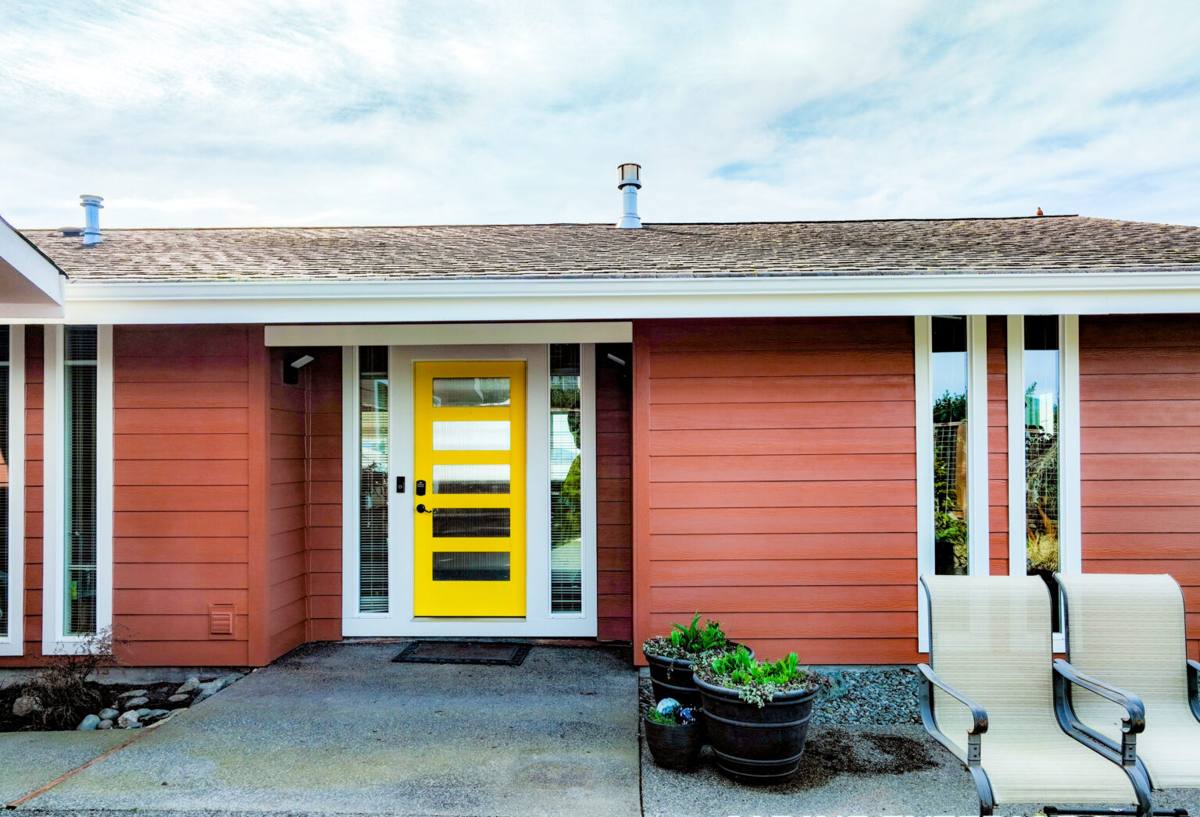
The James Hardie System — Not Just a Board
HZ5: Engineered for This Kind of Wet
James Hardie doesn't sell one formulation nationwide. It builds climate-specific HZ product lines, and the HZ5 line is engineered for cold, wet regions with heavy moisture cycling — which describes Skagit County about as well as any region in the country. The board itself is cement, sand, and cellulose fiber, pressed and cured into a dense, dimensionally stable material. It doesn't expand and contract the way vinyl or wood does across our temperature swings, and because it has no organic substrate, it doesn't feed moss or mildew growth the way wood-based siding can.
ColorPlus Factory Finish
Most of the Hardie siding we install carries the ColorPlus finish — baked onto the board at the factory under controlled conditions rather than rolled or sprayed on-site after installation. That distinction matters more here than in a drier climate, because field-applied paint depends on weather conditions at the time of application, and Burlington doesn't offer many long, dry, temperature-stable windows for that to go well. ColorPlus resists fading, chipping, and cracking better than typical field paint, and it carries its own finish warranty, separate from the substrate warranty on the board underneath it.
Choosing a Product Line for the Wall in Front of You
Hardie's core lines behave differently once they're actually on a house, and the right choice depends on the wall, not just personal taste.
| Product Line | Best Fit | Consideration in This Climate |
|---|---|---|
| HardiePlank lap siding | Most Burlington homes; traditional and craftsman styles | Horizontal laps need consistent, correct overlap to shed wind-driven rain |
| HardiePanel vertical siding | Gables, modern-style homes, accent sections | Fewer horizontal seams, but vertical joints need careful sealing at each course |
| HardieShingle | Craftsman detailing, accent gables, dormers | More seams overall; benefits most from a crew experienced with the profile |
None of these are wrong on a well-built wall. The mismatches we see usually come from a product line chosen for looks alone, without factoring in how much shade, wind exposure, or wall complexity that specific section of the house actually deals with.
What a Correct Installation Actually Requires
Fiber cement is only as good as the installation underneath it, and that's especially true in a climate that punishes shortcuts. A board that's correctly formulated for wet, coastal conditions can still fail early if it's hung with the wrong fastener pattern, insufficient clearance from grade, or flashing that was caulked over instead of properly lapped. Most of the premature siding problems we've been called to look at in Skagit County trace back to an installation detail, not a defect in the material itself.
- Water-resistive barrier installed and lapped correctly behind the entire wall assembly, not just patched around penetrations
- Flashing integrated at every window, door, and roofline transition before the siding goes up — never sealed over after the fact
- Minimum clearance maintained from grade, decks, patios, and roof lines to keep the bottom edge out of standing moisture and splash-back
- Fastener type, spacing, and depth matched to Hardie's published specifications for the specific product line and our wind exposure
- Butt joints and corners treated with the correct gap and sealant, adjusted for whether that wall face sits in sun or shade
- Factory-finished color matched carefully at cuts, corners, and touch-up points rather than covered with mismatched field paint
Our Process, Start to Finish
Assessment and Tear-Off
We start by walking the exterior with you, looking at wall orientation, existing moisture damage, and how each side of the house has actually weathered — a shaded north wall and an open south wall on the same Burlington lot rarely need identical treatment. Tear-off comes next, and it's the point where hidden problems, like soft sheathing behind old siding, surface. We'd rather find that now than have it show up as a callback in two years.
Water-Resistive Barrier and Flashing
Before any Hardie board goes up, the wall gets a correctly lapped water-resistive barrier and flashing at every window, door, and penetration. This is the step that determines whether the finished wall actually keeps wind-driven rain out, and it's also the step that's easiest to rush and hardest to inspect once the siding is on top of it.
Installing the Boards
Installation follows Hardie's published fastening and clearance specifications for the specific product line and climate zone, adjusted for each wall's real exposure. Joints, corners, and trim get sealed to the standard that wall actually needs — a shaded, moss-prone north face and a sun-exposed south wall aren't treated identically, because they don't age identically.
Final Inspection and Cleanup
We walk the finished exterior with you before calling the job done, checking flashing lines, joint treatment, and finish consistency, and we go over what routine maintenance actually looks like on your specific house — not a generic handout.
What a Burlington James Hardie Project Costs
We don't publish blanket per-square-foot pricing, because a number that ignores your home's actual condition and complexity isn't an honest one. The factors below are what consistently move a project's cost up or down.
| Factor | How It Affects the Project |
|---|---|
| Existing wall condition | Hidden moisture or sheathing damage found at tear-off adds repair scope |
| Home size and wall complexity | More corners, gables, and penetrations mean more flashing detail and labor time |
| Product line and profile | Shingle and panel accents typically run higher than standard lap siding |
| Site access | Tree cover, tight lot lines, or difficult staging can extend labor time |
| Finish choice | ColorPlus factory finish versus primed boards for field painting affects both cost and long-term upkeep |
Why a Crew That Already Works in Burlington Matters
A contractor who installs Hardie siding across Burlington and the rest of Skagit County regularly sees how a shaded, north-facing wall on one lot ages compared to an open, wind-exposed wall a few properties over — and adjusts flashing, joint treatment, and product-line recommendations accordingly. That's judgment built from repetition in this specific climate, not from a generic spec sheet. It also means someone local is reachable years later if a warranty question comes up, rather than tracking down a crew that's since moved on to another region.
Warranty: What's Actually Covered
James Hardie's fiber cement products carry a long-term, transferable substrate warranty, meaning it follows the house to a new owner if you sell rather than expiring with the original buyer. The ColorPlus finish carries its own separate warranty covering fading and chipping of the factory finish itself. Reading the actual terms matters more than the headline number — ask what's covered, what voids it, and how a claim actually gets handled before you sign anything.
Living With a Hardie Exterior in This Climate
A correctly installed Hardie exterior asks relatively little of you afterward, but a wet valley climate still calls for basic attention. Keep gutters clear ahead of the wet season so overflow doesn't soak siding and trim at the eaves. Check shaded, north-facing walls periodically for early moss growth and address it before it spreads. Inspect caulked joints at trim and penetrations every year or two — small gaps are easy to miss until wind-driven rain finds them for you.
If you're considering James Hardie siding for a Burlington home, we're happy to walk the property with you, look at how your specific walls are holding up, and put together a free, no-pressure estimate.