 Anacortes
 Salt Air, Driving Rain, and a Long Moss Season: What Ship Harbor Asks of a Siding System
Ship Harbor sits at the edge of Fidalgo Island, close enough to the water that homes here deal with a different set of conditions than siding a few miles inland in Skagit County has to handle. Salt-laden air off the Salish Sea works on any exterior material year-round, not just during storms. Add Anacortes' driving, wind-pushed rain and the long stretch of damp, low-light months that let moss and algae get a foothold on north- and west-facing walls, and you have an exposure that punishes anything with a weak point in its moisture management.
None of this means siding fails quickly here. It means the margin for error is smaller. A product that's marginal in a drier, more sheltered part of the county can genuinely struggle on a Ship Harbor lot that catches wind off the water or sits in shade long enough each day for surfaces to stay damp. Homeowners in this area are usually not asking "what siding looks good" — they're asking what will actually hold up, and that's the right question.
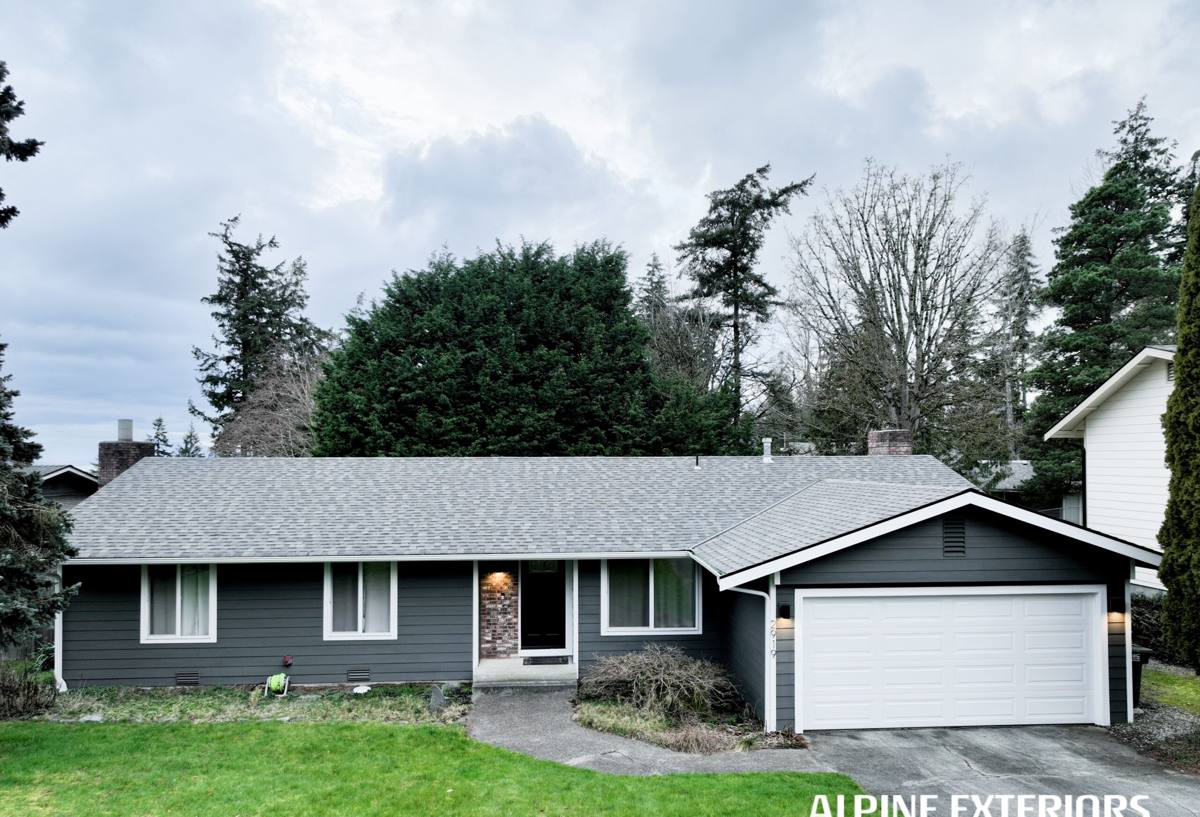
Why Fiber Cement Is the Right Match for This Exposure
We install James Hardie fiber cement siding exclusively, and on a project like this — close to the water, exposed to salt air and sustained moisture — the reasoning is straightforward. Fiber cement is dimensionally stable; it doesn't expand and contract with temperature and humidity swings the way vinyl does, and it doesn't rely on an engineered wood substrate that's vulnerable to swelling if water gets behind it, the way LP SmartSide and similar wood-based products do. It's also non-combustible, which matters increasingly to insurers and to homeowners paying attention to wildfire-adjacent building codes even on the wet side of the state.
The factory-applied ColorPlus finish is part of why we standardized on Hardie specifically rather than fiber cement in general. It's baked on under controlled conditions rather than field-applied, which matters in a climate where salt air and UV off open water can chalk and fade a job-site paint job faster than it would inland. That finish is also what a transferable warranty is actually backing — the coating and the substrate as one engineered system, not a coat of paint over a generic board.
We're not going to tell you vinyl or engineered wood siding can't be installed correctly — they can, by crews who specialize in them. Our position is narrower: for the moisture load, salt exposure, and freeze-thaw swings this part of Anacortes sees, fiber cement is the material we're willing to put our name behind, and it's the only one we install.
What a Correct Fiber Cement Installation Actually Involves
Fiber cement's reputation is only as good as the installation underneath it. The board itself is durable, but almost every real-world siding failure we get called out to inspect traces back to water management details that were skipped or rushed, not to the material.
Flashing and Water Management First
Before a single piece of siding goes up, the wall needs a correctly lapped weather-resistant barrier, properly integrated window and door flashing, and kick-out flashing anywhere a roofline meets a wall. On a Ship Harbor home taking wind-driven rain from the water side, this layer is doing more work than the siding itself — the siding sheds the bulk of the water, but the drainage plane behind it handles what gets past.
Fastening, Gaps, and Caulk Joints
James Hardie's installation instructions specify fastener placement, minimum clearances from the ground and roofline, and gaps at butt joints and trim. Skipping the gap and butting boards tight is one of the most common shortcuts we see on older installs — it looks fine on day one and traps moisture within a couple of seasons. Every joint and penetration gets sealed with a paintable, high-quality sealant rated for the movement and moisture cycling this climate puts it through.
Cuts, Dust Control, and Job-Site Practice
Fiber cement contains silica, and cutting it correctly means proper blades and dust extraction — both for the crew's safety and for a clean, accurate cut line that keeps butt joints tight and consistent. A crew that's rushing cuts on a wet driveway with a standard blade is a sign the rest of the job is probably being rushed too.
Our Process for a Ship Harbor Project
The steps don't change from house to house, but what we pay closest attention to on a shoreline-adjacent property does.
- Assessment and moisture check. We look at the existing siding and, where accessible, the sheathing underneath for signs of trapped moisture, soft spots, or past water intrusion — especially at wall penetrations and lower courses closest to grade or landscaping.
- Tear-off and sheathing inspection. Old siding comes off and we inspect the sheathing directly. Any water-damaged material gets identified and addressed before anything new goes up — covering a compromised wall with new siding just delays the problem.
- Weather barrier and flashing installation. This is the layer that does the real waterproofing work, installed and lapped correctly at every window, door, and roofline intersection.
- Siding installation to spec. Boards go up following James Hardie's fastening schedule and clearance requirements for our HardieZone, with correct gaps and sealant at every joint.
- Trim, caulk, and finish detail. Corners, trim boards, and touch-up work get finished to match the ColorPlus system so the whole exterior reads as one consistent job.
- Final walk-through. We go over the completed work with the homeowner before calling the job done.
Comparing Siding Materials for This Climate
Homeowners doing their own research often ask us to explain the trade-offs plainly rather than sell them. Here's how the materials most commonly compared to fiber cement hold up against the specific conditions Ship Harbor sees.
| Factor | James Hardie Fiber Cement | Vinyl | Wood / LP SmartSide |
|---|---|---|---|
| Salt air resistance | Strong — factory finish and cement substrate don't corrode or wick salt moisture | Moderate — can chalk, fade, and become brittle over time near salt water | Weak to moderate — engineered wood substrate is moisture-sensitive if the finish is compromised |
| Wind-driven rain / moisture behavior | Very good when installed with proper flashing and gaps | Good, but panels can flex and open at laps in high wind | Depends heavily on maintaining an intact factory or field coating |
| Moss/algae growth on surface | Occurs like any exterior surface but doesn't feed substrate decay | Occurs; surface only, doesn't affect structure | More consequential — moisture held against wood-based substrate can accelerate deterioration |
| Fire rating | Non-combustible | Combustible, can melt/deform near heat sources | Combustible |
| Typical lifespan when installed to spec | Multiple decades, factory finish warrantied | Multiple decades, but color/finish degrades faster | Shorter if moisture management isn't maintained |
Cost Factors on a Ship Harbor Job
There's no honest flat number for fiber cement siding without seeing the house — but the variables that actually move the price on a project in this area are consistent:
- Whether it's a tear-off (removing existing siding and inspecting sheathing) or, in limited cases, installation over sound existing material
- Home size, number of stories, and roofline complexity — steep gables and multiple dormers add labor
- Amount of trim, corner detail, and architectural features that need custom cuts and finish work
- Whether water damage or rot is found in the sheathing once old siding comes off, which requires repair before new siding can go on
- Plank profile, color, and any factory-finish upgrades chosen from the HardiePlank and HardiePanel lines
- Site access — waterfront and bluff-adjacent lots sometimes limit staging and equipment access, which affects labor time
We give a firm, itemized number after walking the property — not a phone estimate — because on a house exposed the way Ship Harbor homes are, the sheathing condition underneath the old siding is often the real driver of final cost.
Living With Fiber Cement in a Marine, Moss-Prone Climate
Correctly installed fiber cement is low-maintenance, not no-maintenance. In this climate, a short annual routine keeps it performing the way it's supposed to:
- Rinse the exterior periodically to clear salt residue, pollen, and organic buildup, especially on walls that don't get much direct sun or wind to dry them out
- Check caulked joints once a year for cracking or separation and have them touched up before gaps open up behind them
- Keep landscaping and irrigation from spraying directly onto lower courses of siding
- Keep gutters clear so overflow isn't running down the wall and keeping siding wet longer than it should be
- Trim back vegetation and branches that shade a wall enough to keep it damp and encourage moss or algae growth
Moss and algae growth on the surface of fiber cement is cosmetic — it doesn't feed into the substrate the way it can with wood-based products — but left unaddressed for years it holds moisture against the surface longer and can stain the finish.
Signs Your Current Siding Is Already Losing the Battle
- Paint that's bubbling, peeling, or chalking heavily, especially on water-facing walls
- Soft or spongy spots when you press on the siding near the base of the wall
- Moss or dark staining creeping up from the bottom edge rather than just sitting on the surface
- Visible gaps opening up at trim boards, corners, or butt joints
- A musty smell or visible staining on interior walls that back up to exterior siding
Why a Local Ship Harbor Crew Matters
Fiber cement is engineered by zone for a reason — Skagit County and the rest of the Puget Sound area fall under James Hardie's HZ10 climate engineering for the moisture and freeze-thaw conditions here, and installing to that spec (rather than a generic national default) is part of what makes the warranty mean something. A crew that works Anacortes regularly also knows which elevations on a shoreline-adjacent lot take the worst of the weather, what permitting looks like locally, and how to sequence a tear-off around this area's rain patterns instead of leaving sheathing exposed longer than it should be.
That local familiarity is also what lets us give an honest answer, walking a Ship Harbor property, about whether a section of wall needs more than siding — whether there's sheathing repair to plan for, or whether a particular elevation would benefit from a different trim detail to shed water better. That's not something you can judge accurately from a generic estimate process.
If you're weighing a siding replacement on a Ship Harbor home, we're happy to come take a look and walk you through exactly what we'd find and recommend — no pressure, no pushy sales pitch, just a straight assessment and a written estimate you can take your time with. Use the form below to get started.