 Anacortes
 Old Town Anacortes Homes Carry a Different Set of Siding Problems
Old Town is one of Anacortes' older residential pockets, and homes here tend to be a mix of early-to-mid-20th-century construction and more recent infill. That matters for siding because older houses were often built and re-sided over decades with whatever material was standard at the time — cedar clapboard, later aluminum or vinyl, sometimes a patchwork of both after partial repairs. When it's time to replace siding on a home like this, the job isn't just swapping old boards for new ones. It's dealing with whatever moisture, framing, and trim conditions decades of Pacific Northwest weather have left behind.
Add in Old Town's proximity to the water and the exposure that comes with it, and siding here has to work harder than siding on a newer subdivision home a few miles inland. We've replaced siding on enough older homes in this part of Anacortes to know what tends to be hiding under the exterior — and what a correct replacement needs to address so the next set of siding actually lasts.
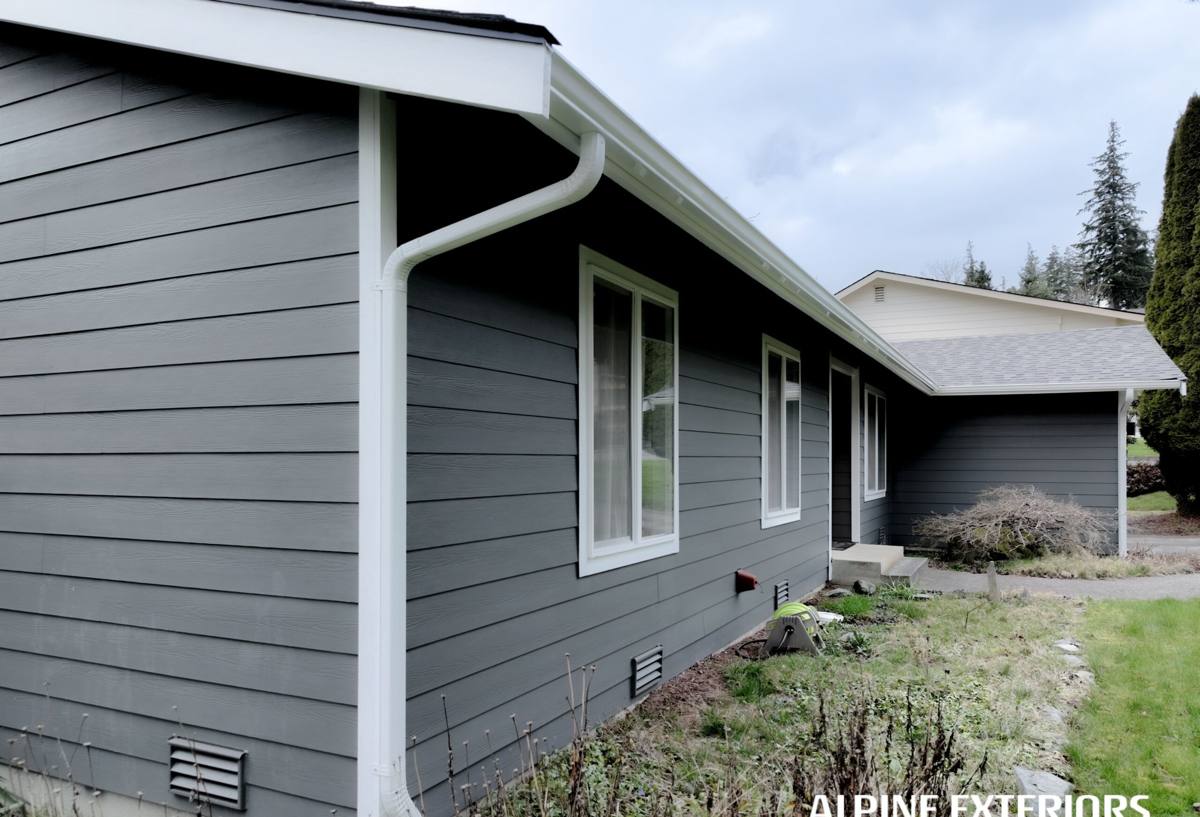
Salt Air, Driving Rain, and Moss Season: Why This Climate Is Hard on Siding
Anacortes sits right on the water in Skagit County, and that location cuts both ways. It's a beautiful place to live, but the same marine exposure that makes it desirable also accelerates siding wear:
- Salt air is corrosive to exposed fasteners, metal trim, and lower-grade paint finishes, and it speeds up the breakdown of caulking and sealants at joints and seams.
- Driving rain off the water doesn't just fall straight down — wind-driven rain gets pushed sideways into wall assemblies, seams, and butt joints that were never designed to handle sustained lateral moisture.
- A long moss and algae season — Anacortes stays damp and shaded for much of the year, and north-facing walls or anything under tree cover holds moisture long enough for moss, mildew, and algae to take hold on siding surfaces that can't shed water fast or dry out between rain events.
None of this is unique to Old Town specifically, but older homes in this neighborhood have had more decades to accumulate the damage — more paint cycles, more caulk failures, more chances for water to find its way behind the siding rather than off of it.
Signs an Old Town Home's Siding Has Reached the End of Its Useful Life
Not every siding problem means a full replacement, but on older homes near the water, these signs usually point to a system that's past patching:
- Soft, spongy, or crumbling spots when you press on the siding, especially near the bottom courses and around windows
- Paint that won't hold — repeated peeling or bubbling within a couple of years of repainting
- Visible cupping, warping, or separation at board seams
- Persistent moss, algae, or dark streaking that comes back within a season of cleaning
- Gaps opening up around trim, corner boards, or window and door casings
- Rising energy bills or drafty rooms that suggest the wall assembly isn't sealing the way it should
- Visible rust bleed from old fasteners, or aluminum siding that's chalking and pitting
If you're seeing two or more of these, it's worth a real inspection rather than another round of caulk and paint. On a lot of older Old Town homes, the surface problem is a symptom of what's happening in the wall behind it.
What's Behind the Siding Matters as Much as What's On It
Replacing siding on an older home is as much about the wall assembly as the finish material. When we pull siding off a house that's been standing for decades, we're checking:
Sheathing and Framing
Long-term moisture intrusion can rot sheathing and framing, particularly near the bottom plate, around window openings, and at any point where old flashing failed. This has to be found and repaired before new siding goes on — covering damaged sheathing with new siding just hides the problem for the next owner to find.
Weather-Resistive Barrier and Flashing
A correctly installed weather barrier and properly integrated flashing at windows, doors, and penetrations is what actually keeps driving rain out of the wall. Older homes were often built to a lower standard here, or the barrier has degraded over the decades. A siding replacement is the one time this is fully accessible and worth doing right.
Ventilation and Drying Capacity
Walls need a way to dry out when they do get damp. On homes near the water, where humidity stays elevated much of the year, we pay close attention to rainscreen gaps and ventilation so the new siding isn't sitting against a wall that never fully dries between storms.
Why We Only Install James Hardie Fiber Cement Siding
We don't install vinyl siding, LP SmartSide, primed spruce, cedar, or other fiber cement brands like Cemplank or Allura. That's a deliberate standard, not an oversight, and it comes directly from what this climate does to siding over time.
Vinyl expands, contracts, and can warp or crack in temperature swings, and it doesn't hold up structurally the way a rigid material does — a concern on a windy, water-exposed site like Old Town. Wood products like cedar and primed spruce look great initially but demand ongoing maintenance — repainting, caulking, moisture monitoring — that most homeowners underestimate, and in a climate with this much sustained dampness and moss pressure, that maintenance gap shows up fast as rot. LP SmartSide is an engineered wood product, and engineered wood is still wood at its core — it can perform well when detailed and maintained correctly, but it carries more sensitivity to sustained moisture exposure than fiber cement, which matters in a marine environment with a long wet season.
James Hardie fiber cement siding is non-combustible, dimensionally stable, and engineered specifically for climates like this one. It doesn't rot, and its ColorPlus factory-applied finish holds color and resists the fading and peeling that plagues field-painted siding under constant UV and salt exposure. Hardie also builds region-specific HZ5 product formulations engineered for the kind of freeze-thaw and moisture cycling the Pacific Northwest sees, and backs the material with a strong transferable warranty. When it's installed to manufacturer spec — correct fastening, clearances, and flashing — it's simply built for exposure like Old Town gets.
Choosing the Right Hardie Profile for an Older Home
Part of doing this right on an older home is matching the new siding profile to the house's existing character, rather than defaulting to whatever's fastest to install. James Hardie makes this straightforward because the product line covers most traditional siding looks:
| Hardie Product | Best Fit For | Notes |
|---|---|---|
| HardiePlank Lap Siding | Traditional clapboard-style homes, the most common look in older Anacortes neighborhoods | Available in multiple exposure widths and smooth or cedar-textured finishes |
| HardieShingle Siding | Homes with an original shingle-style look, or accent gables and dormers | Mimics staggered or straight-edge cedar shingle patterns without the maintenance |
| HardiePanel Vertical Siding | Porches, additions, or homes with board-and-batten style detailing | Often paired with HardieTrim battens for a clean vertical look |
| HardieTrim Boards | Corner boards, window and door casings, fascia | Keeps trim details consistent and rot-free alongside new field siding |
On most Old Town homes, matching the existing profile — rather than switching styles entirely — keeps the house looking like itself while solving the underlying performance problem.
Our Siding Replacement Process
The same process applies whether the home is a few years old or original to the neighborhood, but on older homes we spend more time up front on assessment:
- On-site inspection — we look at the current siding, trim, and as much of the wall assembly as we can assess without full removal, and talk through what we're seeing with you.
- Written estimate — a clear scope covering removal, any sheathing or framing repair allowances, weather barrier and flashing work, product selection, and finish color.
- Removal and wall assessment — old siding comes off, and we identify and address any rot, damaged sheathing, or failed flashing before anything new goes on.
- Weather barrier and flashing installation — correctly lapped and integrated at every window, door, and penetration.
- Hardie siding installation — installed to manufacturer specifications for fastening, clearances, and joint treatment, which is what actually protects the warranty and the performance.
- Trim, caulking, and final detail work — corners, casings, and transitions finished cleanly.
- Walkthrough — we go over the finished work with you before calling the job done.
What Affects the Cost of Siding Replacement in Old Town
Every home is different, but these are the factors that most often move the price on an Old Town project:
| Factor | Why It Matters |
|---|---|
| Extent of hidden damage | More rotted sheathing or framing behind old siding means more repair before new siding can go on |
| Home size and wall complexity | More gables, dormers, and cutouts mean more labor and material waste |
| Siding profile chosen | Lap, shingle, and panel products vary in material and installation time |
| Trim scope | Full trim replacement adds cost but also consistency and longevity |
| Site access | Tight lots, older detached garages, or limited staging space can add labor time |
| Existing paint or lead concerns | Homes built before 1978 may require lead-safe work practices during removal |
We won't know your real number until we've seen the house, but a written estimate will break these factors out so you understand what's driving the cost, not just a bottom-line total.
Why Local Experience in Old Town Anacortes Actually Matters
Every coastal Skagit County town has its own quirks, and Old Town Anacortes is no exception — the age of the housing stock, the specific exposure to wind and rain off the water, and the moss pressure from surrounding tree cover all factor into how we scope and sequence a job here. A crew that's worked this neighborhood before knows to expect hidden moisture damage on homes of a certain age, understands how to sequence work around this area's weather windows, and isn't guessing at what a correctly detailed wall assembly needs to hold up to this specific climate. That experience shows up in fewer surprises mid-project and in siding that's actually built for the conditions it's going to face for the next several decades.
If your Old Town home's siding is showing its age — or you just want a straight answer on whether it needs replacing or can hold on a bit longer — we're happy to take a look. Request a free, no-pressure estimate using the form below, and we'll walk the property with you and tell you honestly what we find.