 Anacortes
 Guemes Island sits out in the water off Anacortes, reachable only by ferry, and that separation shapes everything about how a roof ages out there. The same marine air that makes the island beautiful — the fog rolling off Rosario Strait, the shade from mature fir and cedar, the near-constant humidity — is also what breaks roofs down faster than it would on a dry inland lot. If you're looking at a roof replacement on Guemes Island, it pays to understand what the climate actually does to a roof before you pick a contractor or a material.
Why Guemes Island Roofs Take More Punishment
Three things work against a roof out here at the same time, year-round.
Salt air. Guemes Island is surrounded by saltwater on all sides, and airborne salt doesn't stay near the beach — wind carries it up onto rooftops across the whole island. Salt accelerates corrosion on any exposed metal: flashing, fasteners, gutter hardware, vent caps. A roof detail that would last decades in a landlocked town can start showing rust and pitting years earlier here if the wrong materials were used.
Driving rain. Storms coming off the Strait don't just fall straight down — wind-driven rain gets pushed sideways under shingle tabs, around flashing edges, and into any gap that a calmer climate would never test. Underlayment and flashing details that are merely adequate elsewhere need to be done right here, because wind-driven rain finds every shortcut.
A long moss season. Shade from tall conifers, cool temperatures, and near-constant moisture add up to a moss season that runs most of the year on north-facing slopes and shaded roof planes. Moss isn't just cosmetic — it holds water against the roofing material, lifts shingle edges, and works its way under laps where it doesn't belong.
None of these three problems is unique to Guemes Island on its own. What's unique is having all three stacked together, on a roof that also has to survive the practical realities of being on an island — namely, that a repair crew can't just swing by on a whim.
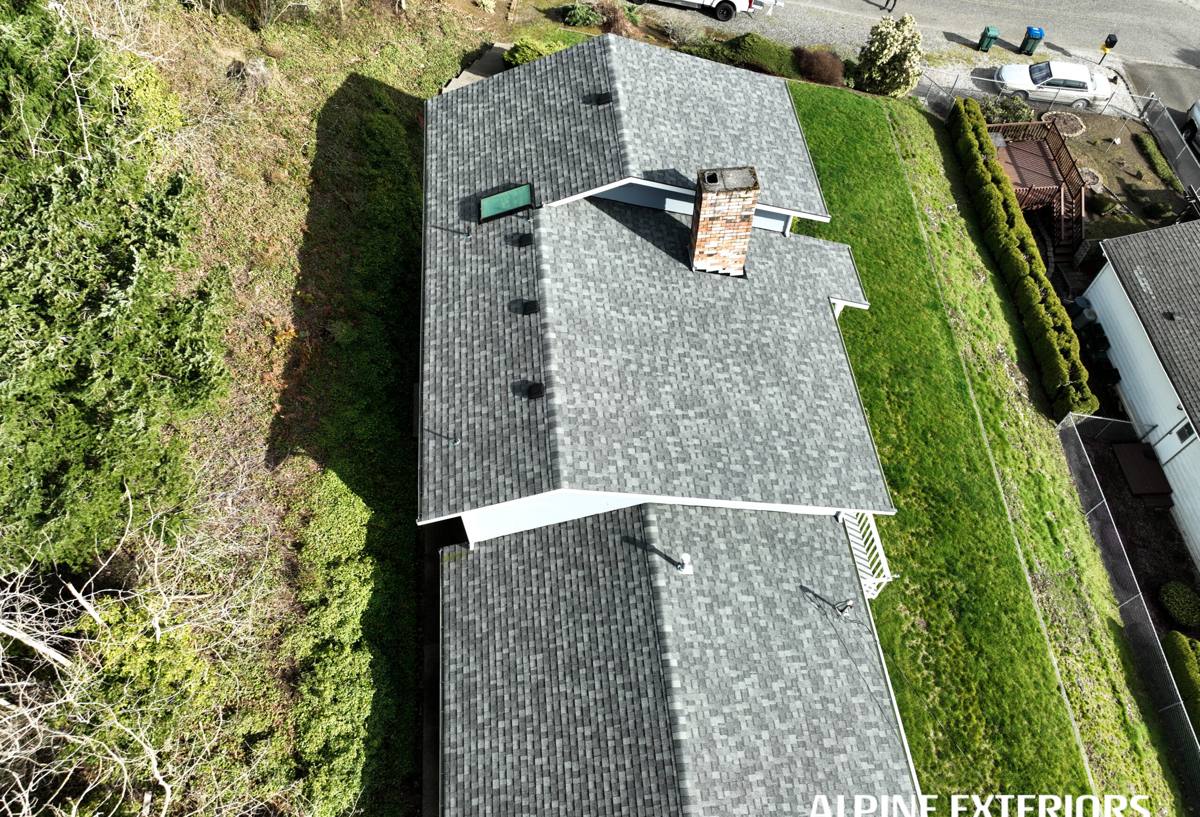
Signs a Guemes Island Roof Needs Full Replacement, Not Another Repair
A lot of island homeowners patch the same trouble spots for years before calling for a real assessment. That's usually the more expensive path in the long run. Watch for:
- Granule loss showing up in gutters or downspouts, or bald patches on south- and west-facing slopes
- Moss or dark algae streaking that keeps coming back within a season of cleaning
- Shingles that are cupping, curling at the edges, or cracking when walked on
- Soft or spongy decking felt underfoot, especially near valleys or chimneys
- Rusted flashing, streaking stains below metal edges, or corroded fasteners backing out
- Leaks that show up in more than one spot, or leaks that reappear after a patch
- A roof at or past 20–25 years old on asphalt, even if it "looks fine" from the ground
One or two of these might mean a repair is enough. Several at once, especially on a roof already in its second or third decade, usually means the underlying materials are failing broadly and a patch is just buying a little time.
What a Correct Roof Replacement Involves
A roof replacement done right on Guemes Island isn't just stripping old shingles and nailing down new ones. Given the climate, the details underneath the visible surface matter as much as the surface itself.
Tear-off and deck inspection
Full removal of the old roofing down to the deck, not a layover, so the decking can actually be inspected. Damp or delaminating plywood or planking gets replaced before anything new goes down — covering rot with new shingles just hides the problem for a while.
Water-resistant underlayment
Self-adhering ice-and-water membrane at eaves, valleys, and around penetrations, plus synthetic underlayment across the field, gives a second line of defense against the wind-driven rain this area sees regularly.
Flashing that's actually built for salt exposure
Step flashing at walls, counter-flashing at chimneys, and proper flashing at skylights and vent penetrations — using metals and coatings suited to a marine environment rather than whatever's cheapest. This is one of the most common places a "fine" roof starts leaking within a few years.
Ventilation, not just shingles
Balanced intake and exhaust ventilation so the attic or roof cavity can actually dry out between rain events, which matters more here than in a drier climate.
Fasteners and wind rating
Nailing patterns and fastener specs suited to the wind exposure an open, waterfront-adjacent island actually gets, not the minimum code allows.
Choosing Materials That Hold Up to Salt Air and Moss
There's no single "best" roofing material for every Guemes Island home — it depends on the roof's pitch, shading, budget, and how the house is built. What matters is picking with the local climate in mind rather than by looks alone.
| Material | How it handles salt air & moss | Maintenance | Typical lifespan |
|---|---|---|---|
| Architectural asphalt shingle (algae-resistant) | Good with copper/zinc-infused granules that resist algae and moss growth; standard fasteners should be corrosion-resistant | Periodic moss treatment and gutter clearing, especially on shaded slopes | Roughly 25–30 years in this climate |
| Standing seam metal | Excellent once properly coated and detailed; sheds moss and moisture well due to smooth, low-friction surface | Low; mainly keeping fasteners and sealant checked over time | 40+ years with correct install |
| Cedar shake | Attractive but holds moisture and is more moss-prone in shaded, humid conditions unless rigorously maintained | High; regular cleaning and treatment required to avoid rot | Shorter effective life here without diligent upkeep |
We're upfront with homeowners about trade-offs rather than steering everyone to one product. Cedar can look great on the right elevation with the right owner committed to upkeep; on a heavily shaded, north-facing roof plane, it's usually not the low-maintenance choice people expect. Metal costs more up front but asks the least of you afterward. A quality architectural shingle with algae-resistant granules is often the practical middle ground for full-island exposure.
Ventilation and Moisture — the Part You Don't See
Homeowners tend to focus on the shingle brand and skip past ventilation, but in a marine climate like this, it's often the difference between a roof that reaches its full lifespan and one that fails from underneath. Trapped moisture in an attic or roof cavity encourages mold, accelerates decking rot, and shortens the life of the roofing material from the back side — invisible until it isn't.
A properly balanced system pulls cooler outside air in at the eaves and lets warm, moist air escape at or near the ridge. On Guemes Island homes with mature tree cover, we also look at whether nearby branches are blocking vents or dumping extra debris and moisture onto specific roof sections, since that changes how a roof needs to be ventilated and maintained.
Our Process for a Guemes Island Roof Replacement
Working on an island adds a logistics layer that a mainland roof job doesn't have, and it shows up most in scheduling and material staging.
- On-site assessment. We walk the roof (or use a ladder-and-lift inspection where pitch or access calls for it), check the decking condition where visible, and look at ventilation, flashing points, and shading that affects moss.
- Written estimate. A clear scope covering tear-off, decking allowance, underlayment, flashing, material choice, and ventilation — no vague line items.
- Scheduling around the ferry. Materials, dumpsters, and crew all have to move on and off the island on a schedule, so we plan delivery and disposal logistics in advance instead of discovering a problem on install day.
- Tear-off and deck repair. Old roofing comes off, decking is inspected and any damaged sections replaced, and the roof is dried in the same day whenever weather allows.
- Install. Underlayment, flashing, ventilation components, and the finish roofing material go on to spec — not the fastest path, the correct one.
- Cleanup and walkthrough. Magnetic sweep for stray fasteners, debris hauled off-island, and a walkthrough so you know what was done and what to watch for.
Cost Factors for a Guemes Island Roof Replacement
We don't publish flat prices because every roof is different, but these are the factors that actually move the number on an island job:
| Factor | Why it matters here |
|---|---|
| Roof size and pitch | More surface area and steeper pitches mean more material, labor, and safety setup |
| Number of existing layers | Multiple old layers add tear-off time and disposal weight |
| Decking condition | Rot or soft sheathing found during tear-off needs replacing before install continues |
| Material choice | Asphalt, metal, and cedar carry very different material and install costs |
| Flashing and penetrations | Chimneys, skylights, and valleys all add detail work that takes more time to do right |
| Ventilation upgrades | Adding or correcting intake/exhaust venting is an investment that pays back in roof lifespan |
| Ferry and logistics | Material delivery and debris removal require island-specific scheduling and coordination |
Any of these can shift the total meaningfully, which is why a real on-site look, not a phone quote, is the only honest way to price a Guemes Island roof.
Why Hire a Crew That Already Works on the Island
A roofing crew that's only worked mainland Anacortes or Skagit County jobs can still do good work, but they're learning the island's quirks on your project. A crew that already works Guemes Island regularly has already solved the practical problems: coordinating ferry timing so a delivery doesn't sit waiting on the dock, knowing which roof orientations on the island collect the most moss and moisture, and understanding how open water exposure changes wind and salt loading compared to a sheltered mainland lot.
That familiarity also matters for permitting and inspection, since island jobs still fall under the same Skagit County requirements as anywhere else in the area — a crew that's been through the process before doesn't have to figure it out for the first time on your house.
After the Roof Goes On: Keeping Moss and Salt Air From Winning Back
Even a correctly installed roof needs some ongoing attention in this climate. A little upkeep goes a long way toward hitting the full lifespan of the material:
- Clear gutters and downspouts at least twice a year so water isn't backing up under the roof edge
- Have moss treated or gently removed before it establishes on shaded slopes — don't let it sit for a season
- Trim back overhanging branches where practical to cut down on shade, debris, and moisture retention
- Check flashing points around chimneys, skylights, and vents periodically for early rust or lifted edges
- Walk the roofline from the ground after major windstorms to spot obvious damage early
None of this is a substitute for correct installation — it's what protects the investment once the installation is done right.
If your Guemes Island roof is showing its age or you just want an honest read on where it stands, we're glad to come take a look. The estimate is free, there's no pressure, and you'll get a straight answer about whether you need a repair or a full replacement — fill out the form below to get started.