 Anacortes
 Building Decks That Hold Up on Guemes Island
Guemes Island sits right off Anacortes, reached only by a short ferry ride across Guemes Channel, and that separation shapes how we think about every deck we build out there. It's a marine environment first and a residential neighborhood second: salt-laden air off the channel and the wider Salish Sea, driving rain that comes in sideways during fall and winter storms, and a long stretch of gray, damp months every year that keep wood and hardware wet far longer than most inland homeowners ever deal with. A deck built to a generic spec sheet does not last on Guemes Island the way it might in a drier part of the state. A deck built for this specific climate does.
We've worked on homes across the island long enough to know which details matter and which ones are just marketing. This page covers what a Guemes Island deck actually needs, what separates a correctly built deck from one that will need major repair in five to eight years, and how we run a project when the job site is on an island reachable only by ferry.
What Guemes Island's Climate Does to a Deck
Three conditions do most of the damage we see on decks around Anacortes and the surrounding islands, and Guemes gets all three at once.
Salt Air
Airborne salt from the channel and the open water beyond it settles on every exposed surface. It accelerates corrosion in fasteners, hinges, and railing hardware, and it's especially hard on lower-grade or improperly coated metal. This is the single biggest reason we're particular about which screws, brackets, and post hardware go into an island deck.
Driving Rain
Wind-driven rain doesn't just fall on a deck, it gets pushed into ledger connections, under railing posts, and into any gap in the flashing. On a waterfront or exposed lot, rain can hit a house nearly horizontally during a winter blow. Every water path into the structure has to be closed off, not just covered.
Moss Season
Skagit County's wet season runs long, and shaded or north-facing decks on tree-covered island lots can stay damp for months at a stretch. That's exactly the environment moss and algae need. Left unmanaged, moss holds moisture against decking boards and framing, which speeds up rot in wood and can leave composite surfaces slick and discolored.
None of these are exotic problems, but they compound each other. Salt-corroded fasteners loosen and let water in. Trapped water feeds moss. Moss holds water longer. A deck that isn't designed around this cycle from day one will spend its whole life fighting it.
What a Correctly Built Guemes Island Deck Requires
Before we talk materials, it helps to lay out what "correct" actually means for a deck out here. It comes down to a handful of non-negotiables:
- Stainless steel or heavy-duty coated fasteners rated for coastal/marine exposure, not standard exterior-grade hardware
- Flashing at every ledger board connection, installed so water sheds away from the house rather than behind the flashing
- Joist tape or an equivalent protective membrane on top of all framing lumber to slow rot at the most vulnerable point on the structure
- Decking gaps and layout that allow real airflow underneath, not just enough space to look correct
- Post bases and railing hardware set above standing water and sized for the exposure the specific lot gets
- A drainage plan for the ground under the deck, especially on sloped or shaded island lots where water doesn't drain on its own
- Material choices matched to how much sun, shade, and wind exposure that particular deck actually gets
Every one of these gets decided differently depending on where a house sits on the island — a deck tucked into trees on the interior needs different moss and drainage handling than an open, wind-exposed deck facing the water.
Choosing Decking Material for Salt Air and Wet Winters
There's no single "best" decking material for every Guemes Island home — it depends on sun exposure, budget, and how much upkeep a homeowner actually wants to do. Here's how the main options hold up in this specific climate:
| Material | Salt Air / Moisture Behavior | Moss & Mildew Resistance | Maintenance |
|---|---|---|---|
| Pressure-treated wood | Performs well if properly sealed and re-coated; hardware corrosion is the main risk | Needs regular cleaning and periodic sealing to resist moss buildup | Highest — annual inspection, periodic staining/sealing |
| Cedar | Naturally moisture-resistant, but still needs finish maintenance near salt air | Moderate; benefits from cleaning in shaded areas | Moderate to high — finish upkeep every few years |
| Composite decking | Very stable in wet, salty conditions; won't rot | Can develop surface algae/moss film in shaded, damp spots — needs occasional washing | Low — periodic washing, no sealing or staining |
| Capped composite / PVC | Excellent moisture and salt resistance; fully sealed surface | Best resistance of the group; smooth cap sheds moss growth more easily | Lowest — occasional rinse |
We install all of these depending on what a homeowner wants, but for shaded, damp lots on the island's interior, or for anyone who wants to spend their weekends off the ladder, we typically steer people toward a capped composite. It's not that wood decking is a bad product — it's that wood asks for a maintenance commitment that a lot of island homeowners, especially those with second homes accessed by ferry, aren't around often enough to keep up with.
Framing, Fasteners, and the Details That Fail First
Most deck failures we get called out to inspect aren't decking board problems — they're framing and connection problems that were invisible on day one. The ledger board attachment to the house is the highest-stakes connection on any deck; if flashing there is wrong or missing, water tracks into the rim joist and the wall framing behind it, and by the time it shows up as a soft spot, real damage has already been done. On Guemes Island specifically, we also pay close attention to:
- Post base connectors and structural screws — standard exterior-rated hardware corrodes faster here than most manufacturers' ratings assume
- Joist protection tape over every cut and fastener point, since exposed end grain is where rot starts fastest
- Beam and post sizing that accounts for actual wind and snow load for the site, not just a minimum code spec
- Under-deck drainage or grading so water isn't pooling against footings through the wet season
None of this is visible once the decking goes down, which is exactly why it has to be done right the first time. A deck that looks great for the first two years and starts failing in year six almost always traces back to one of these hidden connections.
Railings, Hardware, and Salt Corrosion
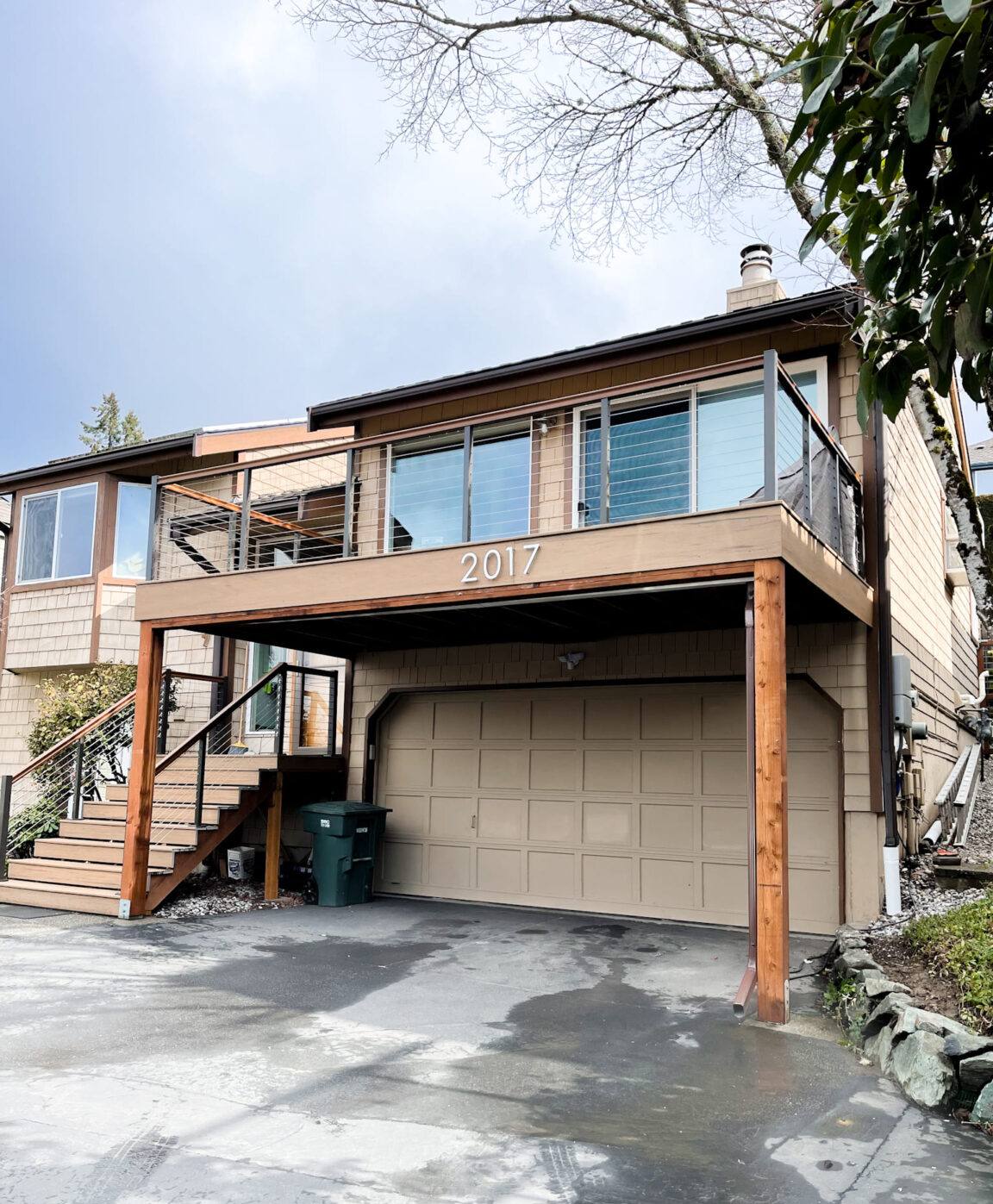
Railings take a disproportionate amount of abuse on an island deck because they're the tallest, most exposed part of the structure and often the first thing that catches driving rain and salt spray. Cable rail systems are popular for the open sightlines they give toward the water, but cable and its end hardware need to be marine-grade stainless — anything less will show rust streaking within a couple of seasons in this air. Glass panel railings hold up well against salt but need attention to the base track where water and debris can collect. Traditional wood or composite railings need the same fastener standards as the deck framing itself.
Whatever railing style a homeowner picks, we spec hardware for the exposure that particular deck gets — a railing on an open, water-facing lot needs a higher hardware standard than one tucked behind the house on the leeward side.
Managing Moss Through a Long Wet Season
Moss isn't just cosmetic on a deck — it holds moisture against the surface and, on wood decking, against fastener heads and framing underneath. The best defense is built in at construction: decking gaps sized for real drainage, layout that doesn't trap standing water in low spots, and material choices that match the amount of shade a deck actually sits in. For decks that stay shaded through the wet months, we'll sometimes recommend trimming sightlines or adjusting board orientation to get more air movement and drying time between rain events. Composite and capped composite surfaces resist moss better than bare wood, but even those benefit from an occasional wash in a deck that sits under trees most of the year.
Our Process for Guemes Island Projects
Building on the island adds a logistics layer that mainland jobs don't have, and we plan around it rather than treating it as an afterthought:
Estimate and Design
We start with a site visit to assess sun/shade exposure, wind exposure, slope, and how the deck will connect to the house, then walk through material and layout options based on that specific lot.
Permitting
Deck projects on Guemes Island fall under Skagit County permitting requirements. We handle that process as part of the job so homeowners aren't left navigating it alone.
Scheduling and Materials
Because everything — crew, tools, and materials — has to cross by ferry, we batch trips and schedule work in efficient blocks rather than making daily crossings. That planning keeps the project moving without wasted ferry cycles driving up cost or timeline.
Construction and Walkthrough
We build to the standards outlined above — proper flashing, corrosion-resistant hardware, correct drainage — and walk the finished deck with the homeowner before we call the job done.
Why Hire a Crew That Already Works This Island
A contractor who's never built on Guemes Island has to learn the ferry logistics, the county permitting process, and the real-world behavior of materials in this specific salt-and-rain environment on someone's project — usually at the homeowner's expense in time or rework. We already know how to schedule around the ferry, what Skagit County expects for permitting, and which fastener and material choices actually hold up here versus which ones just meet a generic spec sheet. That experience shows up in fewer surprises, a more accurate timeline, and a deck that's built for the conditions it will actually face rather than the conditions a standard building guide assumes.
If you're planning a new deck or replacing one that's showing its age on Guemes Island, we're happy to come take a look and put together a straightforward, no-pressure estimate. Use the form below to get started.