 Anacortes
 Flounder Bay's Marine Climate and What It Does to Siding
Flounder Bay sits on the water in Anacortes, on Fidalgo Island in Skagit County, and that location comes with a specific set of demands on a home's exterior. Salt-laden air moves off the water and settles on every exposed surface, wind-driven rain finds its way into laps and joints that would stay dry a few miles inland, and the long, damp Pacific Northwest fall and winter give moss and mildew months to take hold on north- and west-facing walls. None of this is unique to any one house on the bay — it's a function of being close to the water, and it's exactly the kind of exposure that separates siding that performs for decades from siding that starts failing within a handful of years.
Salt air is corrosive to metal fasteners and trim, which is why fastener choice and flashing detail matter more here than in a drier, inland neighborhood. Driving rain, especially wind-driven rain coming off the water, pushes moisture sideways into seams and around penetrations rather than simply running down the face of the wall. And moss doesn't just sit on a roof — spores settle into any porous or organic siding material, and once established, moss holds moisture against the wall long after the rain has stopped. Any siding decision for a Flounder Bay home has to account for all three factors at once, not just one of them.
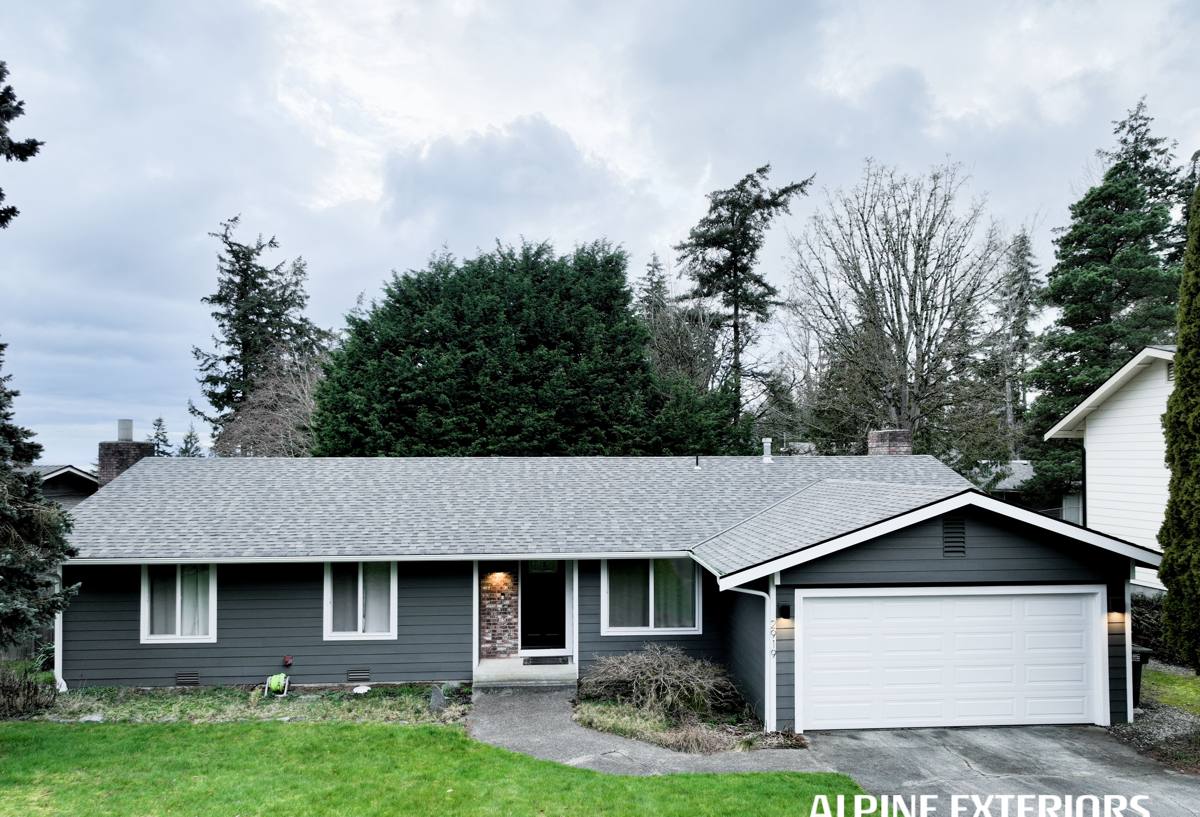
Why We Only Install James Hardie in Skagit County's Marine Neighborhoods
We install James Hardie fiber cement siding exclusively — not vinyl, not LP SmartSide, not Cemplank or Allura, not primed wood or cedar. That's a deliberate standard, not a default. Fiber cement is made from cement, sand, and cellulose fibers, which means it doesn't provide the organic food source that wood-based products do for moss and mildew, doesn't swell and cup the way wood siding does when it takes on repeated moisture, and doesn't soften or warp under UV exposure the way vinyl can over time. It's also non-combustible, which matters in a region that sees wildfire smoke and occasional dry-season burn risk even this close to the water.
None of that means other products are without merit — vinyl is inexpensive and low-maintenance in mild climates, and cedar has a look some homeowners genuinely prefer. But in a marine environment with sustained salt exposure and a long wet season, the maintenance burden and moisture behavior of those alternatives is a trade-off we're not willing to install and then stand behind. Fiber cement, installed correctly, is the product we're comfortable putting our name on for homes exposed to what Flounder Bay sees every winter.
What "Correctly" Actually Means
Fiber cement's reputation depends heavily on installation quality. A Hardie product installed without a drainage gap, with the wrong fasteners, or with unsealed joints will still fail prematurely in a marine climate — the material's durability doesn't compensate for shortcuts in the assembly behind it. That's the part of the job that separates a siding crew that understands coastal exposure from one that's used to installing the same details everywhere, regardless of climate.
The HZ5 System: Engineered for This Climate
James Hardie engineers its products for specific climate zones, and the Pacific Northwest falls into what Hardie designates HZ5 — a zone defined by sustained moisture, freeze-thaw cycling, and humid conditions rather than extreme heat. HZ5 products use a moisture-managed formulation intended to limit water absorption into the board itself, which reduces the risk of the kind of swelling and cracking that generic fiber cement can experience when it's repeatedly wetted and dried in a climate like ours. This isn't a marketing distinction — it affects how the board performs over a 20- or 30-year timeline on a house that sits within sight of the water.
For Flounder Bay specifically, this matters because homes closer to the shoreline see more frequent wetting cycles than homes set back in drier parts of Anacortes or unincorporated Skagit County. A product engineered for a hot, dry climate zone simply isn't the right match for this exposure, even if it carries the same brand name.
What a Correct Installation Involves
The Drainage Gap
Behind the siding, a proper installation includes a rain screen or drainage gap that lets any moisture that gets past the cladding drain and dry out rather than sitting against the sheathing. In a marine climate where wind-driven rain regularly tests every seam, this gap is not optional detailing — it's the difference between a wall assembly that dries out between storms and one that stays damp all winter.
Flashing and Fasteners
Every window, door, and penetration needs flashing that directs water outward rather than into the wall cavity, and every fastener needs to be corrosion-resistant — stainless steel or hot-dip galvanized, not a lesser-grade fastener that will start rusting and streaking within a few salt-air seasons. Fastener placement also has to follow Hardie's published fastening schedule for the specific product and exposure, not a generic pattern.
Joints and Sealant
Butt joints and trim intersections need to be treated correctly — either flashed, or sealed with a high-quality, paintable sealant rated for exterior use — and the siding needs proper ground clearance so splash-back from rain and irrigation doesn't sit against the bottom course. Skipping any one of these steps doesn't show up immediately; it shows up two or three winters later as staining, soft trim, or an open joint that's been letting water in the whole time.
ColorPlus Factory Finish vs. Field Painting
James Hardie's ColorPlus finish is baked onto the board at the factory under controlled conditions, which gives it better adhesion and more consistent color coverage than paint applied on-site after installation. In a salt-air environment, that matters more than it would inland — salt spray and constant humidity are hard on field-applied paint film, and a factory finish holds up to UV and moisture exposure with less risk of early fading or chalking. It also comes with its own warranty coverage separate from the substrate warranty, which is worth understanding before you choose a finish option.
Field-painted Hardie siding is still a legitimate option, particularly for custom colors, but on a waterfront or near-waterfront property we generally walk homeowners through both paths honestly, including what a field-applied finish will realistically need in terms of repainting frequency in this climate compared to a factory finish.
Our Process for Flounder Bay Projects
- On-site assessment — we look at existing siding condition, sheathing and framing underneath where accessible, moisture staining patterns, and how the home is oriented to prevailing wind and rain off the water.
- Prep and tear-off — removal of existing siding, inspection and repair of any compromised sheathing, and installation of a proper weather-resistive barrier and drainage gap system before a single piece of Hardie goes up.
- Installation — HZ5 Hardie products installed to manufacturer specification, with corrosion-resistant fasteners, correct flashing at every penetration, and attention to fastening patterns appropriate to this exposure.
- Trim and finish detail — corner treatments, joint sealing, and finish work done to hold up to the specific wear this location sees.
- Final walk-through — a review with the homeowner before we consider the job complete, including what to expect for maintenance going forward.
Cost Factors for a Flounder Bay Installation
Every home is different, and we don't quote sight-unseen — but the factors below are the ones that most commonly move a project's scope and price on a home in this area.
| Factor | Why It Matters Here | Effect on the Project |
|---|---|---|
| Existing sheathing condition | Homes with past moisture intrusion may need sheathing repair before new siding goes on | Adds labor and material beyond the siding itself |
| Wind/rain exposure orientation | Water-facing and southwest-facing walls take more direct weather | May call for extra flashing detail in those areas |
| Siding profile chosen | Lap, shingle, and panel profiles install differently and at different rates | Changes labor time and material takeoff |
| Trim and architectural detail | Corners, fascia, and window/door surrounds add cutting and fitting time | More detail work increases labor hours |
| Access and site conditions | Waterfront lots can have limited staging space or steep grades | May require different equipment or sequencing |
| ColorPlus vs. field-painted finish | Factory finish and site-applied paint carry different material and labor costs | Affects finish cost and future repainting needs |
Maintenance in a Salt-Air, Moss-Prone Environment
Correctly installed Hardie siding is low-maintenance, but "low-maintenance" isn't "no-maintenance" — especially this close to the water. A short annual routine goes a long way toward protecting the investment:
- Rinse salt spray and general grime off the siding periodically with a garden hose, especially on water-facing walls
- Inspect caulking and sealant joints once a year and re-seal anything that's cracked or pulled away
- Trim back vegetation and tree limbs that shade walls and keep them damp, since that's exactly where moss takes hold first
- Clean gutters and downspouts regularly so overflow isn't running down the face of the siding
- Watch for early chalking or color change on field-painted sections as a sign it's time to repaint before the paint film fails
- Touch up any scratches or chips promptly — an exposed edge is where moisture starts working its way in
- Keep mulch, soil, and hardscaping from building up against the bottom edge of the siding
Why Hiring a Crew That Already Works Flounder Bay Matters
A siding crew that mostly works drier, inland neighborhoods can still do competent work — but competent isn't the same as calibrated to this exposure. A crew that regularly works Anacortes waterfront and near-waterfront properties already knows which walls take the worst of the wind-driven rain, understands the fastener and flashing standards salt air demands, and isn't guessing at how a house on the bay will behave differently than one a few miles inland. That local pattern recognition shows up in the small decisions — where to add extra flashing, which joints need more attention, how to sequence work around the wet season — that don't show up on a quote but show up in how the siding performs five and ten years out.
It also matters for the practical side of the job: knowing local permitting expectations, being realistic about weather windows for tear-off and installation, and having handled similar exposure enough times to spot problems in the existing wall assembly before they become part of a bigger, more expensive repair.
If you're weighing a siding project on your Flounder Bay home, we're happy to take a look and talk through what your house specifically needs — no pressure, no obligation. Use the form below to request a free estimate.