 Anacortes
 La Conner's Climate Is Harder on Siding Than It Looks
La Conner sits right on the Swinomish Channel, a tidal saltwater passage that connects Skagit Bay to Padilla Bay. That waterfront setting is a big part of what makes the town beautiful, and it's also exactly what wears out the wrong kind of siding faster than most homeowners expect. Salt-laden air corrodes fasteners and trim, driving rain off the water finds every gap in a poor installation, and the damp, shaded pockets common in Skagit County keep moss and mildew active for most of the year instead of just a few winter months.
None of that is unique to La Conner — it's the reality of siding anywhere on Fidalgo Island and the surrounding channel and bay communities we serve out of Anacortes. But La Conner's mix of older homes, waterfront exposure, and a wetter microclimate than some inland Skagit County neighborhoods means the siding decision matters even more here. This page covers what fiber cement siding needs to do to hold up in this specific environment, what a correct installation actually involves, and why we've standardized on one product line instead of offering several.
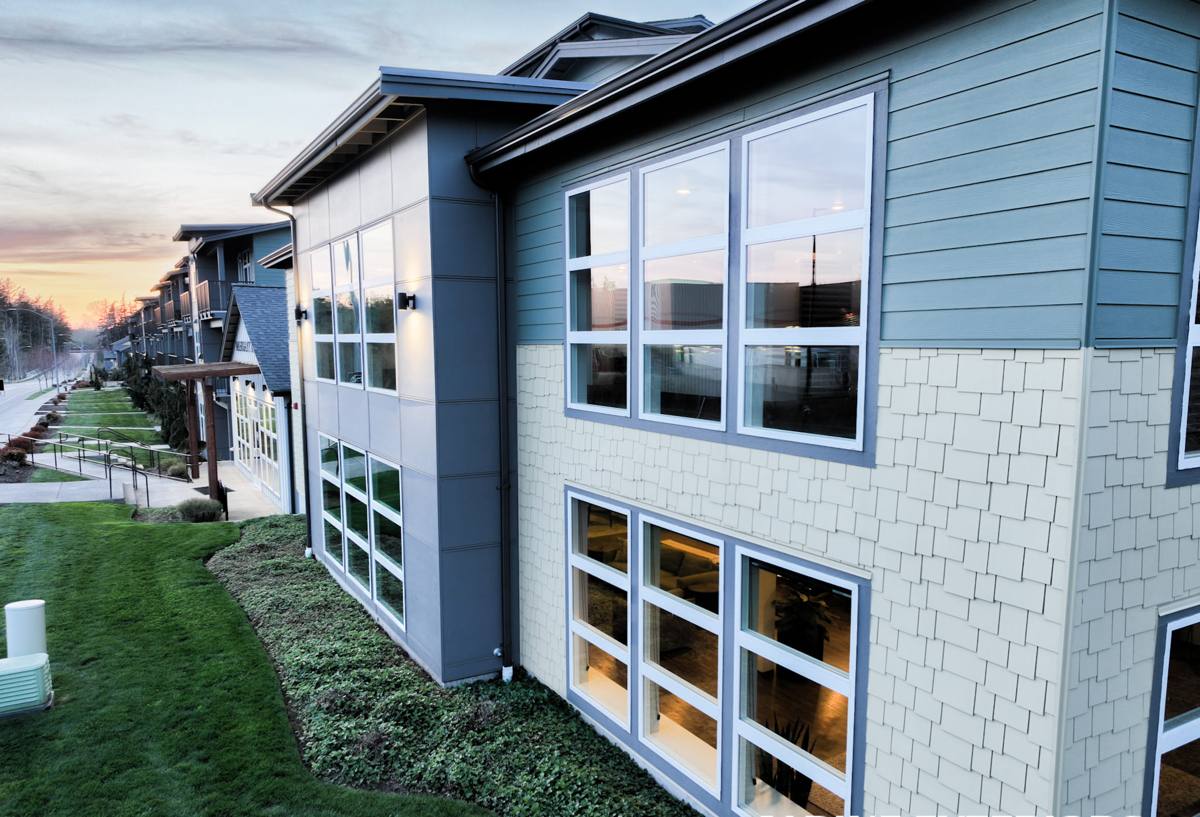
Why Fiber Cement Is the Right Material for This Location
Fiber cement siding is made from cement, sand, and cellulose fibers pressed into planks or panels, then cured. That composition gives it three properties that matter directly for a home near the channel:
- It doesn't rot. Wood and wood-composite siding products absorb moisture over repeated wet-dry cycles; fiber cement doesn't feed fungal growth the way organic wood fiber does when it's kept damp.
- It holds paint and factory finish far longer in a marine environment. Salt air breaks down cheaper coatings faster than inland conditions do, so finish quality is not a cosmetic detail here — it's a durability decision.
- It's dimensionally stable. It doesn't swell and shrink with every rain event the way wood does, which matters when driving rain off the water hits a wall dozens of times a season.
We install James Hardie fiber cement exclusively, not because it's the only fiber cement product on the market, but because of how it's engineered and finished. Hardie's ColorPlus factory finish is baked on under controlled conditions and backed by a real finish warranty — a meaningfully different proposition than field-painted siding that has to be recoated on a homeowner's schedule and a painter's skill level. Hardie also builds separate product lines engineered for different climate zones; homes on this side of the Cascades generally fall into their moderate/marine climate engineering, which is a different formulation than what's built for regions with hard freeze-thaw cycles. That kind of climate-specific engineering is part of why we don't mix and match brands — it's easier to guarantee correct performance when we know exactly what we're installing and how it's rated for this environment.
What a Correct Installation Actually Involves Here
Fiber cement siding fails early almost exclusively because of installation mistakes, not the material itself. In a location like La Conner, where wind-driven rain and salt exposure are constant background stress, the margin for a sloppy install is smaller than it would be somewhere drier and more sheltered.
Moisture Management and Flashing
Siding is the last line of defense, not the only one. Correct installation means a weather-resistive barrier behind the siding, proper flashing at every window, door, and roofline penetration, and rainscreen or drainage gap detailing where the wall assembly calls for it. On a home exposed to driving rain off the channel, water will find any flashing shortcut within a few storm seasons — and once it's behind the siding instead of running off it, the fiber cement itself is fine but the sheathing and framing behind it aren't.
Fastening and Clearances
Hardie specifies fastener type, spacing, and penetration depth, and those specs exist for a reason — under-driven or over-driven nails, wrong fastener material, or fastening into the wrong substrate all show up later as cracking, popped boards, or streaking corrosion stains running down the face of the siding. Ground clearance and roof-to-wall clearances also matter more here than inland: siding installed too close to grade or a roofline stays damp longer and invites moss and mildew growth right at the joint.
Joints, Caulking, and Cut Edges
Every field-cut edge on fiber cement siding needs to be sealed and primed before it's exposed to weather — a factory-finished face means nothing if the cut end soaks up water. Butt joints, corners, and trim transitions are where a rushed crew leaves gaps that look fine at handoff and open up within a year or two of channel weather working on them.
Matching the Look to La Conner's Older and Waterfront Homes
La Conner has a lot of housing character that doesn't match a typical suburban subdivision — a historic waterfront core, older wood-sided homes, and a mix of longtime residences and vacation properties along the water. Fiber cement gives us the range to respect that without compromising on performance:
- HardiePlank lap siding replicates traditional wood lap profiles closely enough that it reads correctly next to neighboring older homes, which matters in a town where architectural character is part of the appeal.
- HardieShingle panels give the look of individual cedar shingles for homes where that's the right style, without the maintenance burden of real cedar shingles in a damp, shaded lot.
- HardieTrim boards match window and corner trim to the same durability standard as the field siding, so you're not left with a mismatched weak point where wood trim meets fiber cement panels.
The goal on an older or architecturally distinct home isn't to make it look like a new build — it's to keep the character homeowners bought the house for while replacing the parts of the wall assembly that are actually failing.
How We Approach a La Conner Siding Project
- On-site assessment. We look at the existing siding and sheathing condition, note where moisture has already gotten in, and check specific problem areas — north-facing walls, spots shaded by trees or neighboring structures, and any area facing the channel directly.
- Product and color selection. We walk through Hardie's plank profiles, textures, and ColorPlus color options against the home's existing trim, roofline, and neighborhood context.
- Tear-off and substrate check. Old siding comes off, and we inspect the sheathing underneath before anything new goes on. Hidden rot or water damage gets addressed before we cover it back up — not patched over.
- Weather barrier and flashing installation. This is the step that determines how the wall performs for the next 30-plus years, and it happens before a single piece of visible siding goes up.
- Siding installation to manufacturer spec. Correct fastener schedule, clearances, joint treatment, and trim detailing throughout — not shortcuts that only show up as problems after the crew is gone.
- Final walkthrough. We go over the finished job with the homeowner and flag any maintenance items specific to the site — shaded areas, gutter overflow points, or anything else worth keeping an eye on.
How Fiber Cement Compares to Other Siding in a Marine Climate
Homeowners considering a siding replacement in La Conner usually have a few materials on their shortlist. Here's how they hold up specifically against salt air, driving rain, and a long moss season — the conditions that actually determine how a wall performs here, not just how it looks on install day.
| Material | Salt Air / Corrosion Resistance | Moisture & Rot Resistance | Moss / Mildew Resistance | Typical Maintenance |
|---|---|---|---|---|
| James Hardie Fiber Cement | Strong — non-metallic face, factory finish holds up well | Excellent — non-organic, doesn't rot | Good with normal upkeep | Occasional wash, no repainting cycle with ColorPlus |
| Vinyl Siding | Fair — can chalk and become brittle over time | Good on its own, but poor at sealing seams against wind-driven rain | Fair — moss and grime cling to textured surfaces | Low, but panels can warp and are hard to color-match if damaged |
| Cedar / Wood Siding | Poor to fair — fasteners and finish both degrade faster near salt air | Poor without diligent upkeep — prone to rot in shaded, damp spots | Poor — organic material feeds moss and mildew directly | High — regular refinishing, caulking, and spot repairs |
| Engineered Wood (e.g. LP SmartSide) | Fair — coating quality is doing most of the work | Fair — better than solid wood but still an organic substrate | Fair — depends heavily on correct installation and drainage detailing | Moderate — finish and edge sealing need monitoring over time |
Maintenance in a Salt Air, Moss-Prone Environment
Fiber cement is low-maintenance, not no-maintenance. A short annual routine keeps it performing the way it's supposed to for decades:
- Rinse the siding down once or twice a year with a garden hose, focusing on shaded, north-facing, and channel-facing walls where moss and grime build up fastest.
- Keep gutters clear and check that downspouts discharge away from the foundation — overflow running down a wall is one of the most common causes of localized staining and moss growth.
- Trim back vegetation and tree limbs that keep any section of wall shaded and damp longer than the rest of the house.
- Check caulking at trim joints, window returns, and corners every year or two, and recaulk before a gap turns into a water path.
- Walk the exterior after major windstorms to check for any siding that's come loose or trim that's pulled away, especially after weather blowing straight off the water.
Why Hiring a Crew That Already Works in La Conner Matters
Siding installation is a local trade in a way people don't always appreciate until something goes wrong. A crew that already works around the channel and the surrounding Skagit County waterfront knows which walls take the worst weather exposure, how to sequence a job around tide and wind patterns that affect scheduling and site access, and what the older housing stock in this area tends to need underneath the surface. That's knowledge that doesn't transfer from a crew whose experience is mostly inland or in a different climate zone entirely.
It also matters for accountability. A contractor based out of Anacortes and working this immediate area regularly is easy to reach if a question comes up two years after the job — not a name from a one-time job that's hard to track down. When you're vetting anyone for siding work in a town like La Conner, ask directly about their experience with waterfront and marine-exposure installations, not just siding in general.
Get a Straight Answer for Your Home
Every home along the channel carries different exposure, shading, and existing wall condition, so the right approach isn't the same from one property to the next. If you're weighing a siding replacement in La Conner, we're happy to take a look and walk you through what your specific home needs — no pressure, no obligation. Use the form below to request a free estimate.