 Anacortes
 Bow Sits Right Where Skagit County's Weather Gets Tested
Bow doesn't get talked about as much as Anacortes or Mount Vernon, but anyone who lives out there knows the exterior of a house takes a beating in a way that inland Skagit County doesn't quite match. You're close enough to Samish Bay and the Sound that salt-laden air is a constant, you catch driving rain off the water with very little to break it, and the shaded, damp stretches of the year turn siding, trim, and fences green faster than most homeowners expect. That combination — salt, rain, and moss — is exactly the kind of environment that separates siding that holds up for thirty years from siding that starts failing at year ten.
Wood-based products absorb that moisture and swell, crack, or rot from the inside out. Vinyl handles moisture fine but does nothing to stop moss and mildew from taking hold in its seams, and it can warp when a sunny afternoon follows a cold, wet morning. Fiber cement, installed correctly, is built for exactly this kind of climate. It doesn't feed mold, it doesn't absorb water the way wood does, and it holds paint and factory finish far longer under salt exposure. That's why it's the only siding material we install on Bow homes.
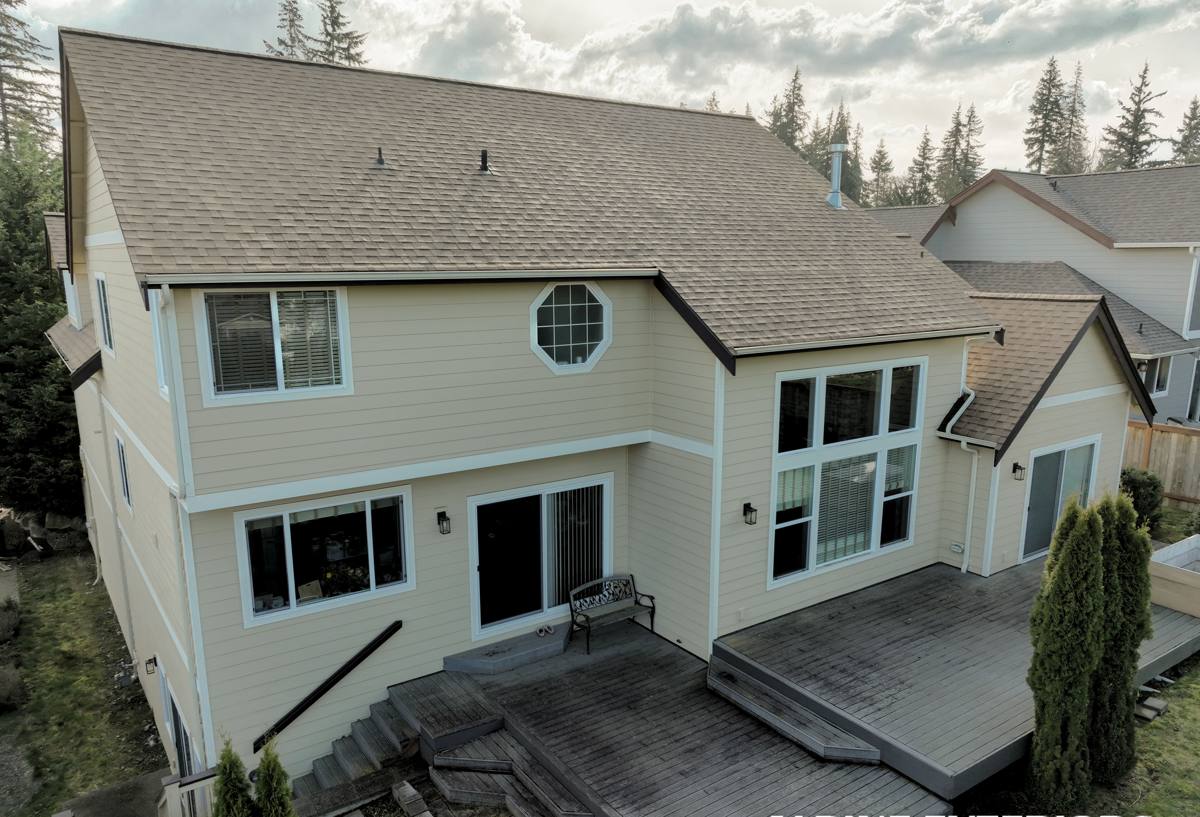
Why Fiber Cement Specifically Makes Sense Here
Fiber cement is a mix of cement, sand, and cellulose fiber, pressed and cured into planks or panels. It's heavy, dense, and dimensionally stable — meaning it doesn't expand and contract with humidity swings the way wood and some engineered products do. For a Bow property sitting near open water and exposed to wind-driven rain much of the year, that stability matters more than it does on a sheltered inland lot.
- Non-combustible core — doesn't contribute fuel to a wildfire or structure fire, unlike wood-based siding
- Resists moisture absorption — won't swell, cup, or rot the way primed wood or spruce siding can after repeated wet-dry cycles
- Holds a factory finish — a baked-on finish stands up to salt air far longer than field-applied paint
- Doesn't feed organic growth — the surface itself isn't a food source for moss and mildew, which matters through Skagit County's long wet season
- Handles wind-driven rain — when installed with correct flashing and laps, it sheds water instead of wicking it into the wall assembly
Why We Install Only James Hardie
Fiber cement is a category, not a single product, and the brand behind it matters more than most homeowners realize going in. We standardized on James Hardie specifically because their HZ5 product line is engineered for regions with exactly this kind of moisture and humidity exposure — the formulation is built to resist moisture-related damage in wetter climates, which describes Bow about as well as anywhere in the county. Hardie also backs its ColorPlus factory finish with a real, transferable warranty, which matters on a coastal property where finish failure from salt exposure is a legitimate risk with lesser products.
We don't install LP SmartSide, Cemplank, Allura, primed spruce, or cedar. Each of those has a place in the market, but none of them gives us the combination of moisture engineering, finish durability, and warranty backing we're willing to put our name behind on a home exposed to salt air and driving rain. If you're weighing options, we're happy to talk through the honest trade-offs of each — but what goes on the wall when we do the work is Hardie, installed to spec.
Picking the Right HZ Product and Color
Hardie makes climate-specific formulations under the HZ5 designation for wetter, more humid regions like ours. For Bow specifically, we typically steer homeowners toward:
- HardiePlank lap siding — the most common choice, available in several exposure widths and textures, for the bulk of the wall field
- HardiePanel or HardieShingle accents — for gable ends, dormers, or accent walls where a different texture helps a home stand out
- HardieTrim — matched trim boards around windows, corners, and fascia so the whole exterior is one integrated, moisture-resistant system rather than fiber cement siding paired with wood trim that will fail first
ColorPlus finishes matter more here than in a dry inland climate — a factory-baked finish resists the fading and chalking that salt air accelerates on field-painted surfaces. Darker colors show dust and pollen streaking a bit faster near the water, which is worth discussing before you commit to a shade.
What a Correct Installation Actually Involves
Fiber cement is only as good as the installation behind it. Most of the siding failures we get called out to inspect aren't material failures at all — they're installation shortcuts that let water get behind the cladding, where it does slow, hidden damage for years before anyone notices. On a Bow home taking on driving rain, these details aren't optional:
- A drainage plane (weather-resistive barrier) installed continuously behind the siding, not patched around penetrations
- Correct starter strip at the base of the wall so the first course sits at the manufacturer-specified angle and drainage gap
- Z-flashing over every horizontal trim board and window head so water is directed out, not into the wall assembly
- Proper nailing pattern and fastener depth — overdriven or underdriven nails are one of the most common causes of premature plank failure
- Correct minimum gaps at butt joints, corners, and any panel-to-trim transition, sealed with a paint-grade sealant rated for the exposure
- Field-cut edges primed or sealed before installation, since raw cut edges are the most vulnerable point on any fiber cement board
- Clearance maintained between the bottom of the siding and grade, decks, or roof lines to keep splashback and standing water off the material
Skip any one of these on a sheltered inland lot and you might get away with it for a while. Skip them on a property catching salt spray and wind-driven rain off Samish Bay, and the consequences show up faster — moisture intrusion, trim rot, and finish failure well ahead of the warranty period.
Our Process on a Bow Job
- On-site assessment — we walk the exterior, check the current siding and trim for moisture damage, and look at wind and rain exposure specific to the lot's orientation
- Written estimate — product line, color, trim package, and scope laid out plainly, with the reasoning behind each recommendation
- Prep and tear-off — removal of existing siding down to sheathing, inspection for hidden rot or moisture damage before anything new goes up
- Weather-resistive barrier and flashing — the part of the job that never shows once siding is on, but determines whether the wall stays dry for the next thirty years
- Installation to manufacturer spec — correct fastening, gaps, and flashing detail at every window, door, and penetration
- Final walkthrough — we go over the finished work with you before calling the job done
Cost Factors on a Bow Project
Every home is different, but the same handful of factors drive most of the cost variation we see on siding jobs in this area:
| Factor | Why It Matters in Bow |
|---|---|
| Existing wall condition | Hidden moisture damage from prior siding failures adds sheathing repair before new siding goes on |
| Home size and wall complexity | More corners, dormers, and gables mean more flashing detail and cut waste |
| Product line and texture | HardiePlank lap versus panel-and-shingle accent combinations price differently |
| Trim scope | Full HardieTrim replacement costs more up front but removes the weak point of mismatched wood trim |
| Site access | Rural Bow lots, long driveways, or limited staging area can affect labor time |
| Color selection | Standard ColorPlus colors are typically more economical than custom-matched finishes |
Living With Fiber Cement Siding in Bow's Climate
One advantage homeowners notice quickly is how little maintenance correctly installed fiber cement asks for compared to wood. It won't need repainting on the same cycle wood does, and it isn't a food source for the moss and algae that spread across so many exterior surfaces in this part of Skagit County during the wet months. That said, no siding is maintenance-free in a coastal environment:
- Rinse the exterior once or twice a year to clear salt residue, pollen, and organic buildup, especially on north-facing walls that stay shaded and damp longer
- Keep gutters clear so overflow doesn't run down the face of the siding and encourage moss growth at the top courses
- Trim back vegetation that keeps a wall section shaded and damp — moss takes hold fastest where sunlight and airflow are limited
- Have caulking at trim joints and penetrations checked every few years and refreshed if it's cracking or pulling away
- Address any impact damage or cracked boards promptly — an unsealed crack is a direct path for moisture into the wall
Why It Matters That We Already Work Bow
A crew that mainly works drier, more sheltered parts of Skagit County can install fiber cement perfectly well and still get the details wrong for a property like yours — under-flashing a window that only leaks under wind-driven rain, or specifying a standard color that shows salt haze faster than expected. Working this area regularly means we already know how the wind comes off the water, how long moss season really runs here, and which details on a house need extra attention because of it. That's the difference between siding that looks right at installation and siding that's still performing the way it should after a decade of Bow winters.
If you're considering new siding for a home in Bow, we'll come take a look, walk you through what your specific exposure calls for, and give you a straightforward estimate — no pressure, no upsell on products we don't stand behind. Use the form below to get started.