 Anacortes
 Building New on Guemes Island: What the Climate Actually Asks of Your Windows
Guemes Island sits out in the salt water of Guemes Channel and Rosario Strait, and that location shapes everything about how a new home should be built there. Salt-laden air works on window hardware, fasteners, and finishes faster than it does a few miles inland in Anacortes proper. Wind-driven rain off the water finds every gap in a building envelope that isn't sealed correctly the first time. And the long stretch of wet, low-sun months that brings moss to roofs and north-facing siding across Skagit County does the same thing to window sills, trim, and any spot where water can sit instead of shed.
None of that is exotic — it's just Pacific Northwest island weather. But it means a new-construction window package on Guemes Island isn't the same job as the same window line installed on a sheltered lot on the mainland. Material choice, flashing sequence, and even the order of trades on site all shift a little to account for it. Getting that right during framing, before siding and trim close everything up, is a lot cheaper than fixing it after move-in.
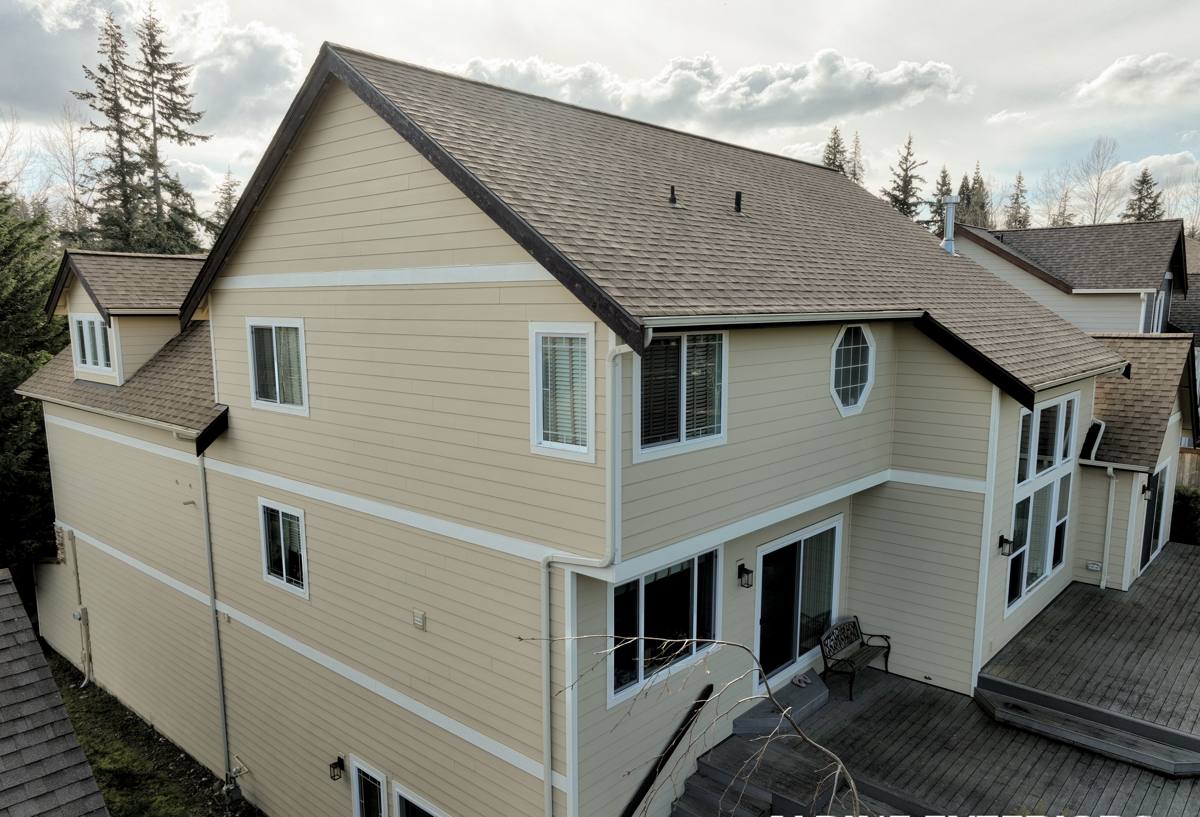
New Construction vs. Replacement: Why the Install Sequence Matters More Here
New-construction window work is a different job than replacing a window in a finished wall. There's no old siding or interior trim to protect or work around, and the rough openings, weather-resistive barrier (WRB), and framing are all exposed and accessible at the same time. That's an advantage — it means the flashing sequence can be built correctly in layers, from the sill pan out, rather than patched in around what's already there.
On an island job, that advantage matters even more. A callback for a leak discovered after drywall and siding are finished doesn't just cost labor and material — it costs ferry crossings, scheduling around sailing times, and coordination with a general contractor whose other trades are waiting on the building to be closed in. Doing the flashing and window-setting sequence correctly the first time isn't just good practice anywhere; on Guemes Island it's the difference between one clean pass and a much more expensive second trip.
What "Correct" Actually Means
For a new-construction install, correct means the water management plane is continuous: WRB laps over sill flashing, sill flashing laps over any sub-sill, jamb flashing laps over the sill flashing, and head flashing laps over the jamb flashing and over the WRB above the window. Every layer sheds water down and out, never letting it get behind the one below. It sounds simple written out like that. Getting every lap right, on every opening, on a home exposed to driving rain off open water, is where careful work pays for itself for decades.
Choosing Window Materials for a Marine, High-Moisture Climate
Frame material is one of the first decisions on a new build, and it matters more on Guemes Island than it would on a sheltered inland lot. Salt air accelerates corrosion on any exposed metal hardware, cladding, or fasteners, and constant moisture exposure punishes any material that depends on a perfect, unbroken finish to stay protected. We steer new-construction clients toward materials that hold up with reasonable, not constant, maintenance.
| Frame Material | Salt Air / Corrosion Behavior | Maintenance | Where It Fits |
|---|---|---|---|
| Vinyl | Won't corrode; UV and salt exposure can affect finish over many years | Low — occasional rinse | Budget-conscious new builds, secondary structures |
| Fiberglass | Very stable in marine air; minimal expansion/contraction | Low | Full-time or high-exposure waterfront homes |
| Wood, unclad | Attractive but needs a sound paint/finish system to resist moisture and salt | High — repainting/refinishing on a schedule | Interiors, or exteriors only with a real maintenance plan |
| Aluminum-clad wood | Good if the cladding and finish are rated for marine use; raw or thin aluminum finishes corrode faster near salt water | Moderate | Design-driven projects where clad look is wanted and finish quality is confirmed |
There's no single "right" answer for every home — budget, design, and how close the lot sits to open water all factor in. What we won't do is install a product on a Guemes Island exterior without being upfront about how it will hold up in salt air over time. That's a maintenance and moisture conversation, not a brand argument, and it's one we have with every new-construction client before windows are ordered.
The Install Sequence: What a Correct New-Construction Window Job Looks Like
Once framing is up and the WRB is on, here's the sequence we follow on a new build:
- Verify each rough opening is square, plumb, and sized correctly to the manufacturer's specs — catching a framing error here is far cheaper than after the window arrives.
- Install a sloped sill pan flashing so any water that gets past the window drains back out, not into the wall.
- Lap the WRB over the sill pan flashing and tape the sill and jamb corners.
- Apply self-adhering jamb flashing over the WRB at both sides of the opening.
- Set the window plumb, level, and square, shimming at the manufacturer's specified points — not just wherever a shim happens to fit.
- Fasten per the manufacturer's installation instructions, which vary by frame material and window weight.
- Install head flashing with a drip edge, lapped under the WRB above the opening so water is directed out and down, over the window rather than behind it.
- Insulate the shim gap with a low-expansion foam rated for window installation — too much pressure can bow a frame out of square.
- Seal the exterior trim with backer rod and a quality sealant rated for the siding material and sun exposure.
- Complete interior sill and trim work, and do a final operation check on every unit before the crew leaves.
Skip a step, or rush the flashing laps because rain is rolling in off the water, and the mistake gets buried under siding for years before it shows up as a stain or soft spot on a wall.
Ferry Logistics and Scheduling: The Guemes Island Factor
Guemes Island is reached by a small car ferry running on a set schedule, and that shapes how a new-construction window job actually gets built, separate from the technical side entirely. There's no lumberyard or big-box store on the island, so windows, flashing tape, sealant, and trim all have to be staged and hauled over ahead of time — a forgotten box of flashing tape isn't a quick run to the store, it's a missed sailing and a lost half-day.
We plan material deliveries around the ferry schedule, not the other way around, and we build in a buffer for standby lines during busy summer sailings. Flashing and sealant work also needs a dry window to do properly, so we watch the forecast closely and sequence window installation for stretches of decent weather rather than fighting driving rain to hit an arbitrary date. A crew that's used to this rhythm plans around it from the start instead of discovering it mid-project.
Permits and Energy Code in Skagit County
Guemes Island is unincorporated, so new construction there is permitted through Skagit County rather than the City of Anacortes. Window specifications on a new build need to meet the Washington State Energy Code's requirements for U-factor and, in some cases, solar heat gain — and any window serving as an egress opening for a bedroom has minimum size and sill-height requirements that have to be met exactly, not approximately.
None of this is unusual for new construction anywhere in the state, but a crew that already knows Skagit County's inspection process and the county's typical documentation requests avoids delays that are much more painful on an island build. A failed inspection that needs a re-check means another sailing, another coordination call with the GC, and another day added to the schedule.
A New-Construction Window Checklist
Whether you're a homeowner working with a general contractor or coordinating the build yourself, these are the items worth confirming before your windows go in:
- Rough openings are checked square, plumb, and correctly sized before windows arrive on site
- Sill pan flashing is sloped to drain water to the exterior, not into the wall cavity
- WRB and flashing layers are lapped in the correct order — sill, then jambs, then head
- Window frame material is matched to the home's exposure to wind, rain, and salt air
- Fasteners and hardware are appropriate for a marine environment
- Head flashing includes a drip edge and laps under the WRB above the window
- Shim gaps are insulated with a low-expansion, window-rated foam
- Exterior sealant is rated for the siding material and sun/weather exposure
- Egress-required windows meet Skagit County's minimum size and sill-height rules
- Every window is operated and checked before the crew leaves the site
Why a Crew That Already Works Guemes Island Matters
A lot of what makes a Guemes Island new-construction window job go smoothly has nothing to do with the windows themselves. It's knowing the ferry schedule well enough to plan a delivery instead of guessing at it. It's having worked alongside island general contractors before, so scheduling a window crew into a framing timeline doesn't require explaining the basics from scratch. It's having actually seen how salt air and a wet Skagit County winter treat different frame materials and finishes over years, not just in a manufacturer's brochure.
An Anacortes-based crew that regularly works Guemes Island builds that familiarity in as a matter of course. It shows up as fewer wasted trips, fewer surprises during inspection, and a window install that's built to hold up against the specific conditions of an island home rather than a generic install applied the same way everywhere.
If you're building new on Guemes Island and want a straight answer on window materials, flashing details, or how we'd sequence your install around the ferry and your GC's schedule, we're happy to talk it through. Use the form below to request a free, no-pressure estimate.