 Anacortes
 Decking Built for What Bow's Weather Actually Does
Bow sits in a stretch of Skagit County where damp air off Samish Bay, heavy tree cover, and a long run of gray, wet months between fall and spring put real stress on anything installed outdoors. A deck here doesn't just get rained on — it often sits under fir, cedar, or maple canopy that keeps dripping long after a storm has passed, and it can pick up a fine salt haze on windy days blowing in off the water. That combination is exactly what wears out a poorly chosen or poorly built deck years before it should fail.
Composite decking, installed correctly, is one of the more sensible answers to that climate. But "composite decking" covers a wide range of products and a wide range of installation quality, and what holds up fine on a sunny, open inland lot doesn't always perform the same way on a shaded, moisture-heavy property outside Anacortes. This page is about what actually matters when you're putting composite decking on a home in and around Bow specifically.
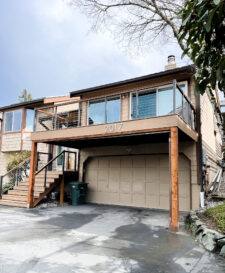
What Bow's Climate Does to an Outdoor Deck
Salt Air
Properties closer to Samish Bay and the surrounding water get steady, low-level exposure to salt-laden air. It's not the harsh, direct spray of an open coastline, but over years it accelerates corrosion on exposed metal fasteners, railing hardware, and hinges, and it can dull or chalk finishes that weren't rated for coastal-adjacent exposure.
Driving Rain
Rain in this part of Washington doesn't always fall straight down — wind off the water pushes it sideways into railings, fascia boards, and the gap between the decking and the house. Wood absorbs and releases that moisture over and over, season after season, which is where cupping, splitting, and loosening fasteners come from. Composite doesn't absorb water the way wood does, but a poor installation can still trap it where it does the most damage.
Moss and Extended Shade
Many lots around Bow carry heavy tree cover, which means decks that stay damp well after the sun is out everywhere else. That's ideal growing conditions for moss and algae, which make a walking surface slick and, on untreated wood, work into the grain and hold moisture against the board. Composite resists that kind of growth far better than wood, but it isn't immune, and surface texture and drainage still matter.
What a Deck Actually Needs to Hold Up Here
Given all of that, a composite deck built for a Bow property needs a few specific things, not just "composite boards instead of wood":
- A fully capped board so the core is sealed from moisture on all sides, not just the top surface
- A textured, slip-resistant surface that stays safer underfoot when it's damp or shaded most of the day
- Corrosion-resistant fasteners and hardware, given the steady salt exposure closer to the water
- Proper airflow underneath the deck so trapped moisture has somewhere to go instead of sitting against the framing
- A layout and drainage plan that accounts for how much rain this area actually sees, not a dry-climate assumption
Composite, Wood, and PVC in This Climate
Every decking material has real trade-offs. None of them are "bad" products — the right choice depends on what you're willing to maintain and what your site conditions demand. Here's how the three most common options generally compare for a shaded, damp, salt-adjacent property like the ones around Bow.
| Factor | Wood | Composite | PVC |
|---|---|---|---|
| Moisture absorption | Absorbs and swells; needs sealing on a strict schedule | Capped boards resist absorption well | Fully resists moisture absorption |
| Moss/algae resistance | Low — grain holds moisture and organic growth | Good, especially with a textured cap | Very good, smooth non-porous surface |
| Ongoing maintenance | Annual sanding, staining, or sealing | Periodic washing, no staining or sealing | Periodic washing, no staining or sealing |
| Upfront material cost | Lowest | Mid-range | Highest |
| Feel underfoot in heat | Stays relatively cool | Can run warmer in direct sun | Can run warmer in direct sun |
| Typical warranty structure | Manufacturer warranty on lumber grade only | Multi-year fade and stain warranty, product-dependent | Multi-year fade and stain warranty, product-dependent |
Given how much shade and rain this area sees, we generally steer Bow homeowners away from uncapped or budget wood decking unless they genuinely want the upkeep that wood demands. It's not that wood fails outright — it's that the maintenance burden in this climate is real and ongoing, and most homeowners underestimate it until year three or four.
What a Correct Installation Actually Involves
Substructure and Framing
The framing underneath a composite deck matters as much as the boards on top. Joist spacing needs to match the board manufacturer's specification for this climate — wider spacing than recommended is a common shortcut that leads to bounce and, over time, board deflection. Ledger board attachment to the house needs proper flashing so water is directed away from the wall assembly, not into it.
Flashing and Fasteners
Every joist should be protected with a flashing tape or butyl membrane before decking goes down, so fasteners driving into the wood don't create an open path for water to sit and rot the joist from the inside. Given the salt exposure around Bow, we use fasteners and hardware rated for coastal or wet-climate use rather than standard interior-grade hardware.
Board Layout and Drainage
Boards need consistent gapping for expansion and contraction, and the whole deck surface needs a slight pitch away from the house so water actually sheds instead of pooling. On shaded lots we also think about how close the deck sits to trees and gutters, since debris and standing moisture at the perimeter is often where problems start, regardless of what the decking itself is made of.
How We Approach a Bow Decking Project
- On-site assessment — we look at sun and shade exposure, existing framing condition if it's a tear-off, drainage patterns, and how close the site sits to salt air exposure.
- Material and layout selection — we walk through composite options and layout choices based on your specific lot, not a one-size answer.
- Permitting — decking projects that change footprint, height, or structural attachment may require Skagit County permitting; we handle that coordination as part of the job.
- Installation — framing, flashing, and board installation done to the manufacturer's specification, not shortcuts that void a warranty.
- Final walkthrough — we go over the finished deck with you, including what maintenance it actually needs and what it doesn't.
Living With a Composite Deck Here
Composite decking is far lower-maintenance than wood, but "low-maintenance" doesn't mean "no maintenance," especially under tree cover. A periodic wash — typically a soft-bristle brush and mild soap, not a pressure washer turned up too high — keeps moss and organic buildup from getting a foothold in the surface texture. Keeping nearby gutters clear and trimming back branches that hang directly over the deck also does more for its long-term appearance than almost anything else, since falling debris and standing shade are what invite moss in the first place.
Here's a practical seasonal checklist for a composite deck in this climate:
- Sweep debris (needles, leaves, moss spores) off the surface regularly, especially in fall
- Wash the deck surface a couple of times a year with a soft brush and mild soap, more often in heavily shaded areas
- Check that gaps between boards stay clear so water can drain through rather than pooling
- Inspect railing hardware and fasteners periodically for corrosion, particularly on properties closer to the water
- Trim back overhanging branches that keep sections of the deck shaded and damp
Choosing the Right Board for Your Property
Not every composite board is the right fit for every lot, and this is where a lot of homeowners get steered wrong by whatever happens to be in stock. Before settling on a product, it's worth working through:
- How much direct shade does the deck actually get, and for how much of the day?
- How close is the property to open water and steady salt air?
- Does the color and finish you want come in a fully capped version, or only a partially capped one?
- What does the manufacturer's warranty actually cover — fading, staining, structural integrity — and for how long?
- Does the surface texture you like also perform well when wet, or does it look better than it functions?
Why a Crew That Already Works Bow Matters
A lot of what makes a deck last in this area has nothing to do with the brand of board and everything to do with decisions made at the framing and flashing stage — decisions a crew makes differently once they've seen what actually fails on properties around Bow versus a drier, more open site elsewhere. That includes knowing how much airflow a shaded substructure needs, which hardware actually holds up against the salt air off Samish Bay, and how to schedule and sequence a build around a genuinely wet season instead of assuming ideal weather.
It also means knowing the practical side of working in this area — rural and wooded lot access, Skagit County permitting expectations, and realistic timelines given how much of the year here is spent working around rain rather than around it. That local familiarity shows up in the details of the finished deck more than in anything you'd notice on a spec sheet.
Get a Straightforward Estimate
If you're weighing composite decking for a home in Bow, we're glad to come take a look, talk through what your specific lot needs given its sun, shade, and exposure, and give you a clear, no-pressure estimate. There's a form below to get that started.