 Anacortes
 Cap Sante Sits in a Tougher Microclimate Than It Looks
Homes on and around Cap Sante enjoy some of the best views in Anacortes — open water, marina traffic, the comings and goings on Guemes Channel. That same exposure is exactly what makes siding decisions here more consequential than they are a few miles inland. Elevated, water-facing lots catch more wind, more salt-laden air, and more driving rain than sheltered neighborhoods, and Skagit County's long, damp shoulder seasons give moss and mildew months at a time to take hold on anything that stays wet. Siding on a Cap Sante home isn't just cladding — it's the first and most tested line of defense the house has.
We install James Hardie fiber cement siding exclusively, and this page is about what that means specifically for homes in this part of Anacortes: what the exposure actually does to a building envelope, what a correct Hardie installation has to account for here, and why a crew that already works this stretch of coastline handles it differently than a general contractor working from a spec sheet.
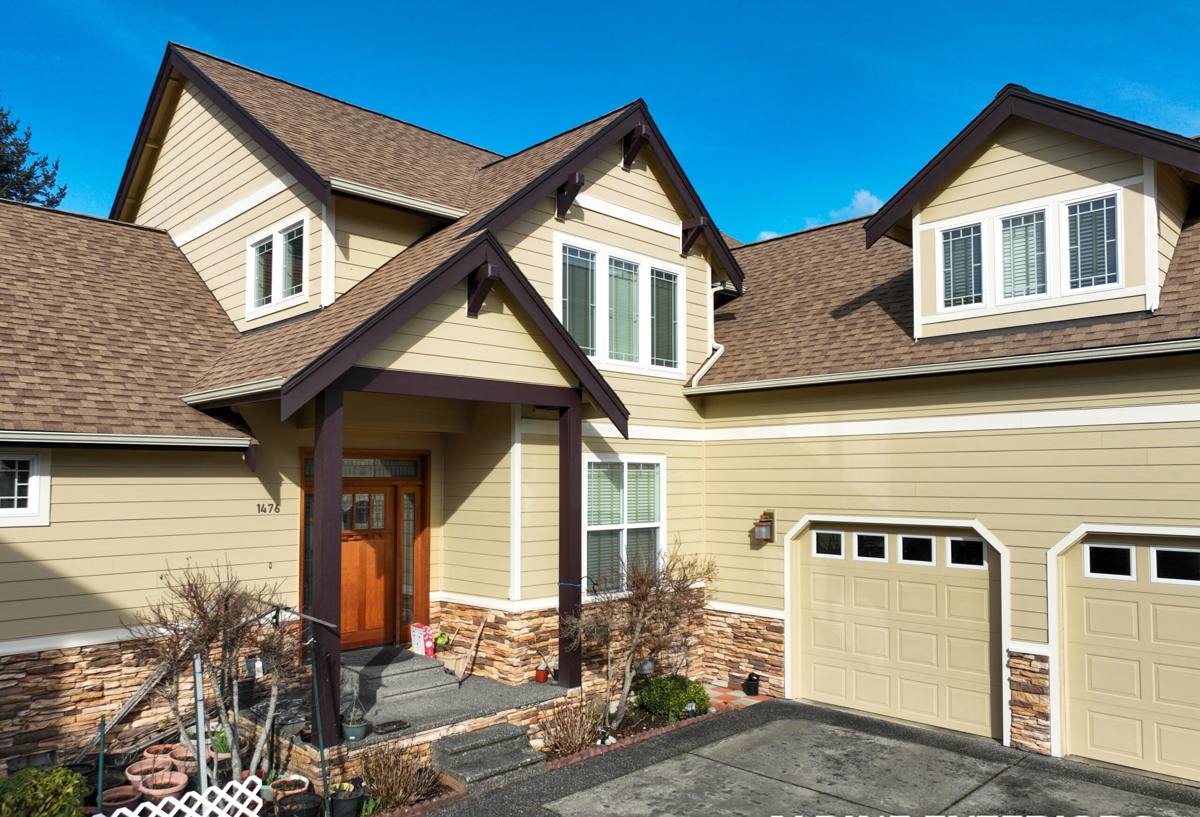
What Salt Air, Driving Rain, and Moss Season Actually Do to a House
Salt air accelerates corrosion you don't see until it's a problem
Airborne salt doesn't just dull paint. It works on fasteners, flashing, and any exposed metal trim, and it settles into microscopic surface texture on lower-quality siding materials, holding moisture against the substrate longer than a plain rain event would. Over years, that steady low-grade exposure is what separates a wall system that still looks tight at year 15 from one that's chalking, staining, and letting water find seams.
Wind-driven rain finds every gap, not just the obvious ones
Rain that comes in sideways off the water behaves differently than rain falling straight down. It gets pushed up under laps, into butt joints, and around trim that would shed water fine in a calmer setting. On exposed Cap Sante elevations, siding details that are "good enough" on a sheltered inland lot — a slightly short flashing lap, a caulk joint doing more work than it should — get tested constantly instead of occasionally.
Moss season means prolonged dampness, not just occasional wetting
Skagit County's wet season runs long, and north-facing or shaded siding surfaces can stay damp for days at a stretch. That's exactly the environment moss, algae, and mildew need to establish themselves. Once organic growth takes hold on a porous or absorbent surface, it holds even more moisture against the wall, and the cycle compounds.
Why James Hardie Is the System We Put on Homes in This Exposure
James Hardie fiber cement is engineered around exactly this kind of punishment. It's a cement-based composite, not wood or wood byproduct, so it doesn't swell, rot, or feed fungal growth the way organic siding materials can when they stay wet. It's also non-combustible, which matters everywhere but carries extra weight in a state where wildfire smoke seasons have stretched insurance and building-code conversations statewide.
Two things about the Hardie system specifically matter for a Cap Sante install:
- ColorPlus factory finish — baked-on, engineered for UV and moisture exposure, rather than field-applied paint that has to be reapplied on a maintenance cycle and is more vulnerable to salt-air breakdown at the film level.
- Climate-engineered HZ product lines — Hardie manufactures regional formulations suited to different moisture and freeze exposure. Western Washington falls under the wetter HZ5 engineering, which is what we specify here rather than a formulation built for a drier climate.
None of that replaces correct installation — it just means the material itself isn't the weak link. The weak link, on almost every siding failure we get called out to inspect, is the install.
What a Correct Installation Actually Involves Here
Fiber cement siding is unforgiving of shortcuts in a way vinyl often isn't, because it's a rigid panel system that depends on the details behind it — flashing, weather-resistive barrier, fastening, and clearances — to actually keep water out. On an exposed water-facing elevation, every one of these gets more important, not less:
- Weather-resistive barrier and flashing sequencing — every penetration, window, and horizontal transition has to be flashed and lapped in the correct shingle-style order so water is directed out, not trapped behind the cladding.
- Proper clearance at grade and hard surfaces — Hardie's own installation instructions specify minimum clearance from soil, decking, and roofing; on lots where grading has settled or hardscape has been added over the years, this is one of the most common things we find wrong on re-sides.
- Correct fastener type, pattern, and embedment — corrosion-resistant fasteners, driven flush (not overdriven), at the spacing Hardie specifies for the exposure category, not a generalized pattern.
- Joint treatment built for wind-driven rain — butt joints and trim intersections detailed and sealed for a high-exposure wall, not just caulked and left.
- Ventilation behind the cladding where the wall assembly calls for it — so any incidental moisture that does get behind the siding has somewhere to go instead of sitting against the sheathing.
Skip any one of these and you can install genuine James Hardie board and still end up with a wall that fails early — which is why the product name on the invoice matters less than who's actually driving the fasteners.
How Siding Materials Compare in This Kind of Exposure
| Material | Salt air behavior | Moss/mildew resistance | Maintenance burden | Typical lifespan here |
|---|---|---|---|---|
| James Hardie fiber cement | Non-corroding substrate; factory finish resists salt-driven fading | Non-organic, doesn't feed growth | Periodic washing, no repainting on standard cycle | 30+ years to first major service |
| Vinyl | Can chalk, warp, or become brittle with UV and temperature swings | Growth sits on surface, can trap moisture at laps | Low, but limited repair options once damaged | Variable; earlier replacement common on exposed elevations |
| Cedar / wood | Absorbs salt-laden moisture; accelerates weathering | High — organic material feeds moss and mildew directly | Regular refinishing, sealing, and moisture monitoring | Shorter without aggressive upkeep |
| LP SmartSide (engineered wood) | Wood-strand core sensitive to sustained moisture exposure | Moderate — treated, but still an organic substrate | Field-applied finish needs monitoring at cut edges and joints | Installation-sensitive; edge sealing is critical in wet climates |
This is why we don't offer vinyl, cedar, or LP SmartSide as options — not because they can't be installed correctly, but because on this kind of exposure the long-term maintenance and moisture-management burden shifts onto the homeowner in ways fiber cement doesn't require.
Our Process for a Cap Sante Home
- On-site assessment. We look at elevation-specific exposure — which walls take the most wind-driven rain, where grading or hardscape has closed up clearance, where existing moisture or moss patterns show where water's been getting in.
- Prep and removal. Old siding comes off cleanly, and we inspect sheathing underneath for hidden moisture damage before anything new goes on — a step that gets skipped on rushed jobs and causes problems later.
- Weather barrier and flashing installation. This is the part of the job that determines whether the siding performs for the next several decades, done before a single piece of Hardie board goes up.
- Hardie installation to spec. Correct fastening, clearances, and joint detailing for a high-exposure Anacortes elevation, not a generic inland pattern.
- Final walkthrough. We go over the finished job with you, including what routine maintenance to expect given your specific exposure.
Why a Crew That Already Works This Area Matters
Siding failures we're called to diagnose are rarely about the material — they're about details that didn't account for the actual site. A crew that regularly works water-facing lots in Anacortes and Skagit County already knows to check clearance at grade on properties where landscaping has crept up over the years, to flash more conservatively on elevations that take direct wind off the channel, and to expect longer damp periods when planning cure and caulk-set times during installation. Some Cap Sante properties also fall under neighborhood design or view-related guidelines — if yours does, that's worth mentioning up front so color and profile choices are squared away before material orders go in.
None of that is exotic knowledge, but it's the difference between a crew executing a checklist and a crew that's actually solving for the conditions your house sits in.
Maintaining Hardie Siding in a Salt-Air, Moss-Prone Environment
Fiber cement is low-maintenance, not no-maintenance. In this specific climate, a few habits go a long way toward protecting the investment:
- Rinse siding periodically, especially on shaded or north-facing walls where salt residue and organic growth accumulate fastest.
- Keep gutters and downspouts clear so overflow isn't running down the wall face during heavy rain events.
- Trim back vegetation and maintain a few inches of clearance where landscaping or mulch has crept up toward the bottom edge of the siding.
- Have caulked joints and trim intersections checked every few years — sealant is the one component that ages faster than the board itself.
- Address any soft spots, staining, or persistent moss patches early rather than waiting for a full inspection cycle.
Signs Your Siding Needs a Closer Look
- Moss or dark streaking that keeps coming back in the same spot after cleaning
- Visible gaps opening up at butt joints or trim corners
- Soft or spongy areas when pressed gently, especially near the bottom courses
- Paint or finish that's peeling or bubbling rather than just fading
- Interior wall staining or musty odor on an exterior wall, which can indicate moisture getting behind the cladding
If your Cap Sante home is due for new siding, or you want a second opinion on an existing installation, we're happy to take a look and give you a straightforward, no-pressure estimate — use the form below to get started.