 Anacortes
 Why Board & Batten Suits Fidalgo Island
Board and batten has a long history on the Washington coast, and it's easy to see why it keeps showing up on Fidalgo Island homes — from cottages tucked into the trees above Similk Bay to newer builds with a craftsman or modern-farmhouse look. The vertical lines read as clean and substantial without looking fussy, and the style pairs naturally with the mix of wooded lots, rocky shoreline, and marine views that define this part of Skagit County. It's a look homeowners choose on purpose, not by default.
But board and batten is also one of the more demanding siding profiles to get right, especially in a climate like ours. The vertical battens create seams and shadow lines that either shed water cleanly for forty years or become the exact place where moisture finds its way in. On Fidalgo Island, where salt air, near-constant winter rain, and a long moss season are just part of owning a house, the material and the installation both matter more than they would somewhere drier and calmer.
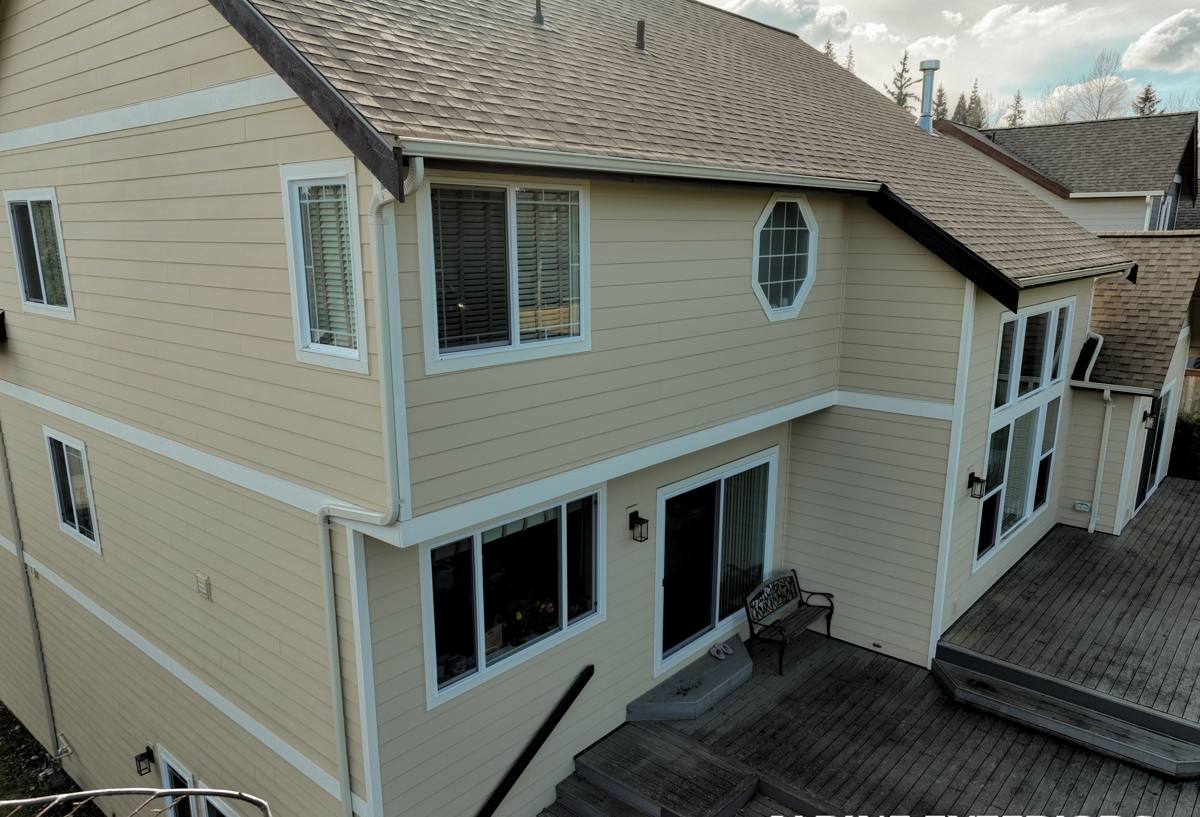
What Fidalgo Island's Climate Actually Does to This Siding
Salt Air
Being surrounded by Rosario Strait, Similk Bay, and Padilla Bay means airborne salt is a constant, low-grade stressor on anything metal or organic on the exterior of a house. Fasteners corrode faster, raw wood grays and checks faster, and any coating that isn't built for marine exposure breaks down ahead of schedule. Board and batten has more exposed fastener points and more seams than lap siding, so salt exposure has more places to work on.
Driving Rain
Storms coming off the Strait don't just fall straight down — wind-driven rain gets pushed sideways into vertical siding at a rate that flat lap siding rarely sees. Every batten joint and every panel-to-trim transition is a potential entry point if it isn't flashed, capped, and backed correctly. On board and batten specifically, a poorly detailed batten seam is one of the more common places we find hidden moisture damage on homes we're asked to look at.
Moss Season
Anacortes and the surrounding island get long stretches of shaded, damp weather, and north-facing or tree-covered elevations barely dry out between rain events for months at a time. That's exactly the environment moss and algae need. Untreated wood and some engineered wood products stay damp long enough for organic growth to take hold and start breaking down the material underneath. A siding surface that resists moisture absorption and cleans up easily matters more here than in a drier inland climate.
How Traditional Board & Batten Materials Hold Up Here
Board and batten was originally a wood siding style, and a lot of homeowners still picture solid cedar boards when they hear the term. On Fidalgo Island, though, that traditional approach runs into the same climate problems described above — just amplified by how much surface area and how many seams the style has compared to standard lap siding.
| Material | Moisture & Salt Air Behavior | Maintenance | Typical Lifespan Locally |
|---|---|---|---|
| Cedar board & batten | Absorbs moisture at seams and battens; prone to cupping, splitting, and rot in shaded, damp areas | Refinish every 3-5 years; ongoing caulk and board replacement | 15-25 years with diligent upkeep |
| Engineered wood (LP-type) | Better than raw cedar but resin-bonded edges are still vulnerable if water sits at cut ends or seams | Repaint on schedule; inspect seams and touch up edge sealant | 20-30 years with strict maintenance |
| Vinyl board & batten look | Won't rot, but flexes and gaps in wind, and salt-air UV exposure fades and chalks the surface over time | Low, but panels can crack or blow off in coastal wind and can't be spot-repaired invisibly | 15-25 years, appearance degrades sooner |
| James Hardie fiber cement | Non-combustible, dimensionally stable, engineered moisture resistance; factory finish holds up to salt air and damp shade | Occasional wash-down; no repainting on a fixed cycle | 30+ years to the product's warranty term |
This is why we standardized on James Hardie fiber cement rather than any of the alternatives above. It isn't that cedar or engineered wood are bad products in general — it's that board and batten's seam-heavy design punishes moisture-sensitive materials in exactly the kind of climate Fidalgo Island has, and we'd rather install something built to take that punishment than come back to a callback in five years.
What James Hardie Board & Batten Actually Is
James Hardie doesn't just make lap siding — their vertical siding system is built specifically to achieve the board and batten look using fiber cement panels and battens engineered to work together, rather than solid wood boards nailed up individually. The panels are cement, sand, and cellulose fiber, cured into a dense, stable board that doesn't expand and contract with humidity the way wood does. That stability is what keeps seams tight and paint lines straight over decades instead of a few seasons.
Hardie's ColorPlus finish is baked on at the factory under controlled conditions, which gives it better UV and moisture resistance than field-applied paint — a real advantage on an island where the exterior gets abused by both sun reflecting off the water and long stretches of wet shade. For homeowners who want a specific look, Hardie's product lines include both the classic board-and-batten profile and Artisan-series vertical panels for a more refined, tighter-reveal appearance.
HZ5 Engineering for Marine Climates
Hardie engineers its products in regional HZ (HardieZone) formulations, and the HZ5 line is built for climates like ours — colder, wetter, and more moisture-cycled than the Southern climate the HZ10 line is built for. That's not a marketing distinction; it affects the moisture management built into the product itself.
What a Correct Board & Batten Installation Involves
The material is only half the equation. Board and batten fails or succeeds based on details that aren't visible once the job is finished:
- Rainscreen gap: a furring strip or drainable house wrap that creates a small air gap behind the siding, so any water that does get past the surface can drain and the wall can dry out
- Weather-resistant barrier: a continuous, properly lapped barrier behind the siding, sealed at every penetration
- Batten spacing and fastening: battens fastened into structural framing, not just through sheathing, with fastener spacing that matches Hardie's engineering specs
- Corrosion-resistant fasteners: stainless steel or hot-dipped galvanized fasteners rated for coastal exposure, not standard interior-grade hardware
- Flashing at every transition: window and door heads, roof-to-wall intersections, and horizontal panel joints all flashed to shed water outward, not into the wall
- Bottom clearance: proper gap and flashing at the foundation line so splashback and standing water don't wick into the lowest boards
Skip any one of these and you can end up with siding that looks right from the street for a few years while moisture quietly works on the sheathing behind it. This is the part of the job that separates a board and batten installation that lasts thirty years from one that needs opened up in ten.
Our Process on Fidalgo Island
We start with an on-site look at the specific elevations involved — a south-facing wall in full sun behaves very differently than a shaded north wall backed up against fir trees, and the details we use often shift accordingly. We check the existing wall assembly for moisture damage before anything goes up, because covering a wet wall with new siding just hides the problem.
From there, we install the weather barrier and rainscreen, hang the Hardie panels and battens to spec, flash every penetration and transition, and finish with factory-matched ColorPlus trim and caulk where the product calls for it — not as a substitute for proper flashing. We also use corrosion-resistant fasteners as standard on every coastal Skagit County project, not as an upgrade option, because that's a place we've seen budget installations cut corners that don't show up until years later.
Why a Crew That Works Fidalgo Island Specifically Matters
Fidalgo Island isn't uniform. A waterfront lot facing open water takes different wind and salt exposure than a sheltered, tree-covered lot a half mile inland, and the right approach to flashing, fastening, and even ventilation can shift between the two. A crew that works this island regularly already knows which elevations need the most attention before they ever climb a ladder, and knows the permitting process with the City of Anacortes and Skagit County for exterior work. That local knowledge doesn't show up on a spec sheet, but it shows up in how the siding performs ten years from now.
What to Expect After Installation
Correctly installed Hardie board and batten is genuinely low-maintenance, not maintenance-free. Plan on:
- An occasional rinse-down, especially on shaded elevations prone to moss and mildew buildup
- A visual check of caulking at trim and penetrations every couple of years
- Prompt attention to any impact damage (branch strikes, debris) so a small chip doesn't become a moisture entry point
- No repainting on a fixed cycle — the ColorPlus finish is warrantied against fading and doesn't need the repaint schedule wood or engineered wood siding requires
Questions Worth Asking Before You Commit
Whoever you hire, board and batten is not the siding style to shop on price alone. Before signing anything, it's worth confirming:
- Whether a rainscreen or drainage gap is included, or if the panels will be installed direct-to-barrier
- What fastener material will be used, and whether it's rated for coastal/marine exposure
- How flashing will be handled at windows, doors, and horizontal joints
- Whether the crew has installed Hardie's vertical siding system specifically, not just lap siding
- What the manufacturer's warranty actually covers, and whether the installer is a factory-recognized contractor
If you're weighing board and batten for a home on Fidalgo Island, we're happy to take a look at your specific elevations, walk through what we'd do differently for your site's exposure, and put together a straightforward estimate — no pressure, no obligation. The form below gets you started.