 Anacortes
 West Anacortes sits close enough to the water that siding here does a different job than siding a few miles inland in Skagit County. Salt-laden air off the surrounding Salish Sea waters, wind-driven rain that hits walls sideways instead of falling straight down, and long stretches of grey, damp weather that feed moss and algae all put steady, cumulative pressure on exterior materials. Fiber cement siding, installed correctly, is built to take that pressure. Installed poorly, or built from a material that was never engineered for this kind of exposure, it becomes a maintenance headache within a few short years instead of a decades-long solution. This page is about what fiber cement siding needs to do specifically for homes in West Anacortes, what a correct installation actually involves, and how our process is built around this neighborhood's conditions rather than a generic checklist.
Why West Anacortes Is Harder on Siding Than It Looks
Anacortes sits on Fidalgo Island, and the west-facing and water-facing parts of town take the brunt of weather moving in off the water. That means more direct exposure to salt spray and moisture-carrying wind than homes tucked further inland. Add in the tree cover common to older West Anacortes lots, and you get shaded siding that stays damp longer after every rain, which is exactly the condition moss and algae need to take hold. Over a full year, a west-facing wall in this part of town can spend far more days damp than a south-facing wall on the same house. Siding material that handles a dry summer fine can still fail here if it can't shed water fast and resist organic growth through a wet Pacific Northwest fall, winter, and spring.
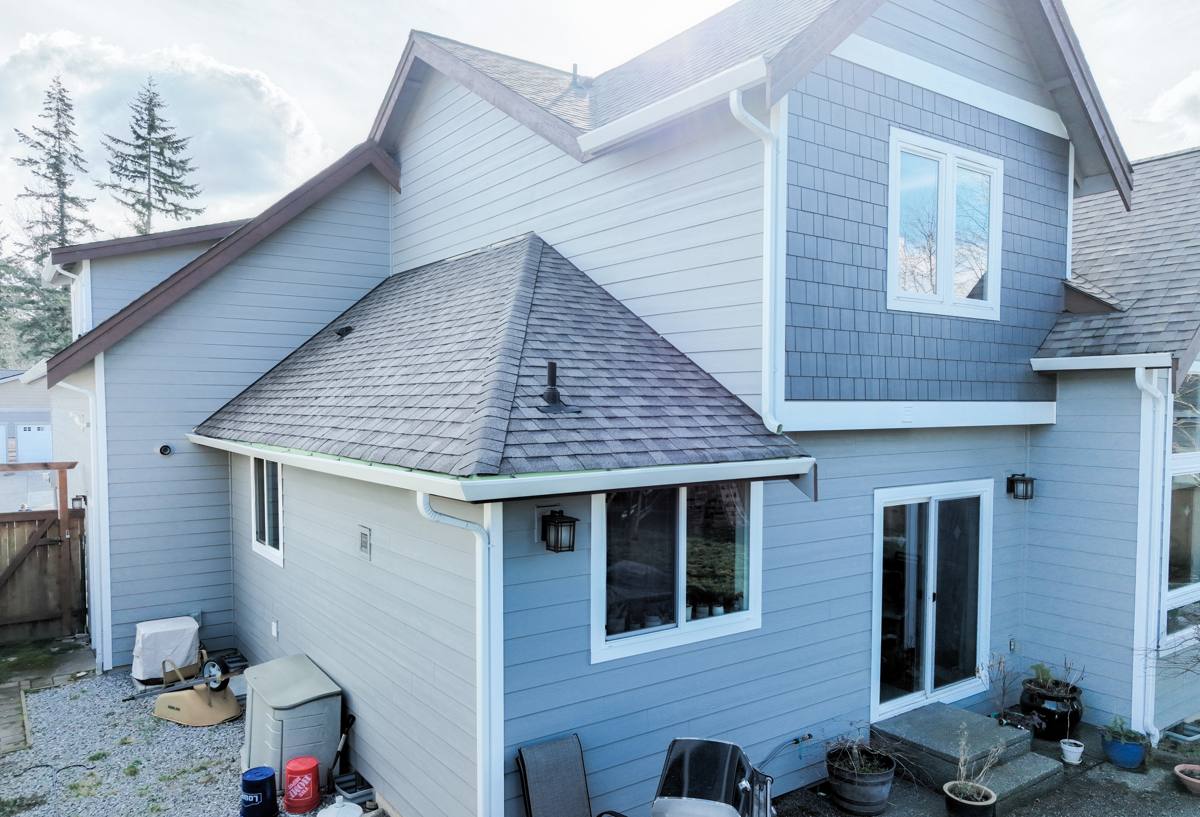
What Correct Siding Needs to Do in This Climate
Given that exposure, siding on a West Anacortes home needs to do three things well at the same time: shed wind-driven rain rather than absorb it, resist salt-air corrosion at every seam and fastener, and hold its finish through repeated wet-dry cycles without cracking, swelling, or feeding moss. Fiber cement handles all three when it's manufactured for this climate and installed with the right details — but only then. The material itself is only half the equation.
Keeping Moisture Moving Out, Not In
Wind-driven rain doesn't just land on siding, it gets pushed into laps, seams, and penetrations if those details aren't built correctly. Fiber cement is dimensionally stable and doesn't swell the way wood-based products can, but it still needs a properly lapped weather-resistant barrier behind it, correct flashing at every window, door, and roof intersection, and enough of a gap at the bottom to let any water that does get behind the cladding drain back out instead of sitting against the wall.
Standing Up to Salt Air Without Constant Repainting
Salt air accelerates corrosion on fasteners and speeds up the breakdown of ordinary field-applied paint. That's a big part of why factory-applied finishes matter here: a finish baked onto the board under controlled conditions before installation holds its color and its bond far longer under salt exposure than paint applied on site after the fact, and it doesn't rely on a painter getting perfect coverage on a breezy day.
Signs Your Current Siding Is Losing That Fight
Because West Anacortes conditions are more demanding than average, siding problems here tend to show up earlier and more visibly than they would on a drier, more sheltered lot. Worth checking for:
- Dark green or black staining that comes back within weeks of being pressure washed
- Soft or spongy spots when you press on the siding, especially near the bottom courses
- Paint that's peeling, bubbling, or chalking heavily on the west or water-facing walls
- Visible gaps opening up at seams, corners, or around trim
- Warping, cupping, or boards that no longer sit flat against the wall
- Rust streaks running down from fastener heads or trim edges
- Interior signs like musty smells or peeling paint on exterior-facing walls
Any one of these on its own might be minor. Several together, especially on a shaded or water-facing side of the house, usually means the siding system is no longer keeping moisture out the way it should.
What a Correct Fiber Cement Installation Involves
Fiber cement is a forgiving material to work with, but it's not forgiving of shortcuts in the details that actually keep water out. A correct installation for this climate includes:
- A continuous, properly lapped weather-resistant barrier installed shingle-style so water sheds downward and outward
- Correct starter strip at the base to set the first course at the right angle and gap
- Flashing integrated at every window, door, deck ledger, and roof-wall intersection — not caulk used as a substitute for flashing
- Corrosion-resistant, stainless or hot-dip galvanized fasteners driven to manufacturer spec, not overdriven
- Proper joint gaps and the specific sealants approved for fiber cement, applied only where the manufacturer calls for sealant rather than at every seam
- Factory-cut and factory-primed edges kept intact, with any field cuts back-primed or sealed before installation
- Adequate clearance between the bottom of the siding and grade, roofing, decks, and patios so splash-back doesn't sit against the material
Skip any one of these and the siding can still look fine going up — the failures show up two, five, or ten years later, usually right where the shortcut was taken.
Our Process for a West Anacortes Project
We treat every West Anacortes job as a marine-exposure job by default, not as an afterthought once we're on site. That shapes the process from the first walk-through.
- Exposure assessment — we look at which walls take the worst wind and rain, how much shade and tree cover the lot has, and where past moisture damage is most likely
- Moisture check on the existing wall — before anything comes off, we check for soft sheathing or hidden water damage so it's addressed, not covered up
- Tear-off versus overlay decision — made based on what we find, not a default assumption either way
- Product and color selection — matched to the home's exposure and the owner's preference, from the profiles and factory finishes that hold up best here
- Installation to spec — barrier, flashing, fasteners, and gaps installed the way the manufacturer requires, with extra attention on the sides of the house that take the worst weather
- Final walk-through — checking seams, caulk lines, trim, and touch-up before we consider the job done
James Hardie Product Lines and Finishes That Fit This Climate
We install James Hardie fiber cement exclusively, and for a project like this that's a deliberate choice rather than a default. James Hardie manufactures its siding in climate-specific formulations, and the HZ5 line is engineered for the wetter, harsher-winter conditions found across the Pacific Northwest — a meaningfully different product than the version sold in dry, hot regions. HardiePlank lap siding covers most wall areas and comes in several width and texture options; HardiePanel works well for vertical accents or garage walls; HardieShingle gives homes that want a shingle-style look the same fiber cement durability in a different profile. All of it is available with the ColorPlus factory-applied finish, which is baked on under controlled conditions before the boards ever reach the job site and holds its color and adhesion far longer under salt air and constant damp than field-applied paint. Hardie also backs its products with a strong, transferable product warranty, which matters more on a coastal-exposure home than on a sheltered inland one, since warranty terms are exactly what you lean on if a manufacturing defect ever shows up years down the road.
Cost Factors for Fiber Cement Siding in West Anacortes
Every project is different, but the same handful of factors drive most of the price variation we see on West Anacortes homes:
| Factor | Why It Affects Cost |
|---|---|
| Tear-off vs. overlay | Removing old siding and repairing any hidden sheathing damage adds labor but is often necessary on moisture-affected walls |
| Home size and wall complexity | More corners, dormers, and trim details mean more cuts, more flashing, and more install time |
| Siding profile chosen | Lap, panel, and shingle profiles differ in material and labor cost per square foot |
| Color and finish | Factory ColorPlus finishes cost more upfront than primed boards painted on site, but reduce repainting for years |
| Access and site conditions | Tight lots, slopes, and mature landscaping around the house can slow staging and installation |
| Existing moisture damage | Rot or soft sheathing found during tear-off needs repair before new siding goes on, which affects the final price |
Why a Local Crew Matters Here
A crew that already works West Anacortes homes knows which walls tend to take the worst weather before they ever pull a tape measure, because they've seen the pattern repeat on house after house in this specific setting. That familiarity shows up in small decisions that matter: where to add extra flashing attention even when it's not the bare minimum required, which sides of a house are worth extra fastener corrosion protection, and how much clearance to leave near grade on a lot where splash-back and standing moisture are a known issue. It also means fewer surprises with permitting through the City of Anacortes and a realistic sense of how long a project actually takes once local weather windows are factored in, rather than a schedule built around conditions somewhere drier.
Living With Fiber Cement Siding in a Marine Climate
Correctly installed fiber cement with a factory finish is genuinely low-maintenance, but low-maintenance doesn't mean zero-maintenance, especially this close to the water. A yearly rinse-down with a garden hose or low-pressure wash keeps salt residue and early moss growth from building up, particularly on shaded or water-facing walls. It's worth a quick look at caulk lines and trim joints once a year, since sealant is the one component with a shorter service life than the siding itself. Keeping gutters clear and downspouts directed away from the foundation reduces the splash-back that causes most of the staining we see at the base of walls. Because ColorPlus finishes are baked on rather than field-applied, most homeowners never need to repaint the siding itself — touch-up paint is typically reserved for small areas like cut edges or fastener heads rather than full walls.
If your West Anacortes home is showing any of the wear signs above, or you're planning ahead before the next wet season sets in, we're happy to take a look and put together a clear, no-pressure estimate. There's a form just below this article to get that conversation started.