 Anacortes
 Roofing on Cap Sante's Exposed Bluff
Cap Sante sits on high ground above the marina, with clear sightlines out toward Guemes Channel and Rosario Strait. That elevation is part of what makes the neighborhood desirable — and part of what makes its roofs work harder than roofs a mile inland. Homes up here take wind off the water more directly, catch salt-laden air with every marine breeze, and sit under a Pacific Northwest sky that keeps roofing materials wet for long stretches of the year. None of that means a roof up here is doomed to fail early. It means the repair work has to account for exposure that a generic roofing checklist doesn't.
We work Anacortes and greater Skagit County roofs regularly, and Cap Sante's mix of established homes and newer builds gives us a good read on how different roofing systems age under this specific combination of salt, wind, and rain. This page covers what that means for a roof repair here, what a correct repair actually involves, and how our process works from first call to finished job.
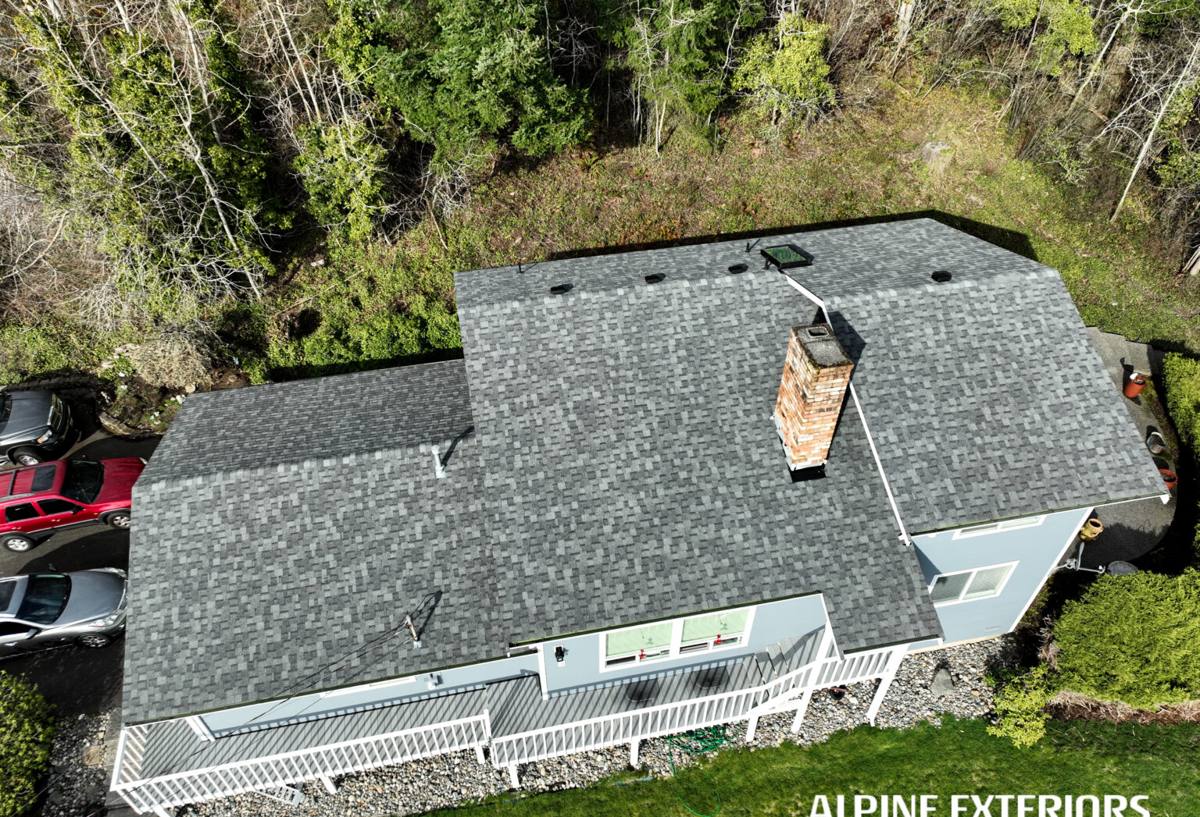
What Salt Air and Driving Rain Actually Do to a Roof
It helps to be specific about the mechanisms, because "salt air is tough on roofs" is true but vague. Here's what we actually see on Cap Sante roofs:
Corrosion at Metal Components
Nails, flashing, roof vents, gutter hardware, and any exposed fasteners are the first casualties of salt exposure. Standard galvanized fasteners can start showing rust streaks well before the shingles or panels around them show any wear. Once a fastener corrodes and loses its grip, the roofing material around it loosens, and that's an entry point for water.
Wind-Driven Rain Finding the Gaps
Anacortes doesn't get the heaviest rainfall totals in western Washington, but wind off the water turns ordinary rain into rain that hits roofs at an angle instead of falling straight down. That matters because roofing systems are designed to shed water moving downhill — not water being pushed sideways under shingle tabs, into flashing laps, or up under ridge caps. A roof that's watertight in calm rain can still leak in a Cap Sante wind event if flashing details or shingle seals are marginal.
Moss and Organic Growth
Skagit County's long wet season — realistically October through May with plenty of gray days mixed in the rest of the year — keeps roof surfaces damp for extended periods, especially on north-facing slopes and anywhere shaded by trees. Moss doesn't just look bad. It holds moisture against the roofing material, works its way under shingle edges as it grows, and can lift tabs enough to let wind-driven rain underneath.
Signs a Cap Sante Roof Needs Repair, Not Just Watching
- Rust-colored streaking below metal flashing, vents, or fasteners
- Moss concentrated on north or shaded slopes, especially if it's thickening year over year
- Granule buildup in gutters or at downspout outlets (a sign asphalt shingles are wearing)
- Curling, cupping, or lifted shingle tabs, particularly on wind-exposed faces
- Water stains on interior ceilings or in the attic near exterior walls, chimneys, or skylights
- Soft spots or slight give underfoot near valleys, chimneys, or roof-to-wall transitions
- Daylight visible through the roof deck from inside the attic
- Flashing that looks lifted, cracked at the seal, or has visible corrosion
Any one of these on its own might be minor. Two or three together, especially clustered around a chimney, skylight, or valley, usually means water has already found a path and the repair window is now rather than next season.
What a Correct Repair Actually Involves
A roof repair that holds up on an exposed, salt-influenced roof is more than patching the spot that's visibly leaking. We approach it in three parts:
1. Find the Real Source
Water travels before it shows up as a stain. A ceiling stain in one room can trace back to a flashing failure several feet away, following the roof deck or a rafter until it finds a path down. We trace the path back to the actual failure point rather than just resealing the spot where the damage became visible — patching the wrong spot means the leak just resurfaces somewhere else after the next storm.
2. Replace, Don't Just Reseal
Caulk and roofing cement have their place, but they're not a substitute for replacing failed material. If shingles are cracked, curled, or have lost their granule coating, or if flashing has corroded through, the fix is replacing that material with new shingles and, where fasteners or flashing are involved, corrosion-resistant hardware suited to a marine-exposed roof. A repair that just seals over a failing component buys a season, not a solution.
3. Address the Contributing Condition
If moss caused the failure, the repair should include moss removal and treatment — not just replacing the shingles moss lifted, which leaves the roof exposed to the same failure again. If wind-driven rain got under a marginal flashing detail, the fix is a properly lapped, properly fastened flashing installation, not a bead of sealant over the old one.
| Repair Type | Typical Cause on Cap Sante Roofs | What a Proper Fix Includes |
|---|---|---|
| Localized shingle replacement | Wind lift, granule loss, isolated storm damage | Matching shingles, corrosion-resistant fasteners, resealed tabs |
| Flashing repair | Corrosion, poor original installation, wind-driven rain intrusion | New flashing material, correct lap and fastening, compatible sealant |
| Moss-related repair | Extended damp season on shaded or north-facing slopes | Moss removal, treatment, replacement of any lifted or damaged shingles |
| Valley or penetration repair | Chimney, skylight, or vent flashing failure | Full flashing rebuild at the penetration, not a surface patch |
| Fastener corrosion repair | Standard hardware exposed to marine air over years | Replacement with corrosion-resistant fasteners in affected area |
Roofing Materials and How They Hold Up Here
Most Cap Sante homes we see are asphalt shingle roofs, with some cedar and metal roofing mixed in on older or custom-built homes. Each has a different relationship with salt air and moisture:
Asphalt Shingles
The most common material and generally a reasonable choice for this climate when installed with attention to flashing detail and fastener quality. The weak points on an exposed roof tend to be fasteners and flashing rather than the shingles themselves — which is why so many "roof leaks" here trace back to a flashing or fastener issue rather than shingle failure.
Cedar Shakes and Shingles
Cedar can look great and has a long history in this region, but it demands more upkeep in a damp climate — periodic treatment, attention to moss and moisture retention, and more frequent inspection than asphalt. We're honest with clients about that maintenance burden upfront rather than after the fact.
Metal Roofing
Quality metal roofing handles wind-driven rain well due to its continuous panel design, but the fasteners, flashing, and any cut edges need corrosion-resistant treatment specifically because of the marine air here — an inland metal roof spec isn't automatically the right spec for a Cap Sante roof.
Our Repair Process
- Assessment: We inspect the roof surface, flashing, penetrations, and — where accessible — the attic from the inside, since interior signs often tell us as much as the roof surface does.
- Honest diagnosis: We explain what's actually failing and why, in plain terms, before recommending a scope of work. If it's a minor localized repair, we say so. If it's pointing toward a larger issue, we say that too.
- Written estimate: A clear scope and price before any work starts, so there are no surprises mid-job.
- Repair work: Using materials and fasteners suited to a marine-exposed roof, not generic inland specs.
- Final check: We confirm the repair addresses the source, not just the symptom, before we consider the job done.
Why a Crew That Already Works Cap Sante Matters
A roofer who mostly works drier, inland parts of Skagit County can still do competent work, but they may not default to corrosion-resistant fasteners, may not think to check north-facing moss buildup as part of a standard inspection, or may spec flashing details built for calmer conditions than a bluff exposed to wind off the strait sees regularly. Working Anacortes roofs consistently means those considerations aren't an afterthought — they're the baseline we start from on every estimate.
We also know that Cap Sante's mix of older and newer homes means roof age, original installation quality, and prior repair history all vary house to house. There's no substitute for an in-person look at your specific roof rather than a one-size answer.
When Repair Makes Sense vs. When to Consider Replacement
Not every roof issue calls for full replacement, and we won't push you toward one if a targeted repair is the honest answer. Generally, repair makes sense when the damage is localized — a section of flashing, a cluster of shingles, one problem valley — and the rest of the roof is in reasonable condition for its age. Replacement becomes the more sensible conversation when repairs are recurring in different spots, when the roofing material is broadly at the end of its service life, or when the cost of repeated repairs starts approaching what a new roof would cost. We'll tell you plainly which situation your roof is in.
If you're seeing signs of trouble on a Cap Sante roof — or just want an honest read on its condition before the next windstorm — we're happy to take a look. Reach out for a free, no-pressure estimate using the form below.