 Anacortes
 Window Replacement in Mount Vernon: Working With Skagit County's Wet, Marine-Influenced Climate
Mount Vernon sits inland along the Skagit River, but it's still close enough to the Salish Sea and the Skagit Valley's open, low-lying farmland to catch the same marine-driven weather pattern that defines this part of Washington. Homes here deal with salt-tinged air carried in off the water, long stretches of driving rain through the fall and winter, and a moss and mildew season that can run for most of the year on shaded siding, trim, and window sills. None of that is unique to Mount Vernon on its own, but combined it adds up to a demanding environment for windows specifically, because a window opening is where the exterior wall has the most seams, the most moving hardware, and the most opportunities for water to get in if something wasn't installed correctly.
We work on siding, roofing, windows, and decks throughout Skagit County and the Anacortes area, and window replacement is one of the jobs where the installation detail matters as much as the window unit itself. A well-known window brand installed with a poorly lapped flashing job will still leak in this climate. A mid-tier window installed correctly, with the flashing properly integrated into the wall assembly, will typically outperform it over the long run.
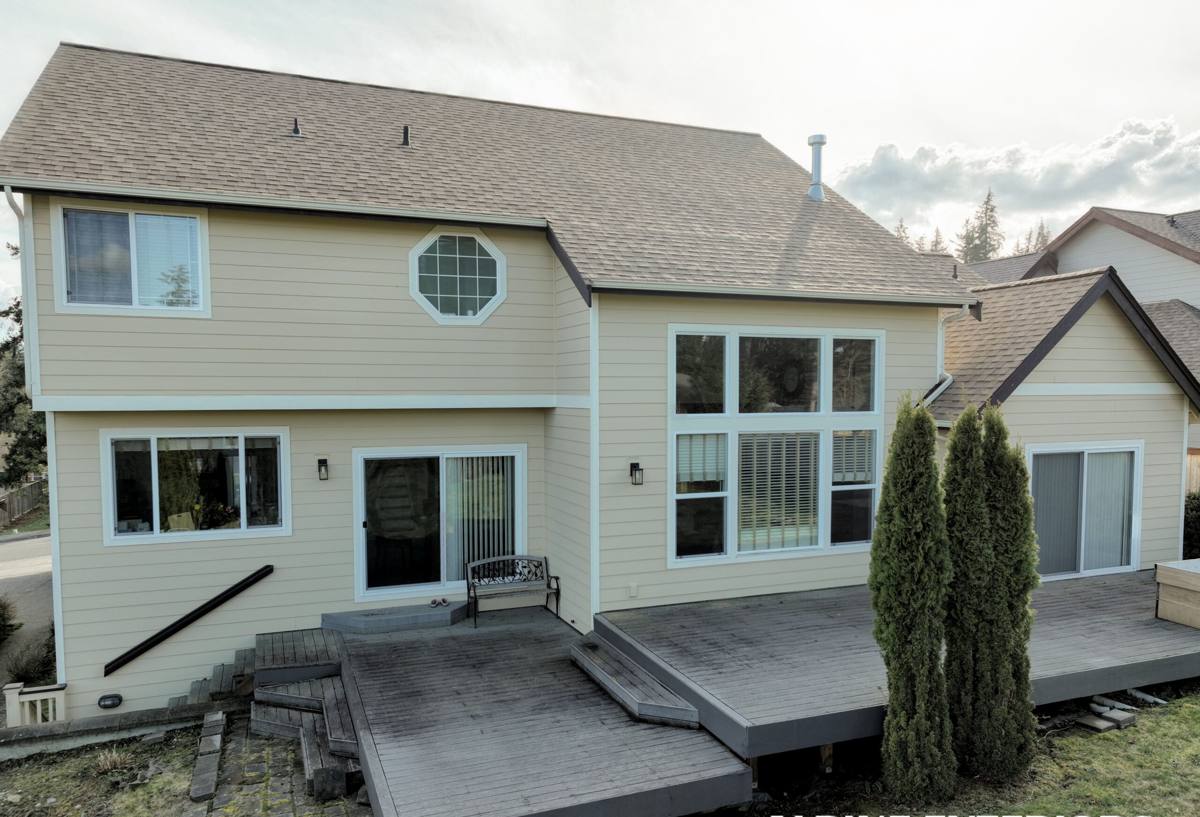
What This Climate Does to Windows Over Time
Wind-Driven Rain
The Skagit Valley's flat, open farmland doesn't offer much of a windbreak, and storms moving through push rain sideways into exterior walls rather than straight down. That matters for windows because sideways-driven rain reaches gaps and seams a calmer, more sheltered climate would rarely test. Flashing that isn't lapped correctly, or housewrap that isn't integrated with the window's nailing flange the right way, gives that wind-driven rain a path behind the siding and into the wall cavity.
Persistent Moisture and Moss
Long wet stretches keep window sills, trim, and the lower corners of frames damp for extended periods, especially on north- and west-facing walls that don't get much direct sun to dry out between storms. Moss and mildew take hold in exactly those damp, shaded spots, and once established they hold additional moisture against the wood or vinyl surface, which accelerates rot in wood-trimmed openings and can stain or degrade caulk joints faster than a drier climate would.
Condensation and Temperature Swings
Skagit County's winters aren't extreme, but the combination of cool, damp outdoor air and warm, humid indoor air is a reliable recipe for interior condensation on older or poorly performing glass. Over years, that moisture cycling can degrade seals on older insulated glass units and contribute to fogging between panes — one of the more common reasons homeowners end up replacing windows that otherwise still look fine from the outside.
Salt-Influenced Air
Mount Vernon doesn't sit directly on the water the way parts of Anacortes do, but it's close enough to the Sound and the tidal flats around the Skagit delta that homes here still see some salt-laden air, particularly during winter storms. That air is harder on exposed metal hardware — hinges, locks, and cranks — than it is in a purely inland climate, which is one more reason hardware quality and finish matter when selecting a window for this area.
Signs a Mount Vernon Home Needs Window Replacement (Not Just a Repair)
- Fogging or a persistent haze between panes of glass — the seal on the insulated glass unit has failed and can't be repaired, only replaced
- Visible rot, soft spots, or paint failure on wood window sills or trim, especially on north- or west-facing walls
- Windows that won't stay open, won't latch fully, or have become difficult to operate as frames swell or warp with seasonal moisture
- Noticeable drafts or cold spots near the window frame even when it's fully closed and locked
- Visible daylight or gaps around the frame where it meets the siding or trim
- Water staining on interior drywall or trim below or beside a window, which usually points to a flashing failure rather than a glass problem
- Single-pane or very old double-pane windows that were never upgraded and are noticeably colder to the touch than newer glass nearby
Some of these — a stuck sash, a failed weatherstrip, a cracked pane — are legitimate repairs and don't call for a full replacement. Others, especially seal failure and rot at the frame, are signs the window has reached the end of what repair can fix. Part of our first visit is being honest about which category a given window falls into instead of defaulting to a full replacement recommendation.
What Correct Window Replacement Looks Like Here
Removal Without Damaging the Opening
The old window comes out carefully, with attention to what condition the rough opening and surrounding sheathing are in. This is often the point where hidden water damage from a prior flashing failure gets found — soft sheathing, stained framing, or a housewrap that was never properly lapped. Catching that now, before the new window goes in, is far cheaper than finding it later.
Flashing Integration
This is the step that matters most in a climate like Skagit County's. Flashing tape and housewrap need to be layered correctly — each layer lapping over the one below it — so that any water that does get past the window itself drains back out rather than working its way into the wall. This detail doesn't show once the trim goes back on, which is exactly why it's worth asking a contractor directly how they handle it.
Setting, Shimming, and Sealing
The new window gets shimmed level and plumb, fastened per the manufacturer's instructions, and sealed with the appropriate sealant at the right joints — not everywhere, since over-sealing can trap moisture in places it needs to escape. Interior and exterior trim get reinstalled or replaced as needed to restore a clean, finished look.
Final Check
Every window gets opened, closed, and locked to confirm it operates smoothly, and the exterior is inspected to confirm the flashing and trim lines look right before we consider the job finished.
Choosing Window Frame Material for Mount Vernon Conditions
| Frame Material | How It Handles This Climate | Trade-Offs |
|---|---|---|
| Vinyl | Resists rot and doesn't need painting; handles persistent moisture well | Limited color options; can expand and contract more with temperature swings |
| Fiberglass | Very dimensionally stable, holds paint if a custom color is wanted, resists moisture and rot | Higher upfront cost than vinyl |
| Clad Wood | Real wood interior with a protective exterior cladding to resist weather | Higher cost; still relies on the cladding and sealant staying intact over time |
| Uncladded Wood | Traditional look, but requires ongoing maintenance | Prone to rot in this climate without diligent upkeep; we generally steer homeowners away from unprotected wood on exposed elevations |
There isn't a single right answer for every home — it depends on budget, the look a homeowner wants, and how much upkeep they're willing to commit to. What we won't do is put an uncladded wood window on a wall that takes direct wind-driven rain without being clear about the maintenance that decision requires.
Cost Factors for Window Replacement
| Factor | Why It Affects Cost |
|---|---|
| Number of windows | Larger jobs benefit from lower per-window labor and setup costs |
| Frame material | Vinyl is generally the most affordable; fiberglass and clad wood cost more |
| Glass package | Low-E coatings, gas fills, and impact-resistant glass all add cost but improve performance |
| Opening condition | Hidden rot or sheathing damage found during removal adds repair work before the new window goes in |
| Trim and siding tie-in | Matching existing trim profiles or siding around the new opening can add labor |
| Custom sizing | Non-standard openings require custom-built windows, which cost more and take longer to arrive |
We're not going to publish a per-window price here, because the honest answer depends on all of the above. What we can say is that a full, itemized estimate after an in-person look at the openings is the only way to get a number worth trusting.
Our Process for Mount Vernon Window Projects
- Initial walkthrough: We look at every window being considered for replacement, check the condition of the surrounding trim and siding, and talk through what the homeowner wants out of the project.
- Written estimate: A clear, itemized proposal covering the window units, frame material, glass package, and installation scope — no vague allowances.
- Ordering: Custom-sized windows are ordered to match each opening; lead times vary by manufacturer and should be communicated up front.
- Installation: Careful removal, inspection of the opening, correct flashing integration, and a clean final finish.
- Final walkthrough: Every window is checked for smooth operation and a tight seal before we call the job done.
Why Hiring a Crew That Already Works Mount Vernon and the Surrounding Area Matters
Window replacement done right isn't complicated in theory, but it's easy to get wrong in ways that don't show up until the next heavy rain, or the next few years of moisture exposure. A contractor who works throughout Skagit County and the Anacortes area regularly sees how flashing details, frame materials, and glass packages actually hold up in this specific climate — not a generalized national average, but the wind-driven rain, marine-influenced air, and long wet season that define this corner of Washington. That kind of repeated, local experience is what tells us to treat flashing integration as non-negotiable, to steer homeowners away from uncladded wood on exposed walls, and to be upfront when a window issue is a simple repair rather than a full replacement sale.
A licensed, insured local contractor is also easier to hold accountable. We're not driving in from out of the area for one job and moving on — we're working on homes throughout this region on an ongoing basis, and our name and reputation here depend on the work holding up.
Ready to Talk About Your Windows?
If you're dealing with foggy glass, drafty frames, rot at the sills, or windows that just don't operate the way they used to, we're glad to take a look and give you a straight answer about what's actually needed. Reach out for a free, no-pressure estimate using the form below.