 Anacortes
 Mount Vernon's Climate Puts Real Stress on Exterior Siding
Mount Vernon sits in the Skagit River valley, close enough to Puget Sound that homes here deal with the same moist marine air, wind-driven rain, and long gray winters that define this part of western Washington. Add the valley's flat, low-lying terrain — which holds humidity longer than higher, better-drained ground — and you get a climate that is genuinely hard on exterior building materials. Siding here doesn't just get rained on occasionally. It sits under a near-constant film of moisture for months at a stretch, especially from late fall through early spring.
Wind-Driven Rain and Constant Moisture
Storms rolling in off the Sound don't fall straight down — they get pushed sideways by wind, which means siding takes on water at seams, laps, and trim junctions that a calmer climate would never test. Any gap in flashing, any short caulk joint, any spot where water can get behind the siding instead of running off it, becomes a slow, ongoing problem. Over years, that's how rot and hidden water damage start, long before anything looks wrong from the street.
A Long Moss and Mildew Season
Skagit County's damp season stretches far longer than most homeowners realize — moss, algae, and mildew get a real foothold on north- and west-facing walls, shaded elevations, and anywhere siding stays wet without much sun exposure. Materials that absorb moisture or have porous, uncoated surfaces give moss something to grab onto and grow. Materials that shed water cleanly and finish with a hard, factory-cured surface make it much harder for organic growth to take hold in the first place.
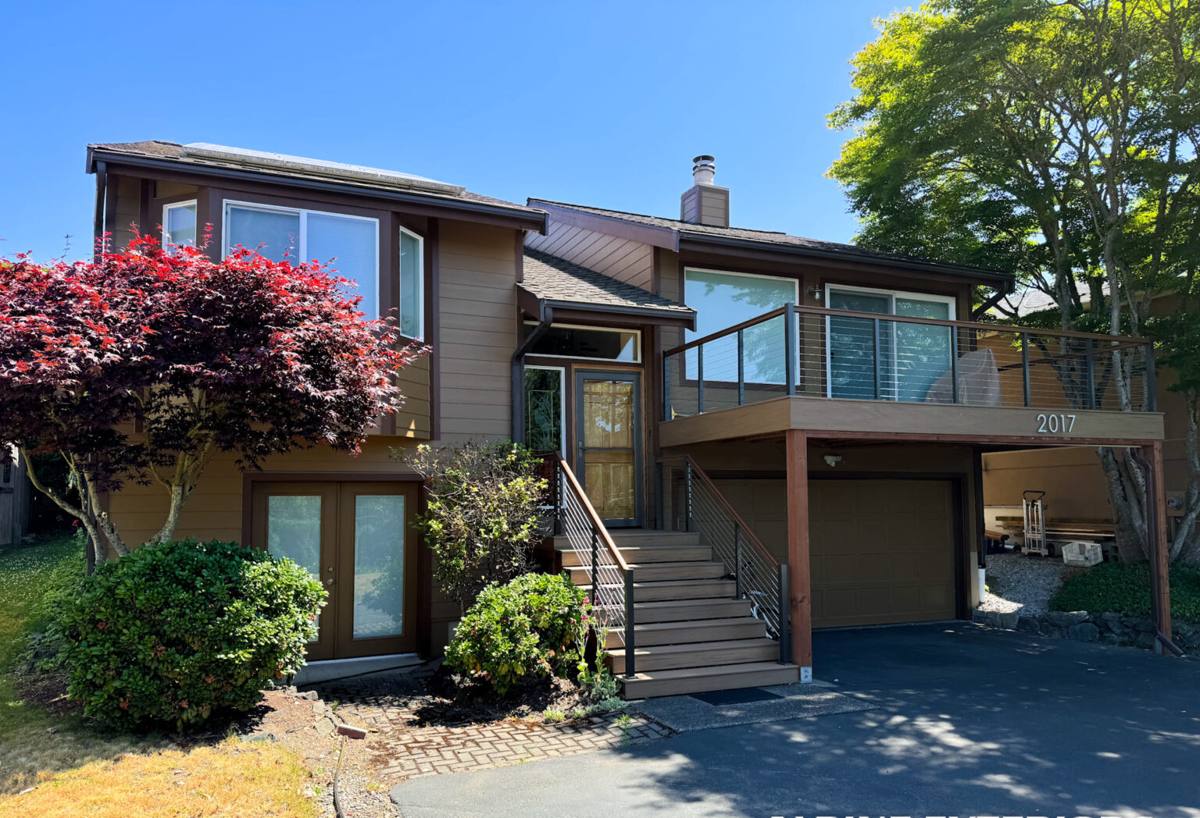
Why Fiber Cement Is the Right Material for This Climate
Fiber cement is dense, dimensionally stable, and doesn't swell, warp, or delaminate the way wood-based products can when they take on repeated moisture cycles. It doesn't feed insects. It holds paint and factory finishes far longer than wood siding because it doesn't expand and contract with humidity the same way. For a climate like Mount Vernon's — wet more months than it's dry — that stability matters more than almost any other performance factor.
That said, "fiber cement" isn't one product. Formulations, finish quality, and manufacturing consistency vary between brands, and those differences show up years down the road, not on installation day. That's a big part of why we're selective about which fiber cement we put on a home.
Why We Install Only James Hardie Fiber Cement
We install James Hardie exclusively. We don't install LP SmartSide, vinyl, Cemplank, Allura, primed spruce, or cedar — not because those products have no legitimate uses, but because after years in this trade, Hardie is the product we're comfortable standing behind on Skagit County homes, and we'd rather specialize in doing one system exceptionally well than spread our crews thin across several.
Climate-Engineered HZ5 Formulation
Hardie manufactures regional HZ (HardieZone) formulations specifically for climate exposure, and homes in our part of Washington fall into the zone engineered for high moisture and freeze-thaw conditions. That's a meaningful difference from a generic, one-size-fits-all fiber cement product — the board itself is designed around the weather it's actually going to face.
ColorPlus Factory Finish
Most Hardie siding we install carries the ColorPlus factory finish — baked on in a controlled environment rather than field-painted after installation. Factory-applied finish is more consistent and more resistant to fading and moisture intrusion than a coat of paint applied on-site in variable weather, which matters enormously in a climate where you rarely get more than a few dry days in a row during install season.
A Warranty Structure That Reflects Confidence in the Product
Hardie backs its siding with a strong, transferable warranty — a meaningful detail for resale, since a documented, professionally installed system with manufacturer backing is worth more to a future buyer than siding with no paper trail. Warranty coverage depends on installation meeting manufacturer specifications, which is exactly why correct installation isn't optional — it's what makes the warranty real instead of theoretical.
What a Correct Fiber Cement Siding Installation Involves
Moisture Management Starts Before the First Board Goes Up
The weather-resistive barrier, flashing at windows and doors, and proper drainage plane behind the siding matter as much as the siding itself — arguably more, in a climate this wet. Fiber cement siding installed directly over a compromised or poorly lapped moisture barrier will trap water behind it regardless of how good the board is. In Mount Vernon's climate, that mistake shows up as rot within a few years, not decades.
Flashing, Fastening, and Clearances
Hardie specifies exact fastener types, spacing, and clearances — how close siding can sit to grade, decks, roofing, and other transitions — and those specs exist because water finds every shortcut. Proper ground clearance and kickout flashing at roof-wall intersections are small details that get skipped by crews in a hurry, and they're exactly the details that determine whether siding lasts twenty years or needs early repair.
Finish Details That Get Skipped by Rushed Crews
Caulking at butt joints and trim, correctly primed and sealed cut edges, and touch-up paint matched to the ColorPlus finish all affect long-term performance. An unsealed cut edge is a direct path for water into the core of the board — a small oversight with a slow, cumulative cost.
Our Process for Mount Vernon Siding Projects
- On-site assessment — we look at your home's current siding, moisture barrier condition, trim, and any problem areas (shaded walls, low clearance spots, prior water staining) before quoting anything.
- Detailed, written estimate — scope, product line, color, and a clear breakdown of what's included, so there's no ambiguity about what you're paying for.
- Tear-off and substrate check — we don't install over hidden rot or a failed moisture barrier; if we find damage underneath, we address it before new siding goes on.
- Weather barrier and flashing installed to spec — the part of the job that's invisible once we're done, and the part that determines how the house performs in ten years.
- Hardie siding installation — fastened, spaced, and clearanced to manufacturer specification, not general contractor habit.
- Finish work and final walkthrough — caulking, trim, touch-up, and a walkthrough with you before we call the job done.
What Fiber Cement Siding Costs — and What Drives the Price
Every home is different, so exact numbers depend on your specific project, but the factors below are what actually move the price up or down on a fiber cement job in this area.
| Cost Factor | Why It Matters |
|---|---|
| Home size and wall complexity | More square footage and more corners, gables, and dormers mean more cutting, fitting, and labor time. |
| Existing siding removal | Tear-off of old siding and disposal adds labor and dump costs beyond the new material install. |
| Substrate or moisture barrier repair | If sheathing or framing has hidden water damage, that repair happens before new siding goes on — it's not optional. |
| Siding profile and Hardie product line | Lap width, shingle-style panels, and trim board options carry different material costs. |
| Color and finish | Factory ColorPlus finishes vs. primed-for-paint boards affect both material cost and long-term maintenance. |
| Access and site conditions | Multi-story walls, tight lot lines, or landscaping that limits staging can add labor time. |
Signs Your Current Siding Is Already Failing
Fiber cement replacement is often most cost-effective when it happens before damage spreads to the wall structure underneath. Watch for:
- Soft or spongy spots when you press on siding, especially near the bottom courses
- Persistent moss or dark streaking that comes back shortly after cleaning
- Visible warping, cracking, or separation at seams and corners
- Paint that's peeling or bubbling rather than just fading
- Water stains or soft drywall on interior walls that back up to exterior siding
- Rising energy bills without another clear explanation, which can point to a failing weather barrier
Why Hiring a Crew That Already Works in Skagit County Matters
A crew that regularly works Mount Vernon and the surrounding Anacortes area already knows how this specific climate behaves — which elevations of a house take the worst weather, how long moisture barriers need to cure between rain windows, and which install shortcuts simply don't hold up here even if they'd be fine in a drier region. That local pattern recognition is hard to get from a crew that mostly works elsewhere and treats every region's weather the same way.
It also matters for accountability. A local, established contractor is easier to reach if a warranty question comes up years later, and has a real reputation in the community to protect — not just a one-time transaction to close.
If you're planning a siding project in Mount Vernon or anywhere in the surrounding Skagit County area, we're happy to take a look at your home and walk you through what correct fiber cement installation looks like for your specific situation. Fill out the form below for a free, no-pressure estimate.