 Anacortes
 Why La Conner Siding Takes a Different Kind of Beating
La Conner sits right on the Swinomish Channel, tucked between tidal water and the farmland of the Skagit Valley. That location is beautiful, but it's also demanding on the outside of a house. Homes here deal with a combination that most inland Washington towns never see: salt-laden air moving off the channel, driving rain that comes in sideways during winter storms, and long stretches of overcast, damp weather that never quite lets siding dry all the way out between rain events.
Add in mature trees and tight lot spacing common in and around La Conner, and you get shaded exterior walls that stay damp longer than a wall in full sun. That's the exact recipe for moss and algae growth, and it's also the reason siding failures here tend to show up first at the bottom courses, around trim, and near anything that traps moisture against the wall.
None of this means siding is doomed in La Conner. It means repairs have to account for moisture, not just patch a visible problem and move on. A repair that looks fine for a season but ignores what's happening behind the siding just delays a bigger job.
What We See Most Often on La Conner Homes
- Moss and algae staining on north- and shade-facing walls, especially lower courses
- Soft or delaminating siding near ground contact, downspouts, and planter beds
- Caulk failure and gapping around trim and window edges from repeated wet/dry cycling
- Corroding or backed-out fasteners on older installations, especially near the water
- Paint failure and color fade on the weather-facing (typically west and south) elevations
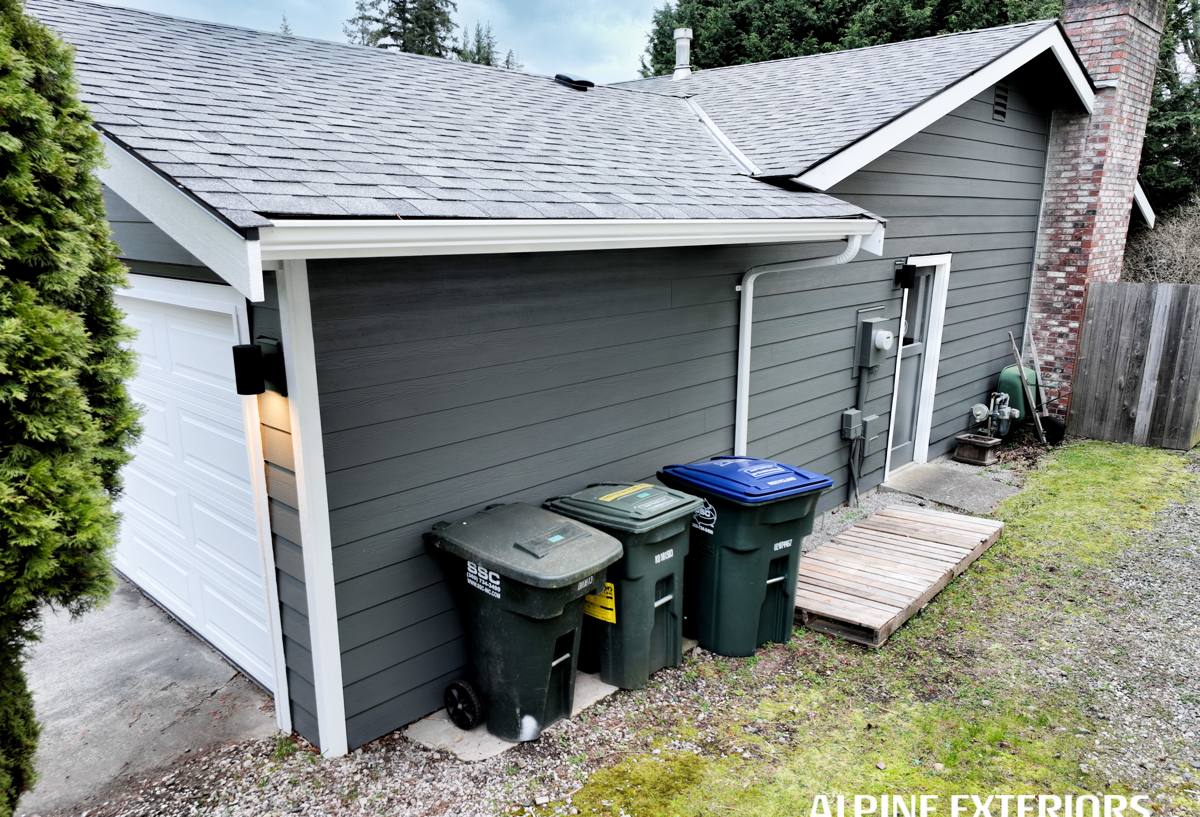
Repair or Replace? How to Tell Which One You're Looking At
Not every siding problem in La Conner means a full re-side. A lot of the calls we get are legitimate repair jobs — a section damaged by a fallen branch, a spot where a downspout failed and soaked a corner, trim that rotted out while the field siding is still sound. The trick is telling the difference between a contained problem and a sign of something spreading underneath the surface.
Usually a Repair
- Damage is limited to one section, corner, or elevation
- The substrate and moisture barrier behind the siding are still dry and intact
- The rest of the siding is structurally sound, just cosmetically worn
- The cause of the damage (impact, a failed gutter, a one-time leak) has been identified and fixed
Usually Points to Replacement
- Soft, spongy, or crumbling siding in multiple areas, not just one spot
- Persistent moss and staining across most of the house, suggesting the siding no longer sheds water well
- Visible warping, buckling, or separation at seams across several courses
- Interior signs of moisture — musty smell, staining, or soft drywall near exterior walls
We won't push a full replacement on a house that just needs a repair, and we won't patch a wall that's clearly failing behind the surface. That call gets made after we've actually pulled a section and looked, not from the driveway.
What a Correct Siding Repair Actually Involves
A siding repair that's done right is more than swapping out a damaged board. In a climate like La Conner's, the details behind the siding matter as much as what you see from the street.
Moisture Barrier and Flashing
Any time siding comes off, the weather-resistive barrier and flashing underneath get inspected. If the barrier is torn, improperly lapped, or missing flashing at a window head or butt joint, that's often the actual reason the siding failed in the first place — replacing the board without fixing the barrier just resets the clock on the same problem.
Fastener Pattern and Clearance
Older or improperly installed siding sometimes has fasteners driven too close to the edge, missing the framing, or set in a pattern that doesn't allow the board to move with humidity changes. We correct fastening as part of any repair, and we check ground clearance — siding sitting too close to grade, mulch, or a deck surface holds moisture against the material and is a repeat offender in La Conner's damp lots.
Color and Texture Match
Matching a repaired section to surrounding siding that's had years of sun and salt exposure is one of the harder parts of a good repair. It's a big reason we only work with one product line — see below.
Our Process for La Conner Siding Repairs
- On-site inspection. We look at the damaged area and the surrounding siding, not just the spot you called about, since related problems often hide nearby.
- Diagnosis. We identify what actually caused the failure — a gutter issue, a grading problem, a flashing gap, simple age — because repairing without addressing the cause just buys time.
- Honest scope. We tell you plainly whether this is a repair, a partial re-side of an elevation, or something bigger, and why.
- Material match. For repairs on existing Hardie siding, we match profile, exposure, and finish as closely as the product line allows.
- Correct installation. Proper flashing, fastening, and clearance get fixed as part of the work, not left as-is because "that's how it was."
Why We Only Repair With James Hardie Materials
We install and repair exclusively with James Hardie fiber cement siding. We don't work with vinyl, LP SmartSide, cedar, primed spruce, or other fiber cement brands, and that standard applies to repair work too, not just new installations. There are a few practical reasons this matters specifically for a repair in a place like La Conner.
Hardie's ColorPlus factory finish is baked on in a controlled environment and holds color more consistently than field-applied paint, which matters when you're trying to match a repaired section to siding that's already weathered a few Skagit Valley winters. Hardie also makes climate-engineered HZ product lines built for wetter climates — material that's less prone to swelling, checking, and moisture absorption than wood-based or lower-grade fiber cement products. And because it's fiber cement, it doesn't feed moss and mildew the way wood-based siding can once organic growth gets a foothold.
None of that means every other product is a bad choice for every homeowner — it means we've made a professional decision about what we're willing to warranty our work on, and Hardie is what holds up best against what La Conner's climate throws at a house.
Repair Cost Factors
Every job is different, but these are the variables that actually move the price on a siding repair in this area:
| Factor | Why It Matters |
|---|---|
| Size of damaged area | A single board vs. a full elevation changes labor and material scope significantly |
| Cause of failure | Fixing a flashing or grading issue behind the siding adds work but prevents a repeat call |
| Access and elevation height | Second-story or hard-to-reach walls take longer and may need staging |
| Color and profile match | Matching older, sun-faded siding sometimes means a slightly larger repair area for a clean transition |
| Underlying trim condition | Rotted trim boards found during the repair add scope but are cheaper to fix now than later |
We give a straight, itemized estimate before any work starts — no vague allowances, and no pressure to upsize a repair into a full re-side unless the house genuinely needs it.
Why a Crew That Already Works La Conner Matters
La Conner is small, and its housing stock and site conditions aren't identical to Anacortes proper or the rest of Skagit County. A crew that's worked the area knows what shaded, tidal-adjacent lots do to siding over time, knows how the local weather patterns off the channel tend to hit a house, and isn't guessing at how quickly moss comes back if the underlying moisture problem isn't solved. That local familiarity shows up in faster, more accurate diagnosis — knowing where to look first instead of treating every house like a blank slate.
Being based nearby also means we can get to a repair without a long drive eating into the job, and we're not disappearing after the invoice is paid. If a repair doesn't hold up the way it should, we're still local and still around to make it right.
A Quick Checklist Before You Call
- Note which side of the house the problem is on (this often points straight to the cause)
- Check nearby gutters and downspouts for overflow or disconnection
- Look for soft spots by pressing gently near the damaged area, not just at the visible spot
- Check indoors for any staining, soft drywall, or musty smell on the same wall
- Take a few photos in daylight if you can, from a few feet back and up close
If your La Conner home has siding damage, moss buildup, or a spot that's been bothering you for a while, we're happy to come take a straightforward look. The estimate is free, there's no pressure to do more work than the house actually needs, and you'll get a clear answer on repair versus replacement before anything gets scheduled.