 Anacortes
 Building a Deck That Can Handle Flounder Bay
Flounder Bay sits on the water on Fidalgo Island, just outside Anacortes, and that location is exactly why building a deck here is a different job than building one a few miles inland. Homes around the bay face salt-laden air coming off the water, wind-driven rain that gets pushed sideways into fascia boards and rail posts instead of falling straight down, and a long stretch of the year — roughly fall through spring — where shade, moisture, and mild temperatures let moss and algae take hold on almost any surface that isn't actively shedding water. A deck built to a generic, one-size-fits-all spec will often look fine for the first year or two, then start showing problems: soft spots near the ledger board, rust bleeding through fastener heads, slick green boards by midwinter. We build decks around here specifically for this environment, not for a mild inland yard, and this page walks through what that actually involves.
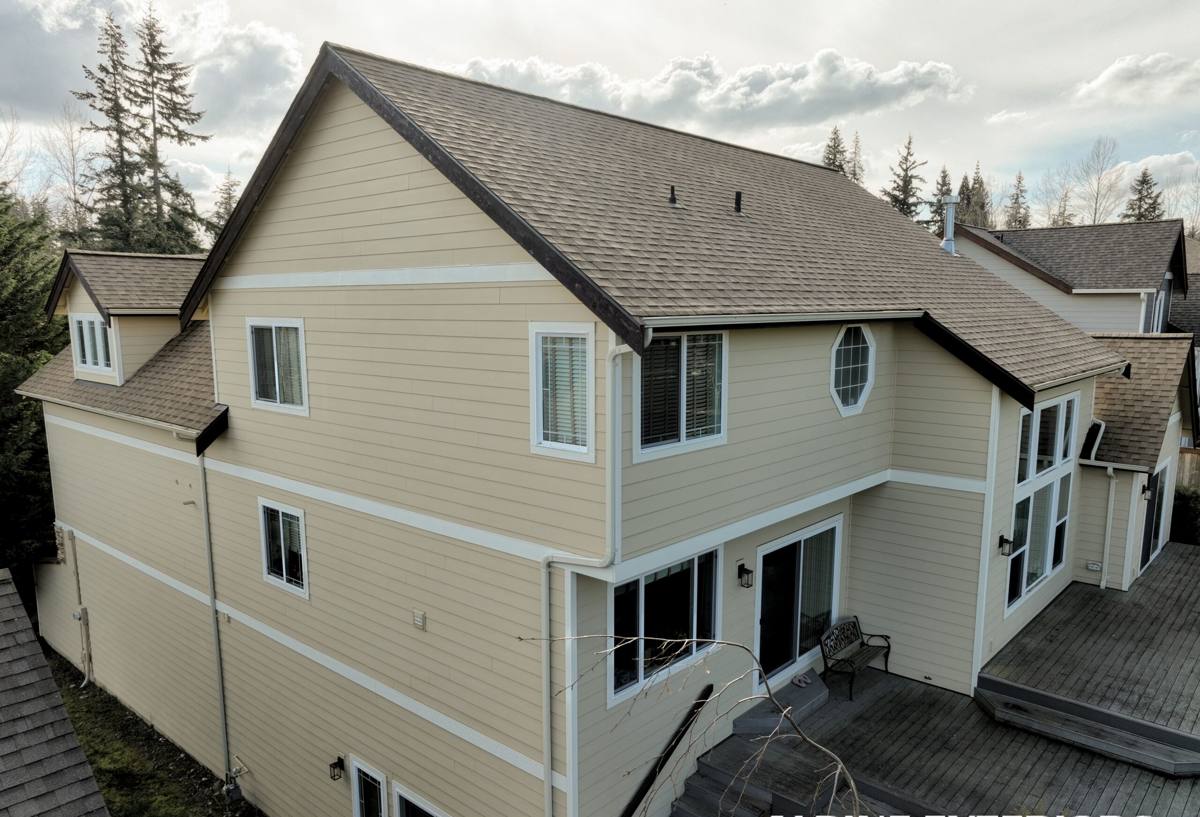
What the Local Climate Actually Does to a Deck
Salt Air and Corrosion
Even homes set back a bit from the shoreline in the Flounder Bay area get regular exposure to salt-carrying air, especially during winter storms blowing in off the water. Salt speeds up corrosion on anything metal — screw heads, joist hangers, structural bolts, railing hardware — much faster than it would happen inland. Once a fastener starts rusting, that's not just a cosmetic streak. The corrosion weakens the connection itself and can stain the wood or composite around it in a way that's hard to remove.
Driving Rain
Rain around the bay rarely falls straight down. Wind off the water pushes it sideways into ledger boards, stair stringers, and the undersides of rail caps — exactly the places a deck has the hardest time shedding water on its own. Over time, that's where rot tends to start: not out on the open decking surface, where water runs off freely, but tucked behind trim, under a rail cap with no drip edge, or where a ledger board meets the house wall without proper flashing.
Moss and Algae Season
Skagit County's damp, mild fall-through-spring stretch is close to ideal growing conditions for moss and algae. On a deck, that means any shaded area — under trees, on the north side of the house, beneath a low railing — builds up a layer of growth that holds moisture against the surface and gets slick underfoot. Moss is more than a slip hazard. A mat of moss trapping moisture against wood or composite decking is one of the more common causes of premature decay we run into on older decks in coastal neighborhoods like this one.
What a Correctly Built Deck Looks Like for This Site
Framing and Fasteners
For a deck within a few miles of Flounder Bay, we treat corrosion resistance as a baseline requirement, not an upgrade. That means stainless steel or heavy-duty coated fasteners rated for coastal or high-moisture exposure, hot-dip galvanized or stainless joist hangers, and structural connectors sized and spaced to current code — not the minimum a builder can get away with. Pressure-treated framing lumber is standard, but the connection hardware is where a lot of corners get cut on cheaper builds, and it's the first thing to fail near the water.
Ledger Attachment and Flashing
The ledger board — where the deck attaches to the house — is the single most failure-prone detail on any deck, and it matters even more here because of the driving rain. A correct ledger attachment includes proper flashing that directs water out and away from the house framing, a gap or membrane behind the ledger so water can't get trapped against the wall, and structural bolts (not just nails or deck screws) rated for the load. Skipping flashing to save an hour of labor is one of the most common shortcuts we find when we're called out to fix an existing deck.
Decking Material
There's no single "best" decking material for Flounder Bay — the right choice depends on budget, how much upkeep you want to do, and how the deck will be used. The table below covers the honest trade-offs for the materials we install most often in this area.
| Material | How It Handles Salt Air & Rain | Moss/Algae Behavior | Maintenance |
|---|---|---|---|
| Pressure-treated wood | Good if properly sealed and re-sealed; end grain and fastener holes are the weak points | Needs regular cleaning; porous surface holds moss and algae if neglected | Annual cleaning and re-sealing recommended |
| Cedar | Naturally rot-resistant but still needs sealing near the water; grays without maintenance | Similar to treated wood — porous surface, needs cleaning | Higher upkeep to preserve appearance and resistance |
| Capped composite | Excellent — the cap resists moisture absorption and doesn't need sealing | Grows less algae than wood, but still needs periodic washing in shaded areas | Low — mainly routine washing |
| PVC decking | Excellent — fully synthetic, no wood fiber to absorb moisture | Most resistant of the common options, though still benefits from occasional cleaning | Lowest — no sealing, minimal washing |
We're upfront with clients that composite and PVC cost more up front than treated lumber. For a lot of Flounder Bay homeowners — especially on decks that get heavy shade, salt exposure, or aren't easy to get to for annual maintenance — the lower long-term upkeep evens that out. For others, a well-built and properly maintained wood deck is the right call. We'll give you a straight answer for your specific site rather than push whatever has the best margin.
Drainage and Slope
A deck surface should have a slight slope away from the house so water sheets off instead of pooling, and the framing underneath needs enough airflow to dry out between rain events — which, in this climate, doesn't leave much of a dry window. Low-clearance decks built tight to grade are one of the more common problems we find on older homes near the bay, because there's nowhere for moisture to go and no airflow to dry the joists.
How We Approach a Flounder Bay Deck Project
Site Visit and Design
We start on site, not over the phone. Exposure to wind and salt air varies noticeably from one lot to the next around the bay depending on elevation, tree cover, and which direction the deck faces, and that affects material recommendations, fastener choice, and how much drainage detailing the framing needs. We walk the site, look at the house's existing water management (gutters, siding, grading), and design the deck to work with that, not around it.
Permitting
Deck construction in and around Anacortes typically requires a building permit through the City of Anacortes or Skagit County, depending on the exact location, along with inspections at the framing and final stages. We handle the permitting process as part of the job so you're not the one chasing down inspections — and we build to pass those inspections the first time, not to just barely get by.
Build and Inspection
We frame to the design, install flashing and fastener hardware to the coastal spec described above, and get the work inspected at the required stages. Before we consider a project finished, we walk it with you and go over how the specific materials on your deck should be cleaned and maintained given your lot's sun, shade, and wind exposure.
Maintaining a Deck in This Environment
No deck material here is truly "maintenance-free" — that's a marketing phrase, not a real category. Every material benefits from a basic seasonal routine, and skipping it is how a well-built deck starts having problems early. A simple annual routine goes a long way:
- Sweep debris (leaves, needles, seed pods) off the deck regularly, especially in fall — trapped debris holds moisture against the surface
- Wash the deck at least once a year with a deck-safe cleaner to remove early moss and algae growth before it takes hold
- Check and clear gaps between boards so water and debris can drain through instead of pooling on top
- Inspect fastener heads and railing hardware yearly for early rust staining, which is easier and cheaper to address early
- Re-seal wood decking on the schedule the sealant manufacturer recommends — don't wait until it visibly needs it
- Confirm gutters and downspouts near the deck are directing water away from ledger and framing areas, not onto them
Shaded, north-facing, or low-clearance decks in the Flounder Bay area typically need this attention more often than a sunny, elevated deck on the same street. If you're not sure how often your specific deck needs it, that's a normal question to ask us during a visit.
Common Problems We Find on Older Decks Near the Bay
When we're called out to look at an aging deck in this area, a handful of issues come up repeatedly. Rusted or corroding fasteners and hangers, installed with hardware that wasn't rated for coastal exposure, are probably the most common. Missing or improperly installed ledger flashing is a close second, and it's usually invisible until there's already rot behind the siding. We also regularly see decks built too low to grade with little to no airflow underneath, and railing posts that were never properly flashed where they penetrate the deck surface — a classic entry point for water that's easy to miss because the post itself looks fine from above. None of these are unusual mistakes; they're what happens when a deck gets built to a generic standard instead of one that accounts for salt air and driving rain.
Why It Matters to Hire a Crew That Works This Area
A deck builder who mostly works drier inland neighborhoods isn't wrong about deck building in general — they're just solving for a different environment. The framing details, fastener grades, flashing choices, and material recommendations that hold up well in Flounder Bay's salt air and driving rain aren't universal defaults; they're decisions we make because we see how decks age around here, year after year, on this side of Skagit County. That local pattern recognition — knowing which details actually cause callbacks in this climate — is the difference between a deck that needs attention in five years and one that's still solid in twenty.
What Affects the Cost of a Flounder Bay Deck
Every deck is priced around the specifics of the site and the scope of work, so we won't quote a number without seeing the job. What we can tell you is which factors move the price up or down, so you know what you're actually paying for.
| Cost Factor | Effect on Price | Why It Matters Here |
|---|---|---|
| Decking material (treated wood vs. composite/PVC) | Moderate to significant | Composite and PVC cost more up front but reduce long-term maintenance in salt air and shade |
| Fastener and hardware grade | Modest increase | Coastal-rated stainless or heavy-galvanized hardware costs more than standard grade but resists corrosion far longer |
| Ledger flashing and waterproofing detail | Modest increase | Proper flashing adds labor and material but is the single biggest factor in preventing hidden rot |
| Deck height and structural complexity | Higher for elevated or multi-level decks | More framing, more footings, more engineering on sloped waterfront lots |
| Site access | Can increase labor cost | Some lots near the water have limited equipment access, which affects labor time |
| Railing style and material | Varies widely | Wood, composite, cable, and metal railings all have different material and installation costs |
We walk through these factors with you during the estimate so you understand exactly where your money is going and where there's room to adjust the scope without cutting corners on the parts that actually protect the deck long-term.
If you're planning a new deck or replacing an aging one near Flounder Bay, we're glad to come take a look and give you a straightforward, no-pressure estimate. Use the form below to get started.