 Anacortes
 Why Conway's Setting Is Tough on Exterior Siding
Conway sits low in the Skagit River delta, close enough to Puget Sound and the tidal sloughs that homes here deal with a mix of moisture problems most inland Washington towns never see. You get salt-laden air moving in off the water, long stretches of driving rain pushed sideways by wind funneling through the valley, and a moss season that can run nine months out of the year in shaded, north-facing exposures. Add the flat, low-lying terrain that keeps humidity sitting close to the ground longer than it would on a hillside, and you have a climate that is genuinely hard on building materials — not in a dramatic way, but in the slow, grinding way that shows up five or ten years later as soft trim, peeling paint, or siding that never quite dries out between storms.
This isn't unique to Conway — it's shared across Skagit County and up through Anacortes and the San Juan approaches — but Conway's particular mix of proximity to tidal water, delta humidity, and heavy tree cover on many lots makes it one of the tougher micro-climates in our service area for exterior products that aren't engineered for wet-side performance.
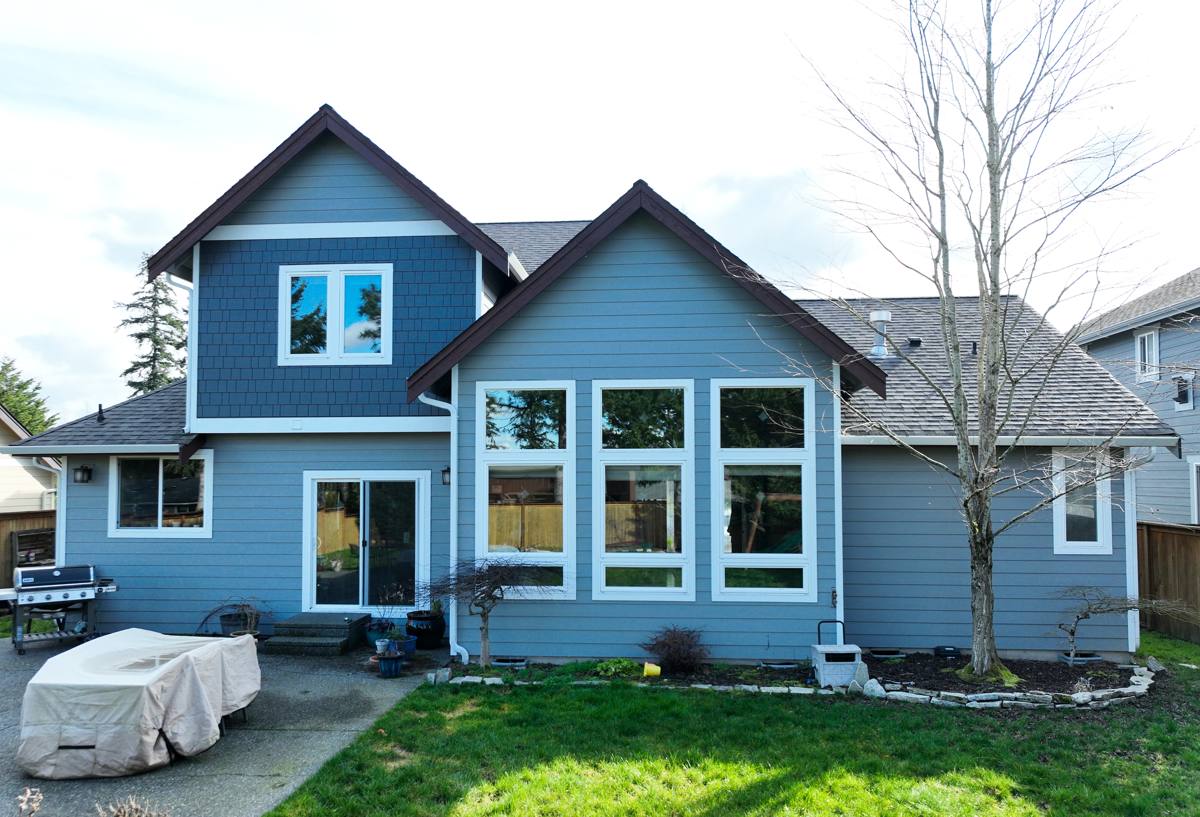
What Salt Air, Rain, and Moss Actually Do to a Wall System
Salt Air
Airborne salt is corrosive to fasteners and metal flashing, and it accelerates the breakdown of paint films on wood-based sidings. It doesn't take a beachfront lot for this to matter — moist air carries salt further inland than most homeowners expect, especially with the persistent westerly and southwesterly wind patterns common to this part of the county.
Driving Rain
Rain that falls straight down is manageable for almost any siding. Rain that's pushed sideways by wind finds every lap, seam, and fastener penetration a wall has. Over time, wind-driven rain is what turns a minor installation shortcut — a missed piece of flashing tape, a caulk joint instead of proper drainage — into a rot problem behind the siding where nobody can see it until the damage is significant.
Moss and Mildew
Shaded, damp surfaces that don't get much direct sun are where moss and mildew take hold fastest. Once organic growth establishes on a wall, it holds moisture against the surface even longer, which speeds up whatever failure mode the underlying material is already prone to.
Why We Standardized on James Hardie for Homes Like These
We install James Hardie fiber cement exclusively — we don't offer vinyl, LP SmartSide, Cemplank, Allura, primed spruce, or cedar. That's a deliberate standard, not a sales pitch, and it matters most in a climate like Conway's. Fiber cement is non-combustible and dimensionally stable in a way wood-based and engineered-wood products aren't; it doesn't swell, delaminate at cut edges, or feed mold the way organic-fiber substrates can when moisture gets behind them. James Hardie's ColorPlus factory-applied finish is baked on and warranted separately from the substrate, which means the paint layer isn't relying on field application quality the way primed-and-painted wood siding does.
None of that makes fiber cement maintenance-free, and we won't tell a homeowner it is. It means the material itself isn't the weak link — the installation is where performance is won or lost, especially in a delta-adjacent climate that gives water every opportunity to find a way in.
Choosing the Right Hardie Product Line for a Conway Property
James Hardie makes climate-engineered HZ product lines, and matching the right one to the site matters more here than it does in a drier part of the state.
- HZ5 lines are engineered for wetter, harsher climates and are generally the right call for exposed or low-lying Conway lots with direct wind and rain exposure.
- Lap siding profiles (traditional and beaded) give the widest color and texture range and work well on most single-family homes in the area.
- Panel siding with battens suits more modern or agricultural-style homes, which show up occasionally on the larger delta-area lots.
- Trim and soffit boards matched to the siding line close out the weak points — inside and outside corners, window returns, and fascia — where most real-world failures actually start.
The product line decision isn't cosmetic. It affects how the board handles moisture cycling and how it holds paint over the long run, which is exactly what's being tested by a Conway winter.
What a Correct Installation Actually Involves
Most siding problems we get called out to inspect aren't material failures — they're installation shortcuts that only show up years later. In a high-moisture setting like Conway, the installation details carry more weight than almost anywhere else in the county.
Weather Resistive Barrier and Drainage Plane
A correctly installed WRB (weather resistive barrier) behind the siding, with a drainage plane that lets any incidental moisture run down and out rather than pool, is the foundation everything else depends on. Skipping or shortcutting this layer is invisible on installation day and expensive to fix later.
Flashing at Every Penetration
Windows, doors, hose bibs, light fixtures, and vents all need proper flashing integration with the WRB — not just caulk. Caulk is a maintenance item; flashing is a structural water-management system. In wind-driven rain, caulk-only details are the first thing to fail.
Fastener Spacing and Type
James Hardie specifies fastener type, spacing, and setback from panel edges precisely, and those specs exist because fastener mistakes are one of the leading causes of siding call-backs — cracking, popped nails, or water intrusion at the fastener hole itself.
Clearances
Manufacturer-specified clearance from grade, roofing, decks, and other siding transitions keeps the bottom edge of the siding out of standing water and splashback — a real concern on flatter delta lots where drainage away from the foundation is often minimal.
Caulking and Joint Treatment
Butt joints, corners, and trim transitions need the right sealant, applied correctly, at the right stage of installation — not as an afterthought to hide a gap.
Our Process, Start to Finish
- On-site assessment — we look at your home's exposure (wind direction, shade, proximity to water or dense tree cover), existing siding condition, and any trim or flashing issues underneath.
- Product and line recommendation — we specify which Hardie line and profile fits your exposure, not a one-size-fits-all pitch.
- Written estimate — scope, product, and a realistic cost range before anything is signed.
- Prep and tear-off — removal of old siding, inspection of sheathing for hidden rot (common on older delta-area homes), and repair before anything new goes up.
- WRB and flashing installation — the invisible layer that determines long-term performance.
- Hardie installation — to manufacturer fastening and clearance spec, not shortcuts.
- Final walk-through — we go over the finished work with you before calling the job done.
Cost Factors on a Conway Job
Every home is different, but the variables that actually move the price on a Conway-area James Hardie project are consistent. We give real ranges during the on-site estimate — this table is meant to explain what drives the number, not to quote it.
| Factor | Why It Matters Here |
|---|---|
| Existing sheathing condition | Delta-area homes with past moisture exposure sometimes need sheathing repair before new siding goes on — this is common enough to plan for. |
| Home size and wall complexity | Dormers, multiple gables, and cut-up wall planes add labor and trim detail regardless of siding brand. |
| Product line (HZ5 vs. standard) | Climate-engineered lines cost more but are the right call for exposed, low-lying, or wind-driven-rain sites. |
| Trim and accessory scope | Full trim, soffit, and fascia replacement alongside the siding costs more up front but avoids mismatched materials aging at different rates. |
| Access and site conditions | Tree cover, fencing, and tight lot lines common on older Conway properties can affect staging and labor time. |
Why a Crew That Already Works Conway Matters
A contractor who only occasionally works this far into the delta doesn't have the same instinct for where moisture actually causes problems on these homes — which walls take the worst wind-driven rain, which lots hold humidity longest, where moss establishes first. A crew that regularly works Anacortes, Conway, and the surrounding Skagit County towns has already seen what five and ten years of this climate does to a wall system, and that shapes decisions on flashing details, product line, and clearances before a single board goes up — not just how the finished siding looks on day one.
Maintaining James Hardie Siding in This Climate
Fiber cement is low-maintenance, not no-maintenance. A few habits go a long way in a moss-prone, salt-air setting:
- Rinse the exterior periodically to clear salt residue and organic buildup, especially on shaded or north-facing walls.
- Keep gutters and downspouts clear so water isn't overflowing onto siding below.
- Trim back vegetation and tree cover that keeps walls shaded and damp longer than necessary.
- Inspect caulk joints at trim and penetrations every couple of years and re-caulk as needed — this is routine maintenance, not a sign of failure.
- Address any soft spots, staining, or bubbling paint promptly rather than waiting — small issues stay small when caught early.
Let's Take a Look at Your Home
If you're weighing a siding replacement on a Conway-area home, we're happy to walk the property, talk through what your specific exposure calls for, and give you a straightforward, no-pressure estimate. Fill out the form below and we'll set up a time to take a look.