 Anacortes
 Deck Replacement Built for Skyline's Marine Climate
Skyline sits close to the water on Fidalgo Island, and that proximity shapes everything about how a deck ages here. Homes in this part of Anacortes catch steady onshore air, long stretches of overcast and drizzle through the fall and winter, and enough shade from mature evergreens that moss and algae get a real foothold on any horizontal wood surface. A deck built without that environment in mind will look tired years before it should — soft boards, rusted fasteners, a substructure that's wetter than it looks from the top. Replacing a deck in Skyline isn't just swapping old boards for new ones; it's an opportunity to correct whatever the original build got wrong for this specific setting.
We work on decks throughout Anacortes and Skagit County, and the ones closest to the water — including Skyline — consistently show wear patterns you don't see as often further inland. That's the starting point for how we approach a replacement here: assume salt-laden air, assume moisture will find any gap, and build accordingly.
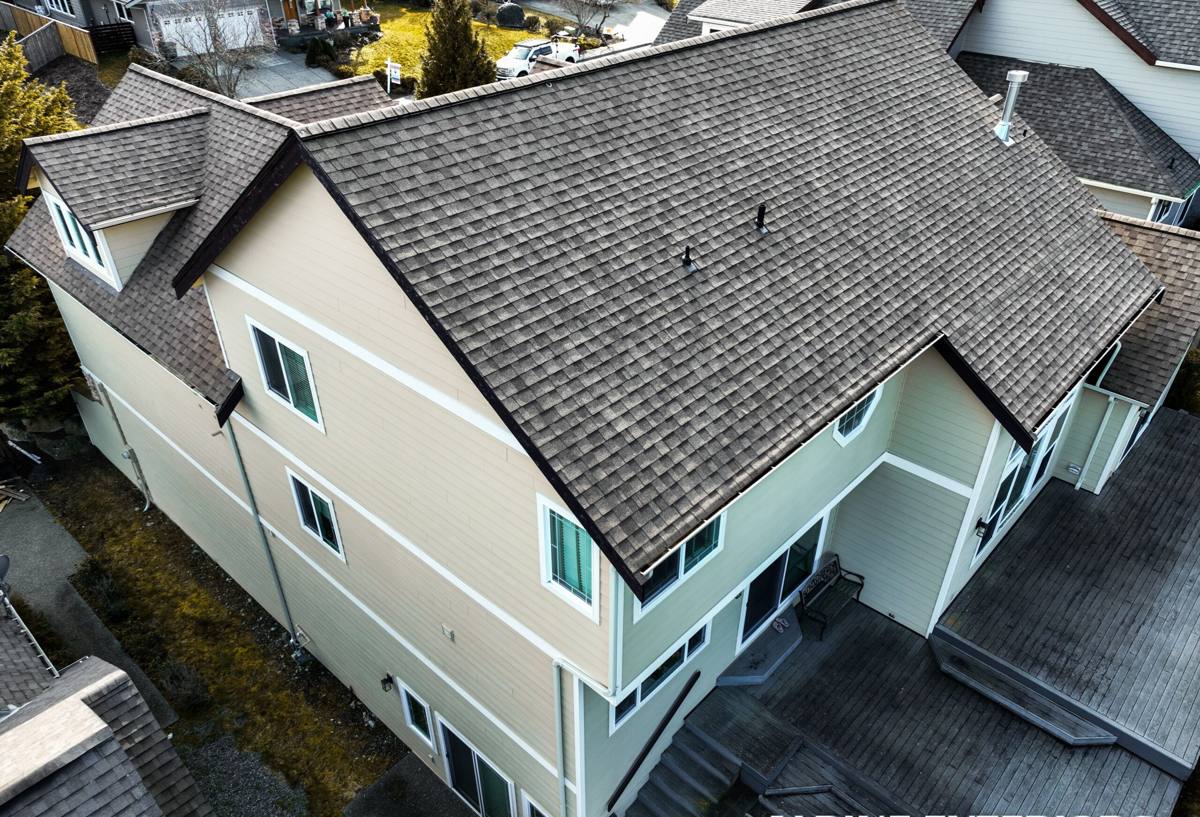
Signs a Skyline Deck Needs Replacement, Not Repair
Not every tired deck needs a full teardown. But there's a point where patching individual boards stops being worth it and a full replacement becomes the more honest recommendation. Walk your deck and check for these:
- Boards that feel spongy or spring underfoot, especially near the house or in shaded corners
- Visible rust streaks bleeding from fastener heads or bolts
- Gaps opening up between boards from repeated wet-dry cycling
- Persistent green or black staining that returns within weeks of cleaning
- A ledger board (where the deck attaches to the house) that shows staining, gaps, or soft wood around the flashing
- Railing posts that wiggle at the base, which usually means the post connection or the framing beneath it has weakened
- A substructure — joists, beams, posts — that's visibly older and more deteriorated than the surface boards suggest
If most of what's failing is decking boards and the frame underneath is sound, resurfacing can make sense. If the framing itself is compromised, or the deck is old enough that you'd be putting new boards on questionable bones, replacement is the more responsible path — both for safety and for what you'll spend on repairs over the next several years.
What Anacortes' Climate Actually Does to a Deck
Salt Air and Metal Fatigue
Salt-laden air corrodes standard fasteners, brackets, and hardware faster than it does inland. Screws that would last decades in a drier, saltier-free climate can start showing rust bleed within a few years near the water. This matters more than it sounds — corroding fasteners don't just look bad, they lose holding strength, and a deck's structural integrity depends on every connection doing its job.
Driving Rain and Water Intrusion
Anacortes gets weather that comes in sideways as often as it comes straight down. Driving rain finds its way into places vertical-only flashing details were never designed to handle — behind ledger boards, around post bases, under railing connections. Over time that moisture gets trapped against wood that can't dry out fast enough between storms, which is exactly the condition that leads to rot.
Moss, Shade, and Slow Drying
A long moss season is one of the defining features of building here. Decks under tree cover or on the shaded side of a house stay damp longer after every rain, and that extra dry-time is what lets moss, algae, and mildew establish themselves. Beyond looking bad, a mossy deck surface gets slick and holds moisture directly against the wood fibers, accelerating decay in exactly the boards that are already getting the least sun exposure.
Choosing Decking Material for a Skyline Home
There's no single right answer here — it depends on your budget, how much upkeep you want to take on, and how close your lot is to direct wind and salt exposure. Here's how the common options actually compare in this climate, without the marketing spin:
| Material | How it handles this climate | Upkeep | General cost position |
|---|---|---|---|
| Pressure-treated lumber | Solid performer if properly sealed and maintained; needs consistent attention to fight moisture and moss | High — annual cleaning and periodic sealing | Lowest upfront |
| Cedar | Naturally rot-resistant and handles moisture well, but still needs finish maintenance to keep its color and resist graying | Moderate to high | Mid-range |
| Composite decking | Doesn't absorb moisture the way wood does, resists rot, and sheds moss more easily with routine washing | Low — occasional cleaning, no sealing or staining | Higher upfront, lower long-term labor |
| PVC decking | Fully synthetic, essentially immune to rot and moisture damage; performs well in wet, shaded conditions | Lowest | Highest upfront |
For a deck that sits under tree cover or gets heavy wind off the water, we lean toward recommending composite or PVC to clients who want to spend less time maintaining the surface. For homeowners who prefer the look and feel of real wood and are willing to keep up with sealing, cedar or properly treated lumber is a completely reasonable choice — it just requires more discipline about maintenance in a climate that doesn't give wood much of a break.
What a Correct Deck Replacement Actually Involves
The Framing Comes First
The decking boards are the part everyone sees, but the framing underneath determines whether the deck lasts. That means joists sized and spaced correctly for the load, beams and posts set on adequate footings, and every structural connection made with fasteners and hardware rated for exterior, corrosion-prone environments — not whatever was code-minimum decades ago when a lot of the older decks in this area were originally built.
Ledger Flashing Is Where Most Failures Start
The ledger board — where the deck attaches to the house — is the single most common point of failure on decks in wet climates. Proper flashing here means water is directed away from the house and away from the ledger itself, not just caulked and hoped for. We treat this connection as the most important detail on the whole project, because a flashing mistake here can rot both the deck framing and the house's wall structure behind it.
Fasteners and Hardware Matched to the Environment
Given the salt air, we use fasteners and structural hardware rated for coastal or corrosive exposure rather than standard exterior-grade hardware. It costs a bit more upfront and it's the difference between hardware that holds for the life of the deck and hardware that starts bleeding rust in five years.
Drainage and Airflow Underneath
A deck that can't shed water and dry out underneath will stay damp longer than it should, which feeds rot and moss growth. Correct spacing between boards, and attention to grading and airflow beneath the structure, keeps the whole system drying properly between the region's frequent rain events.
Our Deck Replacement Process
- On-site assessment. We look at the existing deck, the framing condition, the ledger connection, and how the site's exposure to wind, shade, and rain has affected it.
- Material and design conversation. We walk through decking material options, railing style, and any layout changes, with honest tradeoffs for your budget and maintenance preference.
- Permitting. We handle the permit process with the City of Anacortes where required, so the project is inspected and documented correctly.
- Demolition and disposal. The old deck is removed carefully, checking framing and ledger areas as we go for hidden rot or water damage that needs to be addressed before rebuilding.
- Framing and flashing. New structural framing goes in to current code, with corrosion-resistant hardware and properly detailed ledger flashing.
- Decking, railing, and finish work. Boards and railing are installed to the manufacturer's specifications for our climate, including fastening patterns and expansion gaps where applicable.
- Final walkthrough. We go over the finished deck with you, including any maintenance recommendations specific to the material you chose.
Permits and Local Code Considerations
Deck replacement in Anacortes generally requires a building permit, particularly when the deck attaches to the house, exceeds certain height or size thresholds, or involves structural changes. Permit requirements exist for a real reason here — proper inspection catches ledger and framing issues before they're buried under decking boards, which is exactly the kind of mistake that's expensive to find later. We manage the permitting and inspection process as part of the job so you're not left navigating City of Anacortes requirements on your own.
Why Hire a Crew That Already Works in Skyline
A deck built to a generic national spec sheet doesn't necessarily hold up to what Skagit County's marine weather actually does over ten or twenty years. A crew that regularly works waterfront-adjacent neighborhoods like Skyline has already seen where standard details fall short here — which ledger flashing approaches actually keep water out through a wet winter, which hardware holds up against salt air, and which decking materials handle shaded, moss-prone exposures without becoming a maintenance headache. That local pattern recognition is worth more than a lower bid from a crew that's never built a deck fifteen minutes from saltwater.
It also means faster, more accurate estimates. We're not guessing at what a Skyline lot's exposure looks like — we've built and repaired decks in comparable conditions nearby, and we bring that experience into the recommendation from the first visit.
Get a Straightforward Estimate
If your deck is showing its age — soft spots, rust stains, moss that won't stay gone — we're happy to take a look and give you an honest read on whether it needs replacement or just targeted repair. Reach out for a free, no-pressure estimate using the form below.