 Anacortes
 Composite Decking Built for Mount Vernon's Climate
Mount Vernon sits inland from Anacortes but still gets the full weather package that defines Skagit County: long stretches of driving rain from fall through spring, salt-tinged air pulled in off the Sound and the tidal flats, and shaded, damp yards where moss and algae take hold and never fully let go. A deck here isn't just outdoor furniture with a view — it's a structure that has to shed water, resist rot at every joint, and stay safe to walk on when it's slick and green half the year. Composite decking, installed correctly, handles that load a lot better than wood. Installed poorly, it can trap moisture just as badly as a neglected cedar deck, just with a bigger price tag attached.
This page is about composite decking specifically for Mount Vernon homes — what the local conditions demand, what a correct installation actually involves, and how we approach the job differently than a crew that isn't used to building in this weather.
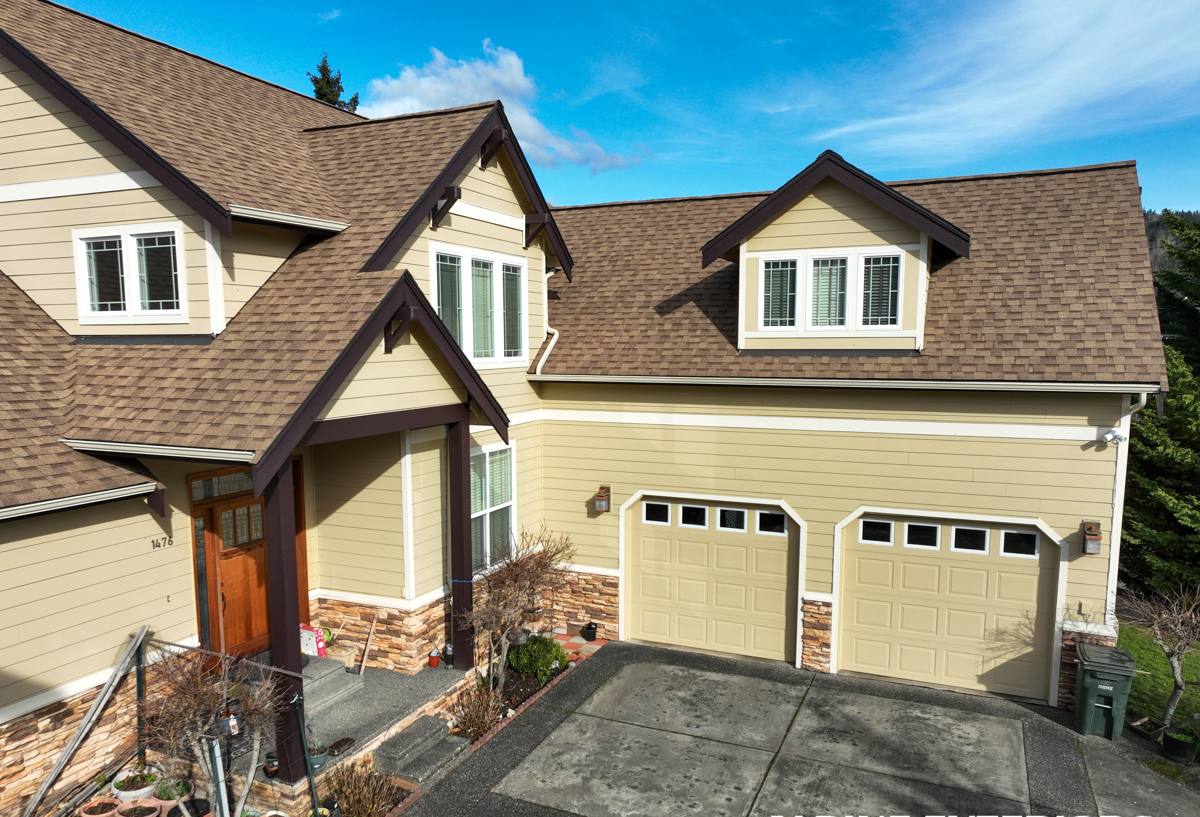
What Skagit County Weather Does to a Deck
A few things happen to decks here that don't happen the same way in drier parts of the state:
- Moss and algae growth: Shaded decks, north-facing yards, and tree cover common around Mount Vernon keep boards damp for days after a storm, which is exactly what moss and algae need to take hold — especially in board grooves and low-traffic corners.
- Standing water at joints and fasteners: Rain that falls steadily rather than in short bursts finds every low spot, gap, and end-cut. Anywhere water can pool instead of drain becomes a weak point over time.
- Salt-influenced air: Proximity to the Sound and the flats means fasteners, flashing, and any exposed metal hardware are under more corrosion pressure than they'd be further inland.
- Freeze-thaw cycling: Skagit Valley winters aren't brutal, but they do dip below freezing often enough that trapped moisture in a board or a fastener pocket can freeze, expand, and start splitting material that wasn't rated or installed for it.
None of this is unusual for the area — it's just the baseline a deck has to be built against. The mistake we see most often isn't choosing the wrong decking product; it's installing a good product using a generic method that ignores what this climate actually does to a structure.
Composite vs. Other Decking Materials
Composite isn't automatically the right call for every homeowner — it's a trade-off, like every decking material. Here's how it stacks up for a Mount Vernon deck specifically:
| Material | How it handles this climate | Maintenance burden | Typical lifespan here |
|---|---|---|---|
| Composite (capped) | Resists moisture absorption and rot well; surface sheds algae easier than raw wood | Periodic cleaning; no staining or sealing | 25–30+ years with correct install |
| Composite (uncapped) | More prone to moisture wicking at cut ends and surface fading | More frequent cleaning; end-cut sealing recommended | 15–20 years |
| Pressure-treated wood | Absorbs moisture readily; moss and algae take hold fast in shaded spots | Annual cleaning, periodic staining/sealing | 10–15 years before major repair |
| Cedar | Naturally rot-resistant but still absorbs moisture over time; softens in constant damp | Regular sealing to hold up in this rainfall | 15–20 years |
| PVC decking | Fully moisture-resistant, doesn't wick at cuts | Low; occasional cleaning | 25–30+ years |
For most Mount Vernon homeowners, a capped composite board is the best balance of upfront cost, low maintenance, and real resistance to what this climate does to a deck. We'll still talk through PVC and wood honestly if either fits your budget or the look you're after better — this isn't a one-product shop.
Why We Favor Capped Composite Here
Capped composite boards have a polymer shell around the wood-fiber core, which is the part that actually matters in a wet climate — it's what keeps water from wicking into the board at cut ends, fastener holes, and scratches. Uncapped composite (and some older-generation products) doesn't have that shell, and in a climate that stays damp as long as ours does, that difference shows up over years in the form of swelling, dark staining, and softer spots near the edges.
What a Correct Composite Deck Installation Involves
The board itself is only part of the job. Most of the moisture and rot problems we get called out to fix on composite decks trace back to the substructure and detailing, not the decking material. A correct install for this area includes:
Substructure and Ventilation
Joists and beams need enough airflow underneath to dry out between rain events. Decks built low to the ground, or over poorly graded soil, stay damp longer — that's where we see rot in the framing even when the composite boards on top still look fine.
Ledger Board Flashing
Where the deck attaches to the house is the single most common failure point on any deck, composite or otherwise. Proper flashing at the ledger board keeps water from working its way behind the siding and into the wall assembly — this matters even more on a composite deck, because homeowners often assume a "low-maintenance" deck means a low-maintenance ledger connection too. It doesn't.
Fastener Selection
Hidden fastener systems and screws rated for coastal/marine-adjacent conditions resist the corrosion that salt-influenced air accelerates. Cheaper fasteners can start staining boards and losing grip years before the decking itself shows wear.
Board Spacing and Drainage
Composite boards expand and contract with temperature more than people expect. Spacing that's too tight traps debris and moisture between boards; spacing that's inconsistent creates tripping and pooling issues. Getting this right the first time avoids a deck that looks fine in July and holds water all through a Skagit Valley November.
Our Process for a Mount Vernon Composite Deck
- On-site assessment: We look at existing framing (if there is any), grading, sun/shade exposure, and drainage before recommending anything — a deck plan that ignores your yard's specific moisture pattern is a plan for callbacks.
- Structural check: If we're building over an existing substructure, we verify it's sound and not already carrying rot damage from a previous deck or wood structure.
- Material selection: We walk through composite options with you honestly, including where a mid-tier board makes more sense than the top-of-line product for your specific use and budget.
- Flashing and substructure work: This is where most of the long-term performance is decided, and it's not visible once the boards go down — so it's not a step we shortcut to save time.
- Installation: Proper fastening, spacing, and edge detailing, including cut-end treatment on any uncapped material.
- Final walkthrough: We go over what maintenance the specific product you chose actually needs — which, for most composites, is less than people expect, but isn't zero.
Maintenance in a Climate Like This
Composite decking is marketed as low-maintenance, and relative to wood, it is. But "low-maintenance" in a Skagit County winter still means something. A realistic maintenance routine looks like:
- Sweep debris (leaves, needles, seed pods) off the deck regularly through fall — trapped organic matter is what feeds moss and algae growth.
- Clean the surface with a soft-bristle brush and a composite-safe cleaner once or twice a year, more often in shaded areas.
- Check board-to-board gaps periodically for debris buildup that blocks drainage.
- Inspect the ledger board connection and any visible fasteners annually for corrosion or gaps in flashing.
- Keep planters and furniture feet from sitting directly on the boards without a breathable pad — constant contact points hold moisture longer than open deck surface.
- Avoid pressure washing at high PSI directly into board grooves; it can drive water into fastener channels rather than clean it out.
Cost Factors for Composite Decking Projects
| Factor | Why it moves the price |
|---|---|
| Deck size and shape | More linear footage of board and framing, plus complexity of cuts around corners or curves |
| Height above grade | Taller decks need more substructure, railing, and sometimes stairs |
| Existing structure condition | Rebuilding a rotted substructure adds cost beyond just replacing the deck surface |
| Board tier | Capped composite and premium lines cost more upfront than uncapped or entry-level boards |
| Railing and fastener systems | Hidden-fastener systems and coastal-rated hardware cost more than exposed screws |
| Site access | Tight side yards or limited equipment access can add labor time |
We give real, project-specific numbers after seeing the site — not a phone-quote range that falls apart once we're standing on your existing deck.
Why Local Experience with Mount Vernon Homes Matters
A crew that mostly builds decks in drier climates, or that treats every job the same regardless of region, tends to under-detail the parts that don't show up until year three or four: ventilation, flashing, drainage slope. We work Skagit County regularly, which means we're not guessing at how much rain exposure, shade, and salt air a Mount Vernon deck will actually see over its life — we're building to what we already know happens here. That shows up in fewer callbacks for moss buildup, soft spots at the ledger board, and fastener corrosion down the line.
If you're weighing composite decking for a Mount Vernon property, we're glad to walk the site, look at what you're working with, and give you a straight assessment — including telling you if a different material or approach would actually serve you better. There's no pressure and no obligation; the estimate form below is the easiest way to get that conversation started.