 Anacortes
 Decking Built for a Waterfront Climate
March Point sits close enough to the water that homes here catch the weather straight off the bay, and that shapes everything about how a deck ages. Salt-laden air, long stretches of driving rain through fall and winter, and a moss season that seems to start earlier every year all work against wood decking in ways that show up fast — cupping boards, rusted fasteners, slick green growth, and gray, splintering surfaces within a few seasons. Composite decking was built to shrug off exactly this kind of punishment, which is why it's become the material we recommend most often for homes in this part of Skagit County.
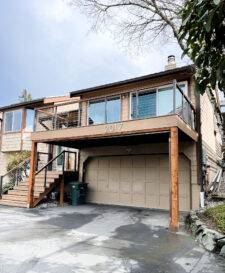
What Salt Air, Rain, and Moss Actually Do to a Deck
Salt Air and Metal Fasteners
Airborne salt doesn't just sit on the surface of a deck — it works into fastener heads, hinges, and any exposed metal hardware. Standard deck screws and nails corrode faster near the water than they do further inland, and once a fastener starts rusting, it stains the wood around it and eventually weakens its grip. This is one of the most common early-failure points we see on older decks in this area.
Driving Rain and Standing Water
Anacortes gets a long wet season, and March Point's exposure to wind off the bay means rain doesn't just fall straight down — it drives sideways into railings, stair stringers, and the undersides of boards. Wood decking absorbs that moisture, swells, and dries unevenly, which is what leads to cupping and splitting over time. Any decking material used here needs to handle repeated wetting and drying without losing its shape.
Moss, Algae, and Shade
Between the rain and the tree cover common on many Skagit County lots, moss and algae get a long runway to establish themselves on horizontal surfaces. Beyond looking bad, a mossy deck surface holds moisture against the boards and becomes genuinely slick underfoot — a real slip hazard on stairs and ramps, especially through the darker months when decks see less direct sun to dry them out.
Why Composite Makes Sense for This Location
Composite decking is manufactured from a blend of wood fiber and recycled plastic, and on the better capped products, that core is wrapped in a polymer shell that doesn't absorb water the way solid wood does. That matters directly for a March Point property: less moisture absorption means less cupping, less splitting, and a surface that doesn't feed mold and algae the way exposed wood fiber does. It won't rust from salt exposure, it doesn't need annual staining or sealing, and it holds its color and texture through repeated wet-dry cycles far better than wood over the long run. It isn't maintenance-free — nothing exposed to this climate truly is — but it removes most of the labor-intensive upkeep that wood decking demands.
Not all composite is built the same way, either. Fully capped boards wrap the wood-plastic core on all sides in a protective polymer shell, while older or partially capped products leave more of that core exposed to moisture. In a climate this wet, the extra protection of full capping is usually worth the difference in price — it's the single biggest factor in how well a composite deck actually performs here over time.
Composite vs. Wood vs. PVC: How They Hold Up Here
| Factor | Wood (cedar/pressure-treated) | Composite | PVC/Vinyl decking |
|---|---|---|---|
| Moisture response near the water | Swells, cups, and splits over time | Minimal swelling with capped boards | Doesn't absorb moisture |
| Salt air on fasteners/hardware | Standard fasteners corrode and stain | Requires corrosion-resistant fasteners; low staining | Requires corrosion-resistant fasteners |
| Moss and algae resistance | Low — porous surface holds growth | Higher on capped products; still needs periodic cleaning | High — smooth, non-porous surface |
| Annual maintenance | Sanding, staining, sealing | Occasional washing | Occasional washing |
| Upfront cost | Lowest | Mid-range | Highest |
| Look and feel underfoot | Natural wood grain and warmth | Wood-look grain, wide color range | More uniform, plastic-like feel to some homeowners |
Wood remains the least expensive option up front, but on a waterfront-adjacent lot like March Point, the maintenance burden and shorter realistic lifespan usually erase that savings within a decade. PVC handles moisture and moss the best of the three, but it comes at a real cost premium and a different look and feel that not every homeowner wants. For most March Point projects, capped composite lands in the sweet spot of performance and cost.
What a Correct Composite Installation Actually Involves
The Substructure Matters as Much as the Boards
A composite deck is only as good as what's underneath it. In this climate, we build the substructure with attention to airflow and drainage — proper joist spacing for the specific composite product, gapping that accounts for board expansion, and blocking that doesn't trap water against the frame. Composite boards are heavier than wood and behave differently with temperature and moisture, so a frame built to generic "deck" specs instead of the manufacturer's actual span tables is a common source of bounce, sagging, or squeaking down the road.
Expansion Gaps and Temperature Swings
Composite boards expand and contract with temperature more than most homeowners expect, and getting the gap between boards right — both at installation and at butt joints — is what keeps a deck looking straight and even instead of buckling or leaving gaps that widen unevenly over a few seasons. This is a detail that's easy to get wrong when a crew treats composite the same as wood, and it's one of the more common corrections we make when we're called in to fix someone else's installation.
Fasteners and Hardware Rated for Salt Exposure
Given the salt air this close to the water, we use fasteners and structural hardware rated for coastal or corrosive environments — not the standard-grade hardware that's fine further inland. This is a small line-item cost that prevents a much bigger problem: rust streaks and weakened connections a few years in.
Drainage and Ventilation Underneath
Composite doesn't rot the way wood does, but the framing underneath it usually still involves wood or wood-based structural members, and trapped moisture under a deck is a slow, hidden problem. Correct grading, gapping, and sometimes an underdeck drainage system keep water moving away from the structure instead of pooling against it.
Board Layout for Moss and Water Shedding
Board direction and picture-framing choices affect how quickly a deck surface sheds water and dries out after rain. On shaded or low-sun sections of a property, we factor that into layout decisions so the areas most prone to holding moisture and growing moss have the best chance of drying between storms.
Our Process for a March Point Decking Project
- On-site assessment. We look at sun exposure, drainage, existing structure (if it's a replacement), and any site-specific issues like slope or proximity to water-facing wind.
- Material and layout discussion. We walk through composite options, colors, and board patterns, and talk through the honest cost and maintenance trade-offs against wood or PVC for your specific situation.
- Written estimate. A clear, itemized quote — no vague allowances — so you know what you're paying for before work starts.
- Permitting. We handle the permit process where required, including structural details for the substructure and railings.
- Demolition and framing (if applicable). Old decking removed, substructure inspected and rebuilt or reinforced to current span and drainage standards.
- Installation. Composite boards installed per manufacturer spec, with corrosion-resistant fasteners and hardware throughout.
- Final walkthrough. We go over the finished deck together, including basic care guidance specific to this climate.
Why It Matters to Hire a Crew That Already Works This Area
Decking installation isn't the same everywhere. A crew that mostly works drier, inland climates may not think twice about fastener grade, drainage detailing, or board gapping for a marine environment — and those shortcuts don't show up as problems until a few winters have passed. We work throughout Anacortes and the surrounding Skagit County waterfront communities, including March Point, and we build every deck assuming it will face salt air, sustained rain, and a real moss season, because around here it will. That's not an upsell — it's just what a deck in this location actually needs to hold up.
What Composite Still Needs From You
Composite decking cuts maintenance dramatically compared to wood, but "low-maintenance" isn't "no-maintenance," especially in a climate this wet and shaded. A little regular care goes a long way toward keeping a composite deck looking and performing the way it should for decades.
- Sweep off leaves, needles, and debris regularly — trapped organic matter holds moisture and feeds moss and mildew even on composite surfaces.
- Wash the deck with a soft-bristle brush and mild soap and water a couple of times a year, more often in shaded, moss-prone areas.
- Avoid pressure washing at close range or high PSI, which can damage the surface texture or capping on some boards.
- Check railing posts and stair connections annually for looseness, since hardware and structure still need periodic attention even when the boards don't.
- Keep gutters and downspouts nearby clear so runoff isn't dumping extra water directly onto or under the deck.
- Trim back overhanging branches where practical to cut down on shade, debris, and the moss growth that comes with both.
What Affects the Cost of a Composite Deck Here
Every project is different, but a few factors consistently drive cost on composite decking jobs in this area: the size and shape of the deck, the condition of the existing substructure if you're replacing an old deck, the composite product tier you choose, railing style and material, and site access for equipment and material delivery. Multi-level decks, built-in stairs, and elevated structures that need engineered footings all add cost beyond a simple ground-level rectangle. A straightforward, accessible lot with a sound existing frame costs less than a project that requires significant structural rebuilding. We break all of this down in a written estimate so there's no guessing.
If you're weighing decking options for a home in March Point or anywhere else around Anacortes, we're happy to take a look and give you an honest read on what your property actually needs. Use the form below to request a free, no-pressure estimate.