 Anacortes
 Why La Conner's Climate Is Hard on a Deck
La Conner sits right on the Swinomish Channel, surrounded by tidal flats and farmland, which means homes here deal with a combination of weather stresses that inland Skagit County properties don't see as much. Salt-laden air off the channel accelerates corrosion on anything metal — fasteners, brackets, railing hardware. Driving rain off Puget Sound comes in sideways more often than straight down, which pushes water into joints and connections that a calmer climate would never test. And the long, gray moss season here — roughly October through April — keeps shaded and low-airflow areas of a deck damp for weeks at a stretch, which is exactly the environment moss, algae, and mildew need to take hold.
None of this means a deck in La Conner is doomed. It means the details that get skipped on an easy job in a dry climate are the details that actually matter here. A deck that's built or installed without accounting for salt air and sustained moisture will show it within a few seasons — fastener staining, soft spots at the ledger, green film on the walking surface. A deck built with this climate in mind will handle it for decades.
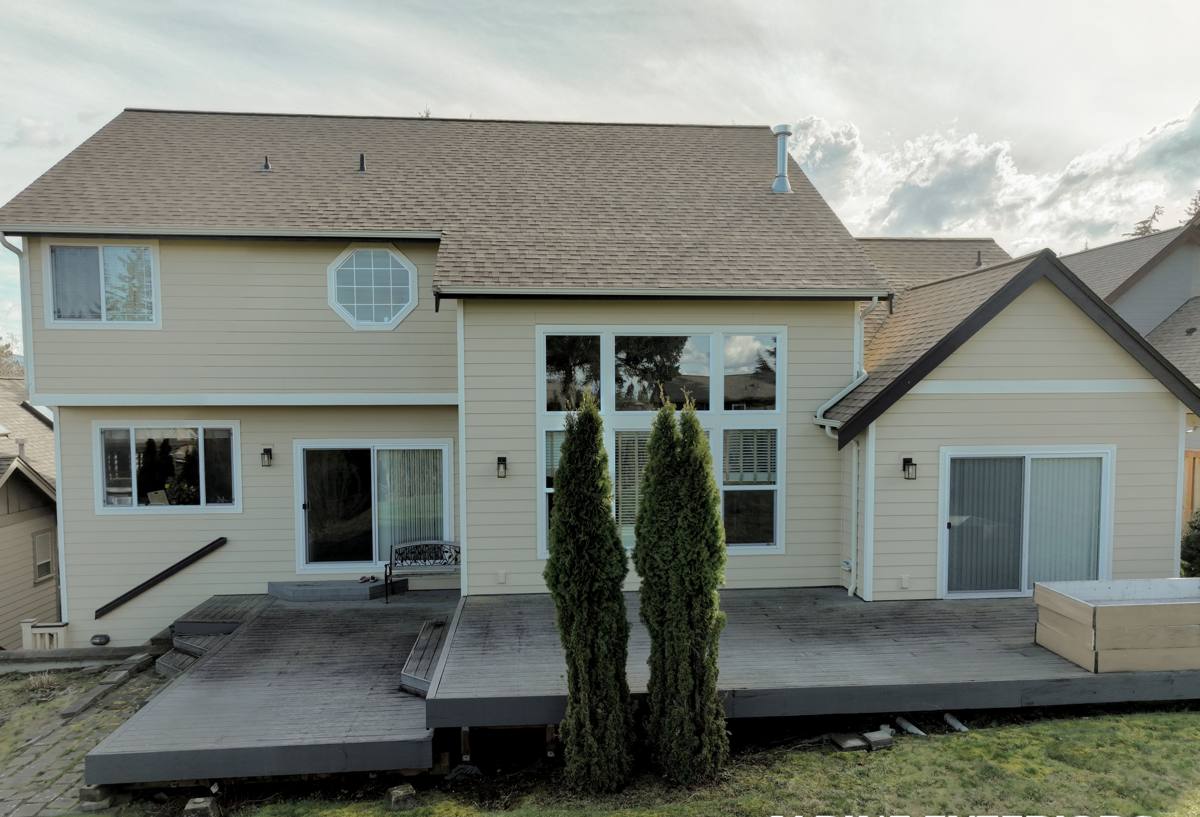
What Composite Decking Needs to Do Here That It Doesn't Elsewhere
Resist salt-air corrosion at every connection point
The decking boards themselves are only part of the equation. Every screw, hidden-fastener clip, joist hanger, and railing bracket is a potential failure point if it's not rated for a coastal, brackish-air environment. We spec stainless steel or marine-grade coated fasteners and hardware on La Conner jobs as a standard, not an upgrade — mild steel hardware in this air will rust and stain the boards around it within a couple of years.
Shed driving rain instead of trapping it
Where the deck meets the house is the single most important detail on any deck, and it's the one most often done wrong. Proper ledger board flashing — installed so water sheds down and away from the house framing, never behind the siding — is non-negotiable in a climate with sideways rain. We also keep board spacing and drainage gaps consistent so water moves off the surface and through the structure instead of pooling.
Stand up to a long, damp moss season
Composite decking doesn't rot the way wood does, but it isn't immune to what a wet, shaded Skagit County winter can grow on its surface. Boards with a fully capped surface (as opposed to older-style uncapped wood-plastic composite) resist moisture absorption into the material itself, which matters a lot in spots under trees or on the north side of a house that barely see direct sun from November to March.
Choosing the Right Board for a Salt-Air, Shade-Prone Site
Not every composite board is a good fit for every yard, and a La Conner property with channel-side exposure or heavy tree cover needs a different conversation than a sunny, open lot inland.
- Cap type: Fully capped composite (cap on all four sides) resists moisture wicking into the core far better than boards capped only on the top and sides — worth the difference in a wet climate.
- Surface texture: A textured, embossed grain gives real slip resistance once algae or moss film starts to form on a shaded section — smooth, glossy boards get slick fast in our wet months.
- Color: Very dark boards run hotter in summer sun and can show pollen, cottonwood fluff, and moss residue more visibly than mid-tone colors; lighter, mottled colors tend to hide seasonal grime between cleanings.
- Airflow under the deck: Board choice matters less than substructure ventilation — a deck built low to grade with poor airflow underneath will stay damp regardless of what's on top.
Composite vs. Wood vs. PVC in This Climate
Every material has honest trade-offs. Here's how the three most common decking options actually perform under La Conner's salt air, rain, and moss conditions.
| Material | Moisture & Salt-Air Behavior | Maintenance | Typical Lifespan |
|---|---|---|---|
| Pressure-treated wood | Absorbs moisture, prone to cupping and splintering; salt air accelerates fastener corrosion and staining | Annual cleaning, periodic sealing/staining | 10-15 years before major boards need replacing |
| Capped composite | Resists moisture absorption and salt-air staining when properly capped and fastened | Periodic wash-down; no sealing or staining | Often 25+ years, backed by manufacturer warranty |
| Cellular PVC | Fully moisture-proof core; performs well in wet, salt-exposed sites | Low; occasional cleaning | Comparable to or longer than capped composite, at a higher upfront cost |
We install composite on the large majority of La Conner decking jobs because it hits the best balance of upfront cost, low upkeep, and real performance in this specific climate. PVC is a legitimate option for a homeowner who wants to spend more for the lowest possible maintenance, and we're glad to walk through that trade-off during an estimate. Untreated or under-detailed wood decking is where we see the most repeat problems in this area, almost always tied to poor flashing or hardware choices rather than the wood itself.
How Our La Conner Decking Process Works
1. Site visit and structural assessment
We look at the existing substructure (if there is one), the ledger connection to the house, grade and drainage around the footings, and how much shade and airflow the site gets through the wet months. This is where we catch problems — soft framing, undersized footings, missing flashing — before they become part of a new deck's problems too.
2. Tear-off and structural repair
If we're replacing an existing deck, we remove the old decking and inspect the framing underneath, which is often the first time it's been seen in years. Any rot, undersized joists, or missing hardware gets addressed before a single new board goes down.
3. Ledger flashing and joist protection
We install or correct ledger flashing so water sheds away from the house, and apply joist tape over the tops of joists to keep fastener penetrations from becoming water entry points — a detail that matters a lot more here than in a dry inland climate.
4. Composite board installation
Boards go down with hidden fastener systems where the product allows, using stainless or coated hardware, with consistent gapping for drainage and material expansion. We keep airflow paths under the deck open rather than boxing them in.
5. Railing, fascia, and finish work
Railing posts, fascia boards, and trim get the same corrosion-resistant hardware treatment as the field of the deck — a beautiful deck with rusting rail brackets after two winters isn't a finished job.
6. Final walkthrough
We walk the finished deck with the homeowner, cover basic care, and point out anything site-specific — a shaded corner that'll need more frequent cleaning, a downspout that should be redirected away from the deck footing, that kind of thing.
Keeping a Composite Deck Ahead of Skagit County's Wet Season
Composite decking is genuinely low-maintenance compared to wood, but "low-maintenance" isn't "no-maintenance" in a climate like ours. A few habits go a long way:
- Sweep leaves and organic debris off the deck regularly through fall — trapped wet leaves are the number one cause of surface staining and moss growth on composite.
- Rinse the deck a few times during the wet season, especially shaded sections, to keep algae and pollen film from building up.
- Check that gaps between boards stay clear of debris so water keeps draining through as designed.
- Look at railing and fastener hardware once a year for early rust or staining, especially on channel-facing or exposed sides of the house.
- Keep gutters and downspouts near the deck clear so runoff isn't dumping extra water onto or under the structure.
- Trim back overhanging branches where practical to cut down on shade, debris, and moisture retention on the deck surface.
Why Hiring a Crew That Already Works in La Conner Matters
Decking work here isn't just a smaller-scale version of decking work anywhere else. A crew that's worked La Conner and the surrounding Skagit County waterfront knows the practical realities: how sideways rain off the channel finds gaps a fair-weather installer never plans for, which yards sit low and hold moisture longer into spring, and where flood-plain or setback considerations near tidal water can affect how and where a deck gets built or attached. That local knowledge shows up in decisions you won't see on the finished deck — footing depth, flashing details, hardware grade — but you'll feel it in how the deck holds up over the next ten winters.
It also means fewer surprises during the project itself. A crew already familiar with the area's permitting expectations and typical soil and drainage conditions moves through the process without the delays that come from learning a new region on your job.
Getting Started
If you're planning a new composite deck or replacing one that's showing its age, we're happy to walk the property, look at what's actually going on with your current structure or site, and give you an honest read on what it'll take to build something that holds up to La Conner's salt air, rain, and moss season. Reach out for a free, no-pressure estimate using the form below.