 Anacortes
 Why Burlington Decks Wear Out Faster Than You'd Expect
Burlington sits inland from the salt water of Skagit Bay and Padilla Bay, but the marine air still reaches the valley. Combine that salt-tinged moisture with the long, low-angle rains that settle over Skagit County from fall through spring, and you get a climate that is genuinely hard on exterior wood structures. A deck here isn't just getting wet — it's getting wet, drying slowly, and repeating that cycle for months at a time. That slow dry-out is what actually breaks decks down, not the rain itself.
Add in the shade from mature trees common on many Burlington lots, and you get long stretches where a deck's surface, especially on the north side of a house or under a covered porch, barely sees direct sun for weeks. That's the exact condition moss, algae, and wood-rot fungi need to establish themselves. We see decks in Burlington that are only ten or twelve years old with structural problems that a deck the same age in a drier climate wouldn't have.
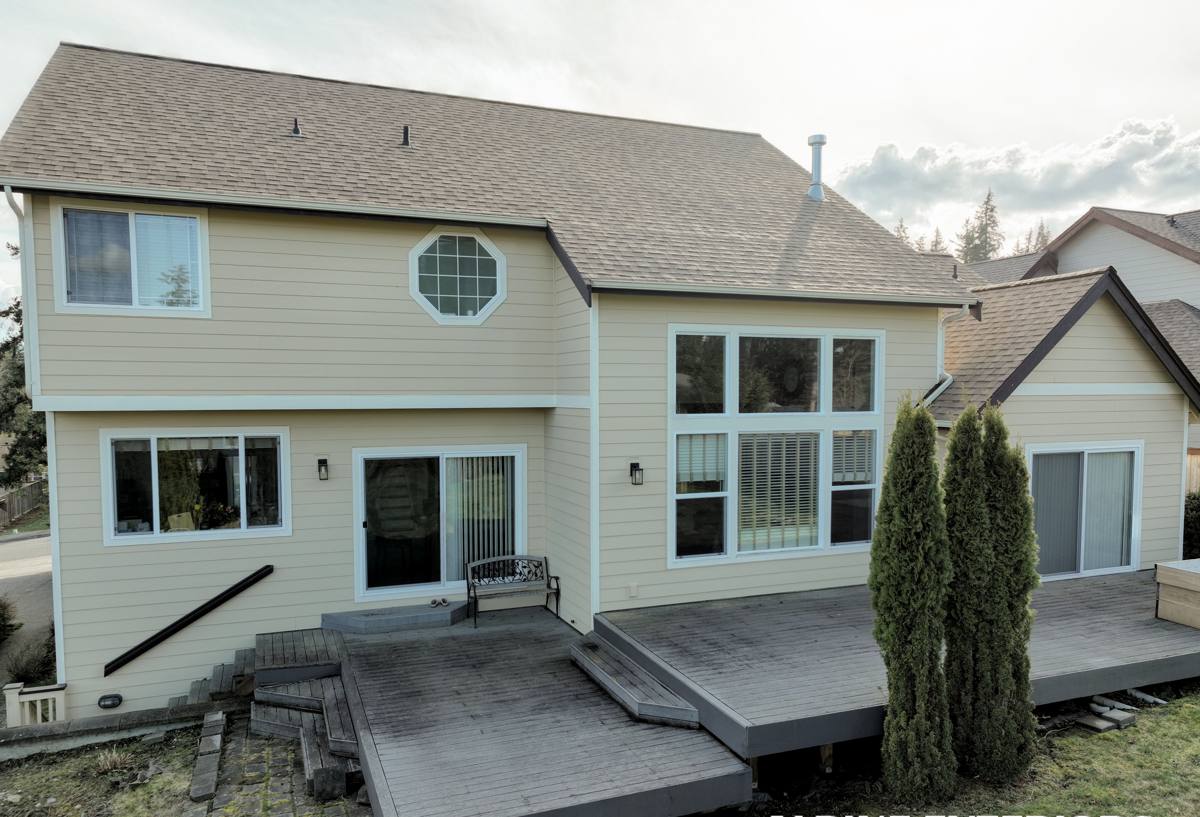
Common Signs Your Burlington Deck Needs Repair
Most homeowners notice a deck problem visually — a soft board, a wobble in the railing — long after the underlying damage started. Catching it earlier saves money, because surface repairs are cheap and structural repairs aren't. Walk your deck with these in mind:
- Boards that feel spongy, springy, or noticeably softer underfoot than the boards around them
- Any railing post or guard that moves when you push on it — this is a safety issue, not cosmetic
- Dark staining or a persistent damp smell near where the deck meets the house
- Green or black film on the decking surface that comes back within weeks of cleaning
- Visible gaps opening up between the ledger board and the house siding
- Fastener heads that are rusted, popped up, or leaving dark streaks down the wood
- Stairs that feel less solid than they used to, especially near the stringer-to-deck connection
If you're seeing two or more of these, it's worth having someone look underneath the deck, not just at the walking surface. The visible boards are usually the last part to fail — the framing underneath fails first.
What's Actually Failing Underneath
Ledger Board and Flashing
The ledger board — the piece that bolts the deck to the house — is the single most important structural connection on most decks, and it's also the piece most exposed to trapped moisture. If the flashing behind it was installed poorly, or wasn't installed at all, water gets channeled directly into the rim joist and wall framing behind it instead of running off. In a climate that stays damp as long as ours does, that's a slow-motion problem that can go unnoticed for years before it shows up as a soft spot or a sagging deck edge near the house.
Fastener Corrosion
Older decks, and some newer ones built with mismatched hardware, often used fasteners that weren't rated for the treated lumber or the coastal-influenced moisture we get here. Once fasteners start corroding, they lose holding strength well before they look obviously rusted, and the wood around them starts to break down from the inside where you can't see it.
Joist and Beam Rot
Framing lumber under a deck rarely rots evenly. It tends to fail first at connection points — where a joist meets a beam, where a post meets a footing, anywhere water can sit against wood without draining or drying. A deck can look completely fine from above while carrying a joist that's lost real structural capacity underneath.
Moss, Algae, and Surface Wear
On the decking boards themselves, moss and algae aren't just cosmetic. They hold moisture against the wood surface and make it slick and dangerous underfoot, especially on stairs. Left long enough, that surface growth accelerates checking and splitting in the wood, which then gives moisture even more places to get in.
Repair or Replace? How We Help You Decide
Not every deck problem means starting over, and we don't push full replacements when a targeted repair will genuinely hold up. The honest answer usually comes down to how much of the structure — versus just the surface — has been compromised.
| Factor | Leans Toward Repair | Leans Toward Replacement |
|---|---|---|
| Ledger board condition | Solid, properly flashed, isolated soft spot | Rot along most of its length or no flashing at all |
| Framing (joists, beams, posts) | Damage limited to one or two members | Rot or corrosion spread across the structure |
| Decking boards | Scattered bad boards, rest sound | Widespread cupping, splitting, or softness |
| Age of original build | Under ~15 years with visible good framing | Original construction quality was already poor |
| Footings and posts | Stable, no movement or heaving | Undersized, settling, or improperly set |
We'll always tell you plainly which side of that table your deck falls on, including when a repair is the right call even if a replacement would be a bigger job for us.
What a Correct Deck Repair Actually Involves
A repair that's done right starts below the decking, not on top of it. That means pulling boards where needed to actually see the joists, ledger, and hardware rather than guessing at their condition from the surface. Once we know what we're dealing with, the work generally includes some combination of:
- Removing and replacing any joists, beams, or posts that have lost structural integrity
- Correcting or adding proper ledger flashing so water sheds away from the house instead of into it
- Replacing corroded fasteners with hardware rated for treated lumber and coastal-influenced moisture
- Swapping out individual decking boards while matching span and fastening pattern to the rest of the deck
- Re-securing railings and stair stringers to current structural standards, not just tightening what's loose
- Improving drainage and airflow under the deck where standing moisture is part of the problem
We don't consider a repair finished just because it looks solid on top. If the framing underneath isn't sound, a fresh coat of stain or a few new boards is just hiding the problem for another season.
Our Process for Burlington Deck Repairs
- On-site inspection. We look at the deck from above and below, checking ledger attachment, joist condition, post and footing stability, and fastener condition, not just the walking surface.
- Honest scope and estimate. You get a clear picture of what's actually wrong, what repair options exist, and what each one costs — including telling you if replacement is the more honest long-term answer.
- Structural work first. Any framing, ledger, or fastener issues get corrected before cosmetic work starts. This is the part that determines whether the deck is actually safe.
- Decking and railing repair. Damaged boards, railings, and stair components get replaced and matched as closely as possible to the surrounding structure.
- Final check. We walk the deck with you, point out what was done and why, and flag anything worth watching going forward.
Decking Material Considerations When Repairing
When we're replacing individual boards on an existing deck, matching material matters more than it seems. Mixing composite boards into an older cedar or pressure-treated deck, or vice versa, can create uneven wear patterns and moisture behavior between old and new sections — one section drying faster than the other, or expanding and contracting differently. Where the existing decking is still a sound product and just needs partial replacement, we'll match it. Where the original decking material has reached the end of its useful life across the board, that's usually the point where a full resurfacing makes more sense than chasing individual boards indefinitely.
We're also honest about wood species and treatment level. Not every board sold as "deck lumber" is rated the same way, and in a climate that stays damp as long as ours does, the difference between a properly rated treated joist and an undersized or improperly treated one shows up within a few years, not decades.
Keeping Your Repaired Deck Healthy Through Skagit County's Wet Seasons
A repair holds up longer with a little seasonal attention, especially given how long our wet season runs. None of this is complicated, but it's the kind of thing that's easy to let slide until a problem shows up again.
- Clear leaves and debris out of the gaps between boards before they trap moisture through the winter
- Keep gutters and downspouts near the deck clear so water isn't dumping directly onto or under it
- Sweep or gently power-wash moss and algae off the surface before it gets a foothold, especially on stairs
- Check the ledger area for staining or gaps once a year, ideally before the fall rains set in
- Reseal or restain wood decking on the manufacturer's recommended schedule — our climate shortens that interval compared to drier regions
- Keep planters, rugs, and furniture that trap moisture from sitting in one spot for months at a time
Why Work With a Crew That Already Knows Burlington
Deck problems in Skagit County follow patterns that aren't the same as what you'd see in a drier inland climate. A crew that works this area regularly already knows where ledger flashing tends to fail, which fastener grades hold up against the salt-tinged marine air, and how much shade and moss exposure a given lot is likely to deal with based on its orientation and tree cover. That's the difference between a repair that's built for this climate and one that technically meets code but wasn't built with Burlington's actual conditions in mind.
If your deck has soft spots, a wobbly rail, moss that keeps coming back, or you just haven't had anyone check underneath it in a while, we're happy to take a look. We'll give you a straight assessment of what's going on and a free, no-pressure estimate for fixing it — no obligation, just an honest read on where your deck actually stands. The form below is the easiest way to get that scheduled.