 Anacortes
 Asphalt Shingle Roofing Built for Conway's Weather
Conway sits low in the Skagit River valley, close enough to Puget Sound and Skagit Bay to catch salt-laden air off the water, and low enough that fog and moisture tend to settle in and linger rather than blow through. Add the long, wet Pacific Northwest roofing season and a heavy tree canopy in a lot of the surrounding properties, and you've got a set of conditions that ages an asphalt shingle roof faster than it would in a drier inland climate. A roof that's rated for 30 years on paper can lose real years off that lifespan here if it wasn't installed with this specific climate in mind.
We install and repair asphalt shingle roofing for homes in and around Conway as part of our regular service area out of Anacortes. This page covers what actually matters for a shingle roof in this part of Skagit County — not generic roofing advice, but the details that matter for houses dealing with salt air, driving rain, and moss on a yearly basis.
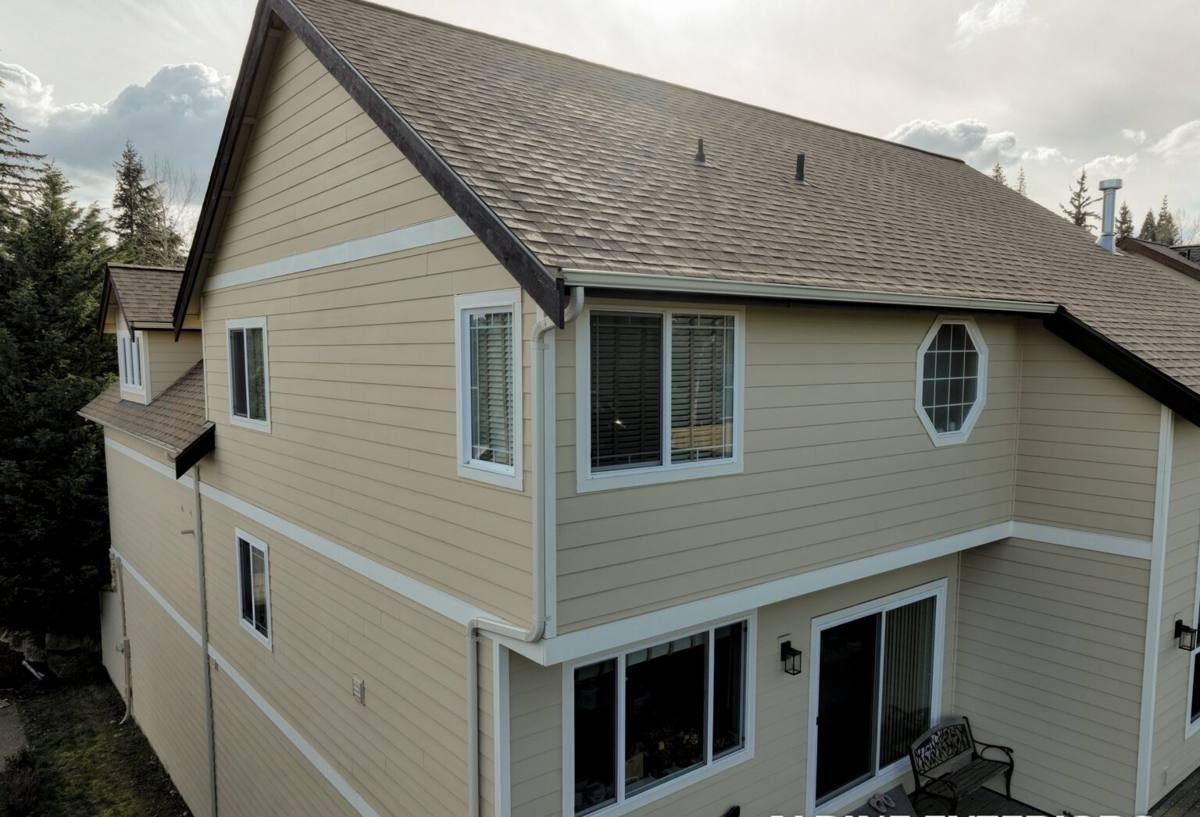
What Conway's Climate Actually Does to a Shingle Roof
Salt Air and Metal Component Corrosion
Conway isn't oceanfront, but it's close enough to tidal water that airborne salt reaches roofs here, especially on north and west-facing slopes that catch the prevailing weather. Salt air doesn't hurt the asphalt shingles themselves much, but it accelerates corrosion on the metal parts of a roofing system — nail heads, flashing, drip edge, and any exposed fasteners. Once corrosion starts on a nail head under a shingle tab, that fastener loses holding power and the shingle above it becomes vulnerable to wind lift. This is one of the more overlooked failure points in coastal Skagit County roofs, because it's invisible until a shingle actually blows loose.
Driving Rain and Wind-Driven Water
Storms coming off the Sound and up the valley tend to arrive with real wind behind them, which means rain doesn't just fall straight down — it drives sideways and works its way up under shingle tabs, around penetrations, and into any gap in the underlayment. A roof that would be fine in a calm, straight-down rain climate can leak in Conway if the underlayment, ice-and-water membrane at vulnerable areas, and shingle nailing pattern weren't done to handle wind-driven water specifically.
Moss, Shade, and Moisture Retention
A lot of Conway-area properties sit close to trees, and shaded roof sections stay damp far longer after a storm than open, sun-exposed ones. That combination — shade plus a long wet season — is exactly what moss needs to get established. Moss holds moisture directly against the shingle surface, works its way under tab edges as it grows, and can lift shingles enough to let water in underneath. Left long enough, moss growth also traps granules and organic debris in valleys and around penetrations, which is where most moss-related leaks actually start.
What a Correct Asphalt Shingle Job Looks Like Here
A shingle roof that's going to hold up in Conway's conditions needs a few things done right that a lower-cost or rushed install often skips. None of these are exotic — they're standard trade practice — but skipping any one of them is where problems start two, five, or ten years down the road.
- Corrosion-resistant fasteners and flashing — hot-dipped galvanized or better-grade fasteners and flashing in areas exposed to salt air, not the cheapest stock nail.
- Full underlayment coverage — synthetic underlayment across the whole deck, not just spot coverage, to give a second line of defense if wind-driven rain gets past the shingles.
- Ice-and-water membrane at vulnerable areas — valleys, eaves, and roof-to-wall transitions get a self-adhering membrane, since these are the spots wind-driven rain and standing moisture hit hardest.
- Correct nailing pattern — proper nail count and placement per the manufacturer's high-wind specification, not the minimum, since under-nailed shingles are the most common cause of wind-lift failures we see.
- Proper ventilation — balanced intake and exhaust venting so moisture from inside the attic isn't adding to what the roof already has to shed from outside.
- Metal flashing at every penetration and transition — chimneys, pipe boots, skylights, and wall intersections, sealed and integrated with the underlayment rather than just caulked over the top.
Our Process for a Conway Re-Roof
1. On-Site Inspection and Assessment
We start by getting on the roof, not just looking at it from the ground. We check the deck condition, existing ventilation, flashing condition around penetrations, and how much moss or moisture damage is already present. This tells us whether it's a straightforward tear-off and re-roof or whether there's deck repair or ventilation work that needs to happen first.
2. Honest Scope and Written Estimate
You get a written estimate that spells out the shingle product, underlayment type, where ice-and-water membrane goes, flashing scope, and ventilation plan — not just a single lump-sum number. If we find deck rot or other issues once tear-off starts, we stop and talk to you before doing anything beyond the agreed scope.
3. Tear-Off and Deck Prep
Full tear-off to the deck on a re-roof, with any damaged sheathing replaced before anything new goes down. Roofing over an existing layer, even where local code allows it, hides the deck condition and shortens the life of the new roof — it's not something we do as standard practice.
4. Underlayment, Membrane, and Flashing
Full synthetic underlayment, ice-and-water membrane at valleys, eaves, and wall transitions, and new flashing at every penetration. This is the stage that does the most to protect against wind-driven rain, and it's also the stage that's completely invisible once the shingles go on — so it matters that it's done right the first time.
5. Shingle Installation
Shingles installed to manufacturer spec for nail count and pattern, with attention to starter strip and ridge cap detail since those are common weak points. We work with the wind-resistance ratings appropriate for our area rather than the base-tier product spec.
6. Final Walkthrough
We walk the finished roof with you, cover what maintenance (if any) it needs, and make sure you know what warranty coverage applies to the materials and to our labor.
Repair, Re-Roof, or Moss Treatment: Which Do You Need?
Not every roof problem in Conway means a full re-roof. Here's how we typically sort it out:
| Situation | Likely Fix | Why |
|---|---|---|
| Roof is under 10-12 years old, isolated leak or damaged section | Targeted repair | Localized flashing or shingle damage can usually be fixed without disturbing the whole roof |
| Moss present but shingles and deck are sound | Moss removal and treatment, plus a look at ventilation/shade issues | Addresses the cause, not just the symptom, and avoids paying for a re-roof you don't need yet |
| Roof is past 18-20 years, granule loss visible, multiple soft spots | Full re-roof | At this age, patch repairs become a cycle of chasing new leaks rather than solving the underlying wear |
| Deck has soft spots or visible rot at eaves/valleys | Full re-roof with deck repair | Underlayment and shingles can't perform correctly over a compromised deck, regardless of product quality |
| Frequent leaks despite past repairs | Full inspection to find root cause | Repeated leaks usually mean an underlying ventilation, flashing, or underlayment issue rather than a shingle problem |
What Drives Cost on a Conway Roofing Project
Every roof is different, but the same handful of factors move the price up or down on most jobs we quote in this area:
- Roof size and pitch — larger and steeper roofs take more material and more labor time, and steep-pitch work requires additional safety setup.
- Number of layers to remove — tearing off two layers of old roofing costs more in labor and disposal than tearing off one.
- Deck condition — any sheathing replacement is priced separately, since it isn't known for certain until tear-off.
- Shingle product tier — architectural (dimensional) shingles cost more upfront than 3-tab but hold up better to wind and typically carry longer warranties, which matters given our storm exposure.
- Complexity of the roofline — valleys, dormers, skylights, and multiple penetrations all add flashing work and time.
- Access — tree cover, steep driveways, or limited staging area can add to labor time.
We give straightforward, itemized estimates so you can see what you're paying for rather than a single number with no breakdown.
Maintenance That Actually Extends a Conway Roof's Life
A shingle roof in this climate isn't maintenance-free, but the upkeep it needs is minor compared to the cost of an early re-roof. A short annual checklist covers most of it:
- Clear debris and needles from valleys and gutters before the fall rains set in — trapped debris holds moisture against the shingles.
- Check shaded sections for early moss growth each spring, before it has a chance to establish through a full wet season.
- Have flashing around chimneys, skylights, and vent pipes visually checked every couple of years — these are the most common leak points on an otherwise sound roof.
- Keep overhanging branches trimmed back where practical, since they both drop debris and keep sections of roof shaded and damp longer.
- After any major windstorm, a quick visual check (from the ground, or have us look) for lifted or missing shingles is worth doing before the next rain arrives.
Why Hire a Crew That Already Works in Conway
Roofing crews that mostly work drier inland areas or different climates don't always build in the margin this area needs — the extra ice-and-water membrane coverage, the corrosion-resistant fastener choice, the attention to moss-prone shading. We work throughout Anacortes and the surrounding Skagit County communities, including Conway, so the climate factors on this page aren't theoretical to us — they're the conditions we plan for on every roof we install here. That also means we're not disappearing after the job is done; warranty service and follow-up questions are answered by the same local crew that did the work.
If you're weighing a repair against a full re-roof, or just want an honest read on how much life is left in your current roof, we're glad to take a look. Reach out for a free, no-pressure estimate using the form below, and we'll walk you through exactly what your roof needs and why.